 Indietro
Investment Decision: Replace or Renovate Machinery (Managerial Accounting)
Guida di studio - Note intelligenti
 Appunti personalizzati basati sui tuoi materiali, ampliati con definizioni chiave, esempi e contesto.
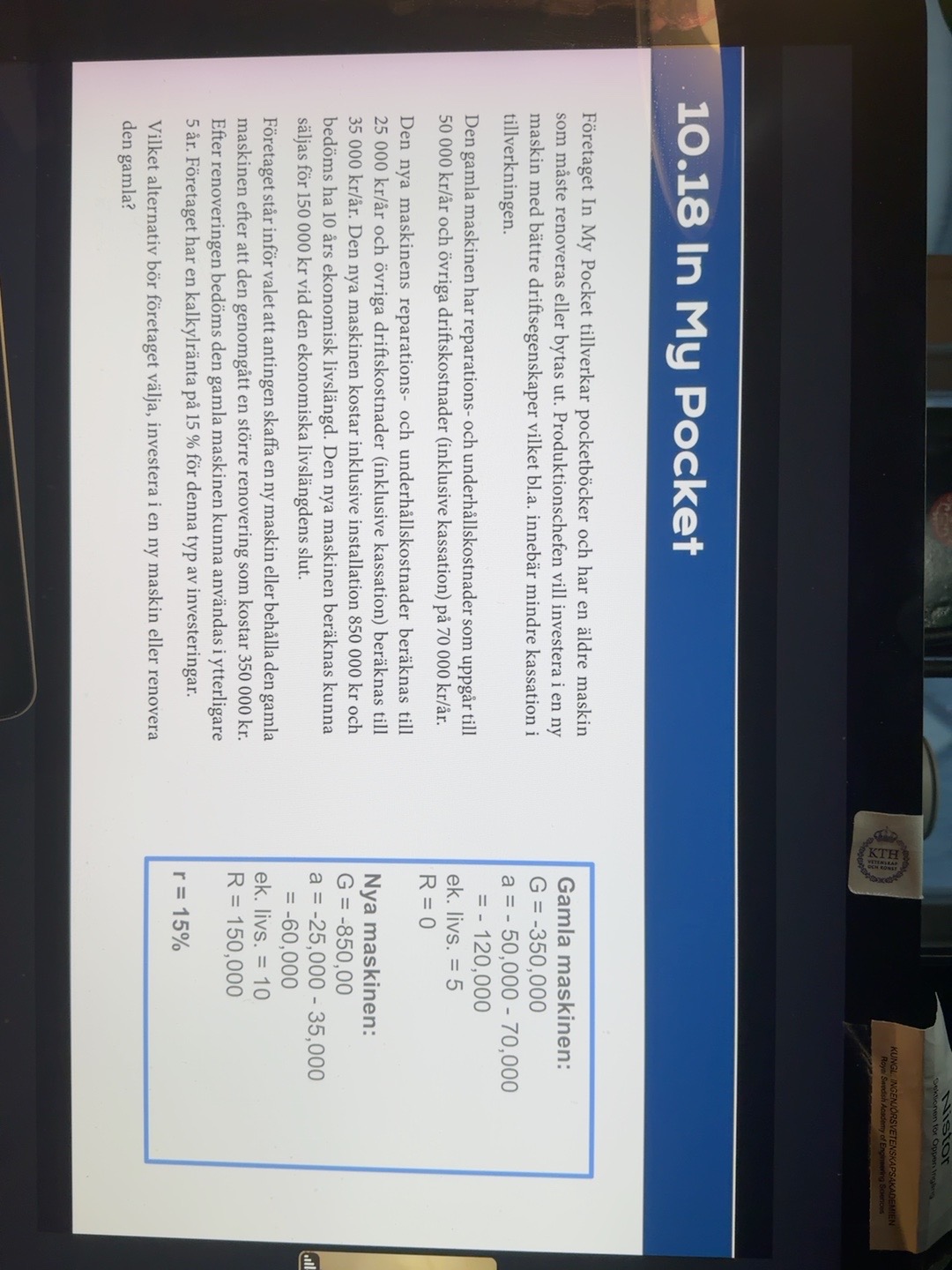
Q1. Should the company invest in a new machine or renovate the old one? (Calculate and compare the economic life-cycle costs for both alternatives.)
Background
Topic: Capital Budgeting & Investment Decision Analysis
This question tests your ability to analyze and compare the costs and benefits of two investment alternatives using concepts such as present value, economic life, and discount rate. You are asked to determine which option (renovating the old machine or investing in a new one) is more financially advantageous for the company, based on the provided data.
Key Terms and Formulas
Capital Budgeting: The process of evaluating investment alternatives to determine which projects or assets to invest in.
Present Value (PV): The current value of future cash flows, discounted at a given rate.
Discount Rate (r): The rate used to discount future cash flows (here, 15%).
Economic Life: The period over which the machine is expected to be used (5 years for old, 10 years for new).
Annual Operating Costs (a): Yearly costs for repairs, maintenance, and operation.
Residual Value (R): Value at the end of economic life (old: 0, new: 150,000 SEK).
Investment Cost (G): Initial outlay for the machine (old: 350,000 SEK, new: 850,000 SEK).
Present Value Formula:
Where:
= Initial investment
= Annual cost
= Residual value
= Discount rate
= Economic life (years)
Step-by-Step Guidance
Identify all relevant data for both alternatives (old and new machine): initial investment, annual costs, economic life, residual value, and discount rate.
Set up the present value calculation for each alternative using the formula above. For the old machine, use , , or , . For the new machine, use , , , .
Calculate the present value of the annual costs for each alternative. This involves discounting each year's cost back to present value using the formula for each year .
Calculate the present value of the residual value for the new machine: .
Add together the present value of the initial investment, the sum of discounted annual costs, and subtract the discounted residual value for each alternative.
Compare the total present value costs for both alternatives to determine which is more cost-effective. (Stop here—do not calculate the final numeric result yet.)
Try solving on your own before revealing the answer!
Final Answer:
After calculating the present value of all costs for both alternatives, the new machine has a lower total present value cost compared to renovating the old machine (even when considering the lower annual cost for the old machine). Therefore, the company should invest in the new machine.
This is because the new machine's longer economic life and residual value offset its higher initial investment and annual costs, making it the more financially advantageous option.
