 Indietro
Ch.2 Body Structure: Levels of Organization, Body Planes, and Cavities
Guida di studio - Note intelligenti
 Appunti personalizzati basati sui tuoi materiali, ampliati con definizioni chiave, esempi e contesto.
Body Structure
Levels of Body Organization
The human body is organized into several hierarchical levels, each building upon the previous one. Understanding these levels is essential for grasping how the body functions as a whole.
Cellular Level: The smallest functional unit of all living organisms. Cells contain a cell membrane, cytoplasm, and a nucleus.
Tissue Level: Groups of similar cells that work together to perform related functions.
Organ Level: Structures composed of two or more types of tissues working together for a specific function.
Organ System Level: Groups of organs that coordinate to perform complex functions.
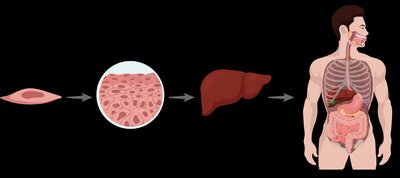
Cell Structure and Function
Cells are the basic building blocks of the body. Each cell contains:
Cell Membrane: Provides protection, communication, and regulates the exchange of substances in and out of the cell.
Cytoplasm: Gel-like substance that surrounds internal structures and supports cellular processes.
Nucleus: Contains genetic material (DNA) and acts as the control center, regulating cell reproduction, metabolism, and growth.
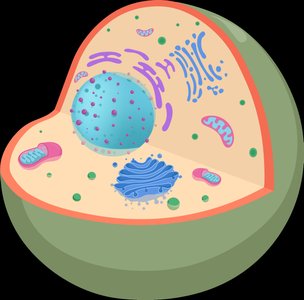
Example: The nucleus contains genetic material and acts as the control center of the cell.
Tissue Types
Tissues are groups of similar cells that perform specific functions. There are four main types:
Epithelial Tissue: Covers surfaces and lines cavities (e.g., lining of the stomach). Functions include protection, absorption, secretion, and filtration.
Connective Tissue: Found in bones, cartilage, tendons, blood, and fat. Provides structure, support, and protection.
Muscular Tissue: Includes skeletal (attached to bone), smooth (internal organs), and cardiac (heart) muscle. Contracts to create movement.
Nervous Tissue: Found in the brain, spinal cord, and nerves. Detects stimuli and transmits signals.
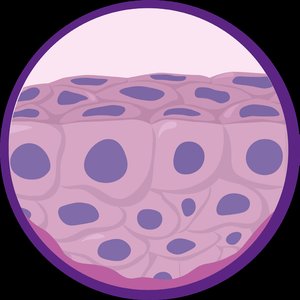
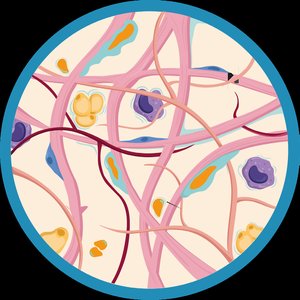
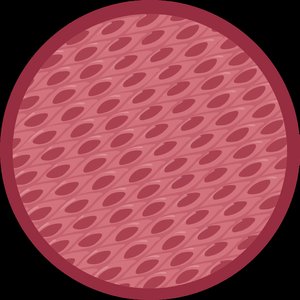
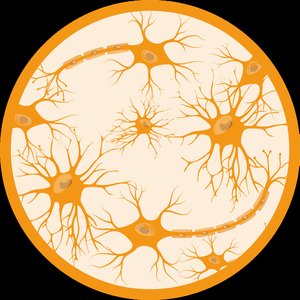
Example: Connective tissue supports and binds other tissues like bones and tendons.
Organs and Organ Systems
Organs are made up of two or more types of tissues working together for a specific function. Organ systems are groups of organs that coordinate to perform complex functions.
Integumentary System: Skin, hair, nails – protection and temperature regulation.
Skeletal System: Bones, joints, cartilage – structure and protection.
Muscular System: Muscles – movement.
Nervous System: Brain, spinal cord, nerves – communication and control.
Cardiovascular System: Heart, arteries, veins – transport of substances and waste removal.
Blood System: Blood – transport of substances.
Lymphatic System: Lymph nodes, spleen, tonsils – immune defense.
Endocrine System: Pituitary gland, adrenal gland – communication and control.
Respiratory System: Lungs, trachea – gas exchange.
Digestive System: Stomach, intestines, liver – ingestion, digestion, absorption.
Urinary System: Kidneys, bladder – filtration and removal of waste.
Reproductive System: Ovaries, testes – reproduction.
Body Planes and Directions
Body Planes
Body planes are imaginary surfaces used to divide the body for anatomical reference and descriptions. The standard anatomical position is standing upright, feet together, arms at sides, and palms facing forward.
Frontal (Coronal) Plane: Divides the body into anterior (front) and posterior (back) portions.
Sagittal Plane: Divides the body into left and right portions.
Transverse (Horizontal) Plane: Divides the body into superior (upper) and inferior (lower) portions.
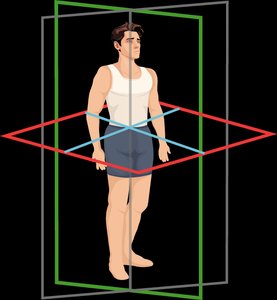
Example: The transverse plane separates the urinary bladder and cranium.
Body Directions and Positions
Directional terms describe the location of body parts relative to each other and the body’s position. These are essential for accurate communication in anatomy and clinical settings.
Medial: Toward the midline of the body.
Lateral: Away from the midline.
Proximal: Closer to the point of attachment or origin.
Distal: Farther from the point of attachment or origin.
Superior (Cranial): Toward the head or upper part of a structure.
Inferior (Caudal): Away from the head or toward the lower part of a structure.
Anterior (Ventral): Toward the front of the body.
Posterior (Dorsal): Toward the back of the body.
Body Positions:
Supine: Lying face up.
Prone: Lying face down.
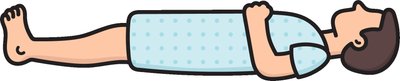

Example: The foot is inferior to the heart, and the hips are superior to the heart.
Body Cavities
Introduction to Body Cavities
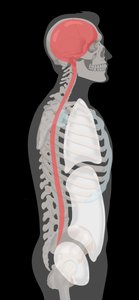
Body cavities are hollow spaces that house internal organs. They are classified into two main groups:
Ventral (Anterior) Cavities: Located at the front of the body. Includes the thoracic, abdominal, and pelvic cavities.
Dorsal (Posterior) Cavities: Located at the back of the body. Includes the cranial and spinal cavities.
Ventral Body Cavities:
Thoracic Cavity: Contains the lungs (pleural cavities) and heart (pericardial cavity), separated from the abdominal cavity by the diaphragm.
Abdominal Cavity: Contains the stomach, intestines, and other digestive organs.
Pelvic Cavity: Contains the urinary bladder and reproductive organs.
Dorsal Body Cavities:
Cranial Cavity: Space inside the skull, contains the brain.
Spinal Cavity: Contains the spinal cord and spinal fluid.
Example: The stomach is in the abdominal cavity, the heart is in the thoracic cavity, and the urinary bladder is in the pelvic cavity.
Abdominopelvic Regions and Quadrants
Regions and Quadrants
The abdominopelvic cavity is divided into regions and quadrants for anatomical reference and clinical purposes.
9 Regions: Used for anatomical studies.
4 Quadrants: Used for diagnostic and surgical purposes (Right Upper Quadrant [RUQ], Left Upper Quadrant [LUQ], Right Lower Quadrant [RLQ], Left Lower Quadrant [LLQ]).
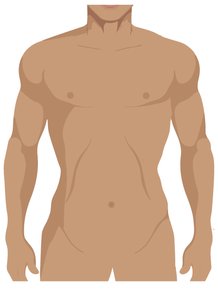
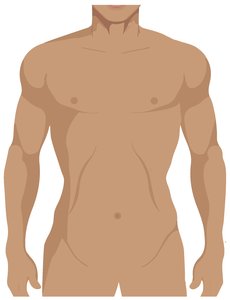
Abdominopelvic Regions:
Right and Left Hypochondriac Regions: Upper row, below the cartilage of the ribs.
Epigastric Region: Upper middle, above the stomach.
Right and Left Lumbar Regions: Middle row, at the lower back level.
Umbilical Region: Center, at the navel.
Right and Left Inguinal (Iliac) Regions: Lower row, near the groin.
Hypogastric Region: Lower middle, below the navel.
Abdominopelvic Quadrants:
RUQ: Contains the right kidney, gallbladder, and part of the liver.
LUQ: Contains the left kidney, spleen, and stomach.
RLQ: Contains the right ureter, right ovary and fallopian tube, and appendix.
LLQ: Contains the left ureter, left ovary and fallopian tube.
Example: The urinary bladder is located in the hypogastric region and in the lower quadrants.
Additional info: The small and large intestines are present in all four quadrants, while some organs are unique to a single quadrant.
