 Indietro
Chapter 1: Introduction to Word Parts and Word Construction – Medical Terminology Study Notes
Guida di studio - Note intelligenti
 Appunti personalizzati basati sui tuoi materiali, ampliati con definizioni chiave, esempi e contesto.
Introduction to Word Parts and Word Construction
Overview
This chapter introduces the foundational concepts of medical terminology, focusing on the structure and construction of medical terms. Understanding how medical words are built from word parts enables students to decipher unfamiliar terms and communicate effectively in healthcare settings.
Learning Objectives
Apply programmed learning techniques to master medical terminology.
Use phonetic pronunciation guides for accurate verbal communication.
Distinguish between constructed and nonconstructed medical terms.
Identify and describe the three main word parts: prefixes, word roots, and suffixes.
Understand the function of combining vowels in word construction.
Deconstruct medical terms into their component parts for meaning.
The Programmed Learning Approach
Technique and Application
The programmed learning approach involves stepwise completion of information frames, where students fill in missing words to reinforce learning. This method encourages active participation and self-assessment, with pronunciation guides and syllable emphasis provided for accuracy.
Write the missing word in each frame before checking the answer.
Pronunciation guides use phonetic spelling and syllable emphasis (capital letters).
Audio samples are available for further practice.
Constructed and Nonconstructed Terms
Definitions and Examples
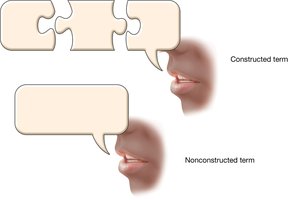
Medical terms are categorized as either constructed or nonconstructed. Constructed terms are formed from multiple word parts, while nonconstructed terms must be memorized as whole units.
Constructed Terms: Built from prefixes, word roots, and suffixes.
Nonconstructed Terms: Include eponyms, acronyms, and terms from other languages.
Examples of Constructed Terms:
Pathology: path/o (disease) + -logy (study of)
Tonsillectomy: tonsill/o (tonsil) + -ectomy (surgical removal)
Neonatologist: neo- (new) + nat/o (birth) + -logist (one who studies)
Examples of Nonconstructed Terms:
Impetigo
Coma
Cushing syndrome
The Word Parts
Types and Functions
Most medical terms are formed by assembling word parts. The three primary types are:
Prefix: Added to the beginning of a word to modify its meaning.
Word Root: The core part of the term, providing the primary meaning.
Suffix: Added to the end of a word to alter its meaning.
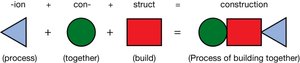
Some terms may have more than one word root or may be formed from only a prefix and a suffix. A fourth part, the combining vowel, is often used to make terms easier to pronounce.
Examples of Word Construction
Bradycardia: brady- (slow) + cardi (heart) + -ia (condition of)
Gastritis: gastr (stomach) + -itis (inflammation)
Gastroenteritis: gastr (stomach) + enter (intestine) + -itis (inflammation)
Gastroenterocolitis: gastr (stomach) + enter (intestine) + col (colon) + -itis (inflammation)
Combining Vowels
Combining vowels (most commonly "o", but sometimes "i" or "e") are used to connect word roots or to join a root to a suffix that begins with a consonant. They are not used between a prefix and a word root.
Use a combining vowel when adding a suffix that begins with a consonant or when combining two roots.
Drop the combining vowel when the suffix begins with a vowel.
Common Combining Forms in Anatomy
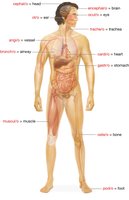
Many combining forms are derived from anatomical terms. Understanding these forms helps in constructing and deconstructing medical terms related to the human body.
Origin of Medical Terms
Historical and Linguistic Roots
Most medical terms originate from Latin and Greek. The Greeks are considered the founders of modern medicine, while the Romans contributed additional terms and concepts. Medical terminology also reflects influences from history, mythology, geography, and other cultures.

Forming Words from Word Parts
Rules and Examples
Prefixes usually do not change when combined with other word parts. Common prefixes include:
anti- (against)
brady- (slow)
endo- (within)
epi- (upon)
neo- (new)
pre- (before)
Common Word Roots and Combining Vowels
append/o, appendic/o (appendix)
bi/o (life)
cardi/o (heart)
cerebr/o (brain)
derm/o, dermat/o (skin)
electr/o (electricity)
encephal/o (brain)
gastr/o (stomach)
hem/o (blood)
hepat/o (liver)
hyster/o (uterus)
laryng/o (larynx)
leuk/o (white)
mamm/o, mast/o (breast)
ment/o (mind)
nat/o (birth)
neur/o (nerve)
path/o (disease)
proct/o (anus/rectum)
psych/o (mind)
rhin/o (nose)
tonsill/o (tonsil)
vas/o (vessel)
Common Suffixes
-al (pertaining to)
-ectomy (surgical removal)
-emia (blood condition)
-gram (record)
-ia (condition)
-iatry (treatment)
-ic (pertaining to)
-itis (inflammation)
-logist (one who studies)
-logy (study of)
-pathy (disease)
-philia (attraction for)
-plasty (surgical repair)
-scope (instrument for viewing)
-tic (pertaining to)
Summary of Word Construction
To decipher a constructed medical term, define the suffix first, then the prefix, and finally the word root(s) or combining forms.
The prefix modifies the meaning, the word root provides the core meaning, and the suffix alters or specifies the meaning.
Combining vowels (usually "o") are used to connect word roots or to add suffixes beginning with consonants.
Examples with cardi/o (heart):
Bradycardia
Electrocardiogram
Carditis
Endocarditis
Cardiologist
Cardiology
Cardiopathy
Cardioplasty
Table: Examples of Word Roots from Greek and Latin
Word Root | Meaning | Origin |
|---|---|---|
cardi/o | heart | Greek |
dermat/o | skin | Greek |
gastr/o | stomach | Greek |
hepat/o | liver | Greek |
neur/o | nerve | Greek |
ren/o | kidney | Latin |
pulmon/o | lung | Latin |
vas/o | vessel | Latin |
oste/o | bone | Greek |
psych/o | mind | Greek |
rhin/o | nose | Greek |
arthr/o | joint | Greek |
encephal/o | brain | Greek |
hemat/o | blood | Greek |
my/o | muscle | Greek |
nat/o | birth | Latin |
tonsill/o | tonsil | Latin |
Additional info: Table entries inferred from standard medical terminology resources.
