 Indietro
Aerobic Respiration and Microbial Metabolism: Pathways, Energy Yield, and Electron Transport
Guida di studio - Note intelligenti
 Appunti personalizzati basati sui tuoi materiali, ampliati con definizioni chiave, esempi e contesto.
Aerobic Respiration and Microbial Metabolism
Overview of Microbial Metabolic Diversity
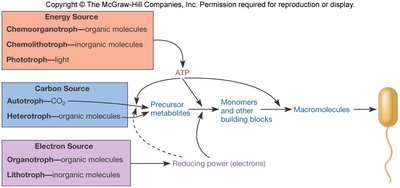
Microorganisms utilize a variety of strategies to obtain carbon, energy, and electrons, which are essential for growth and cellular function. These strategies are classified based on the sources of energy, carbon, and electrons.
Energy Source: Chemoorganotrophs use organic molecules; Chemolithotrophs use inorganic molecules; Phototrophs use light.
Carbon Source: Autotrophs utilize CO2; Heterotrophs utilize organic molecules.
Electron Source: Organotrophs use organic molecules; Lithotrophs use inorganic molecules.
These sources contribute to the synthesis of precursor metabolites, monomers, and macromolecules necessary for cellular structure and function.
ATP Generation: Substrate-Level vs. Oxidative Phosphorylation
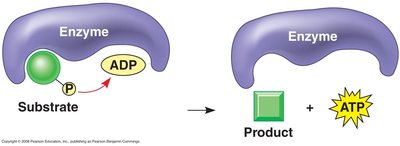
ATP is the universal energy currency in cells, generated by two main mechanisms:
Substrate-Level Phosphorylation (SLP): Direct transfer of a phosphate group from an organic substrate to ADP, forming ATP. This process does not require an electron transport chain (ETC) or proton motive force (PMF).
Oxidative Phosphorylation: ATP synthesis powered by ATP synthase, which utilizes the PMF generated by the ETC. This process is highly efficient and is the primary source of ATP in aerobic respiration.
Chemoorganotrophic Fueling Processes
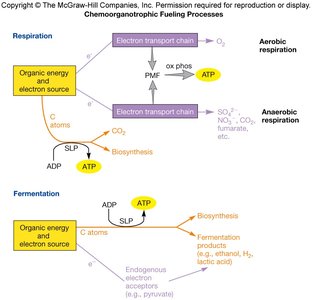
Chemoorganotrophs obtain energy and electrons from organic compounds. Their fueling processes include respiration (aerobic and anaerobic) and fermentation.
Aerobic Respiration: Organic compounds are oxidized, electrons are transferred to O2 via the ETC, generating ATP by oxidative phosphorylation.
Anaerobic Respiration: Similar to aerobic, but the final electron acceptor is an oxidized molecule other than O2 (e.g., NO3-, SO42-).
Fermentation: Organic compounds serve as both electron donors and acceptors. ATP is generated only by SLP, and fermentation products (e.g., ethanol, lactic acid) are produced.
Pathways of Glucose Catabolism
Glycolysis (Embden-Meyerhof-Parnas Pathway)
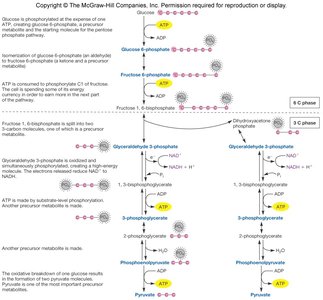
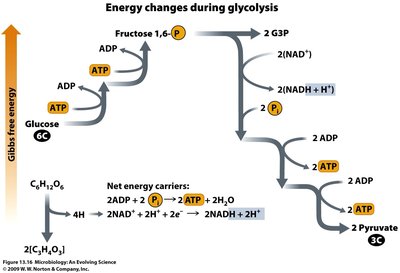
Glycolysis is the most common pathway for glucose breakdown, converting glucose to pyruvate and generating ATP and NADH. It operates in both the presence and absence of O2.
Key Steps: Glucose is phosphorylated, split into two 3-carbon molecules, and further processed to yield pyruvate.
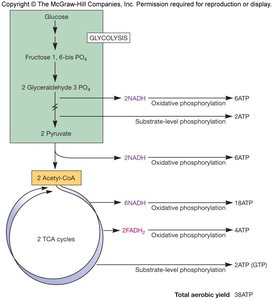
ATP Yield: Net gain of 2 ATP per glucose via SLP.
NADH Production: 2 NADH per glucose, which can be reoxidized via ETC (aerobic) or fermentation (anaerobic).
Alternative Pathways: Entner-Doudoroff and Pentose Phosphate Shunt
Some bacteria utilize alternative pathways for glucose catabolism:
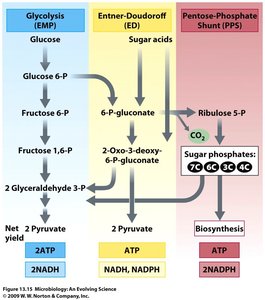
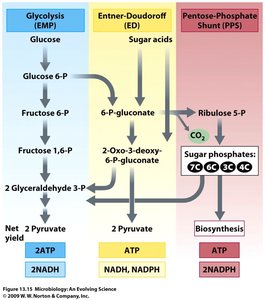
Entner-Doudoroff Pathway: Used by some Gram-negative bacteria (e.g., Pseudomonas aeruginosa, Rhizobia, E. coli). Yields less ATP than glycolysis but allows metabolism of acidic sugars.
Pentose Phosphate Shunt (PPS): Generates NADPH and precursors for biosynthesis (nucleotides, amino acids, vitamin B6). Less energy is produced compared to glycolysis.
Aerobic Respiration: Complete Oxidation of Glucose
Stages of Aerobic Respiration
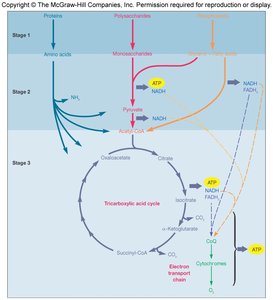
Aerobic respiration involves the complete oxidation of glucose to CO2 and H2O, with maximal ATP yield. It consists of three main stages:
Stage 1: Breakdown of macromolecules (polysaccharides, proteins, lipids) to monomers.
Stage 2: Conversion of monomers to pyruvate and acetyl-CoA.
Stage 3: Complete oxidation of acetyl-CoA in the tricarboxylic acid (TCA) cycle, generating NADH and FADH2 for the ETC.
Tricarboxylic Acid (TCA) Cycle
The TCA cycle (Krebs cycle) is central to aerobic metabolism, oxidizing pyruvate to CO2 and generating high-energy electron carriers.
Complete Oxidation: All carbon atoms from glucose are released as CO2.
Energy Yield: Each turn of the cycle produces ATP (or GTP), NADH, and FADH2.
Electron Transport Chain and Oxidative Phosphorylation
Electron Transport Chain (ETC)
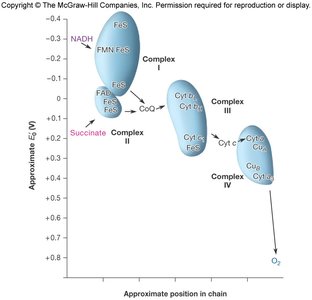
The ETC is a series of protein complexes that transfer electrons from NADH and FADH2 to O2, generating a proton gradient across the membrane.
Reduction Potential: Electrons flow from molecules with lower reduction potential to those with higher potential, releasing energy (exergonic process).
Proton Motive Force (PMF): The energy released is used to pump protons, creating a chemical (pH) and electrical gradient.
ATP Synthesis by ATP Synthase
ATP synthase utilizes the PMF to synthesize ATP from ADP and inorganic phosphate. This process is called chemiosmosis.
Yield: In mammals, the maximum theoretical ATP yield from aerobic respiration of glucose is 38 ATP.
Microbial Variation: Bacteria like E. coli have shorter ETCs and branched pathways, resulting in lower ATP yield per NADH.
Regulation and Inhibition of Electron Transport and ATP Synthesis
ETC Inhibitors and Uncouplers
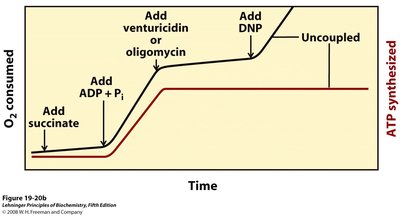
Electron transport and ATP synthesis can be uncoupled by specific inhibitors and uncouplers:
ETC Inhibitors: Block both electron transport and oxidative phosphorylation.
Uncouplers: Allow electron transport to continue without ATP synthesis, dissipating the PMF.
Summary Table: Pathways of Glucose Catabolism
Pathway | Main Substrate | Key Products | ATP Yield | Importance |
|---|---|---|---|---|
Glycolysis (EMP) | Glucose | 2 Pyruvate, 2 NADH | 2 ATP | Universal pathway for energy production |
Entner-Doudoroff (ED) | Sugar acids | 2 Pyruvate, NADH, NADPH | 1 ATP | Used by some Gram-negative bacteria |
Pentose Phosphate Shunt (PPS) | Glucose | Ribulose-5-P, NADPH | 1 ATP | Biosynthesis of nucleotides, amino acids |
Additional info: The notes above expand on the original content by providing definitions, context, and examples for each pathway and process, ensuring completeness and academic quality for microbiology students.
