 Indietro
Anaerobic Respiration, Fermentation, and Chemolithotrophy in Microbial Metabolism
Guida di studio - Note intelligenti
 Appunti personalizzati basati sui tuoi materiali, ampliati con definizioni chiave, esempi e contesto.
Anaerobic Respiration and Fermentation
Overview of Anaerobic Respiration
Anaerobic respiration is a form of respiration that occurs in the absence of oxygen, utilizing alternative terminal electron acceptors. This process is essential for many bacteria, especially in environments where oxygen is limited or absent.
Definition: Anaerobic respiration uses electron acceptors other than O2, such as nitrate (NO3-), sulfate (SO42-), or fumarate.
Facultative Anaerobes: Organisms like Escherichia coli can switch between aerobic and anaerobic respiration depending on the availability of electron acceptors.
Electron Transport Chains (ETCs): Facultative anaerobes possess multiple ETCs to utilize different terminal electron acceptors.
Energy Yield: Anaerobic respiration generally yields less energy than aerobic respiration because alternative electron acceptors have lower reduction potentials than O2.
Example: Paracoccus denitrificans can use O2, NO3-, or fumarate as terminal electron acceptors, adjusting its metabolism based on environmental conditions.
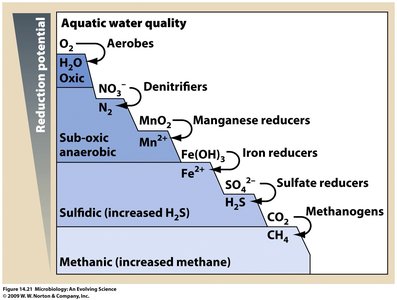
Common Electron Acceptors in Respiration
Microorganisms utilize a variety of electron acceptors in respiration, which determines the amount of energy generated and the ecological impact of their metabolism.
Oxygen (O2): Highest energy yield; used in aerobic respiration.
Nitrate (NO3-): Used in denitrification; yields less energy than O2.
Sulfate (SO42-): Used by sulfate-reducing bacteria; produces hydrogen sulfide (H2S).
Fumarate: Used by some bacteria as a terminal electron acceptor under anaerobic conditions.
Ecological Consequence: Denitrification by bacteria reduces soil fertility by converting bioavailable nitrogen to N2 gas.
Fermentation
Fermentation is a metabolic process that allows cells to generate ATP in the absence of an external electron acceptor. It is crucial for recycling NADH to NAD+ to sustain glycolysis.
Definition: Fermentation is the anaerobic breakdown of organic substrates, where the electron acceptor is typically an organic molecule such as pyruvate or its derivatives.
ATP Generation: ATP is produced exclusively by substrate-level phosphorylation, not by oxidative phosphorylation.
Obligate Fermenters: Some organisms, such as Clostridia, lack ETCs and rely solely on fermentation.
Facultative Fermenters: Organisms like E. coli ferment when exogenous electron acceptors are unavailable.
Example: Lactic acid fermentation in muscle cells and certain bacteria produces lactate from pyruvate.
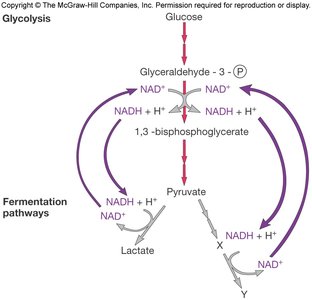
Characteristics of Fermentation
Fermentation pathways are diverse, producing various end products such as ethanol, lactic acid, hydrogen gas, and others.
Some organisms exclusively ferment, while others can switch between fermentation and respiration.
Chemoorganotrophic and Chemolithotrophic Fueling Processes
Chemoorganotrophy
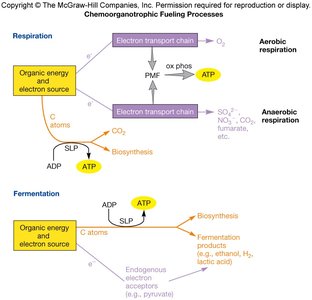
Chemoorganotrophs obtain energy and electrons from organic compounds. They can use respiration (aerobic or anaerobic) or fermentation to generate ATP.
Respiration: Involves an electron transport chain and oxidative phosphorylation.
Fermentation: Involves substrate-level phosphorylation only.
Chemolithotrophy
Chemolithotrophs use inorganic compounds as sources of energy and electrons. They play a significant role in biogeochemical cycles and are often autotrophs, fixing CO2 as a carbon source.
Energy Source: Inorganic molecules such as H2, NH3, NO2-, Fe2+, or S compounds.
Electron Transport: Electrons are usually donated directly to the ETC; NAD+ and FAD are often not involved.
ATP Generation: ATP is produced by oxidative phosphorylation.
Reverse Electron Flow: Some chemolithotrophs use reverse electron flow to generate NADH/NADPH for biosynthesis, as their electron donors are less reducing than NAD+.
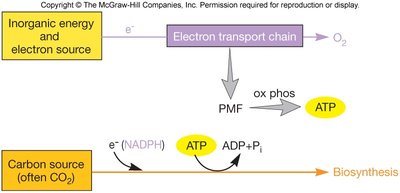
Comparison of Chemoorganotrophy and Chemolithotrophy
While both processes involve electron transport chains and ATP synthesis, they differ in their energy and electron sources.
Process | Energy Source | Electron Source | ATP Generation |
|---|---|---|---|
Chemoorganotrophy | Organic compounds | Organic compounds | Substrate-level and oxidative phosphorylation |
Chemolithotrophy | Inorganic compounds | Inorganic compounds | Oxidative phosphorylation |
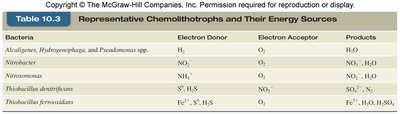
Representative Chemolithotrophs and Their Energy Sources
Chemolithotrophs utilize a variety of electron donors and acceptors, contributing to important environmental processes.
Bacteria | Electron Donor | Electron Acceptor | Products |
|---|---|---|---|
Alcaligenes, Hydrogenophaga, Pseudomonas spp. | H2 | O2 | H2O |
Nitrobacter | NO2- | O2 | NO3-, H2O |
Nitrosomonas | NH4+ | O2 | NO2-, H2O |
Thiobacillus denitrificans | S0, H2S | NO3- | SO42-, H2O |
Thiobacillus ferrooxidans | Fe2+, S0, H2S | O2 | Fe3+, H2O, H2SO4 |
Nitrification and the Nitrogen Cycle
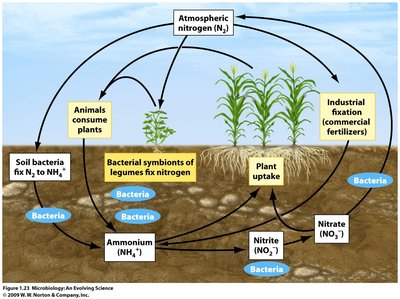
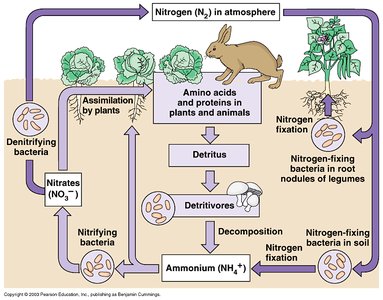
Nitrification is a two-step process carried out by chemolithotrophic bacteria, crucial for the nitrogen cycle in ecosystems.
Step 1: Nitrosomonas oxidizes NH4+ to NO2-.
Step 2: Nitrobacter oxidizes NO2- to NO3-.
Ecological Role: These processes are essential for soil fertility and the global nitrogen cycle.
Reverse Electron Flow in Chemolithotrophs
Some chemolithotrophs must use reverse electron flow to generate reducing power (NADH/NADPH) for biosynthetic reactions, as their electron donors are not sufficiently reducing.
Mechanism: Electrons move "uphill" from the electron transport chain to reduce NAD+ to NADH, driven by the proton motive force (PMF).
Importance: This process is energetically costly but necessary for autotrophic growth.
Ecological Consequences of Metabolic Diversity
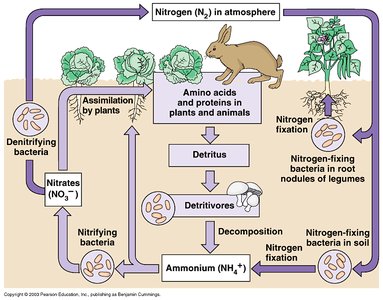
Microbial metabolic diversity has profound effects on ecosystems, influencing nutrient cycling, soil fertility, and environmental chemistry.
Denitrification: Reduces soil fertility by converting nitrate to nitrogen gas.
Sulfate Reduction: Produces hydrogen sulfide, impacting sulfur cycling and aquatic environments.
Nitrification: Essential for plant-available nitrogen in soils.
Additional info: Chemolithotrophy is not considered "respiration" in the strict sense, as the term is reserved for organotrophs. However, chemolithotrophs do use electron transport chains and oxidative phosphorylation for ATP synthesis.
