 Indietro
Antimicrobial Drugs: Mechanisms, Spectrum, Resistance, and Clinical Applications
Guida di studio - Note intelligenti
 Appunti personalizzati basati sui tuoi materiali, ampliati con definizioni chiave, esempi e contesto.
Antimicrobial Drugs
Introduction to Antimicrobial Drugs
Antimicrobial drugs are essential tools in modern medicine, used to treat infections caused by bacteria, fungi, viruses, protozoa, and helminths. Their development and application are based on the principle of selective toxicity, which aims to destroy pathogens without harming the host.
Chemotherapy: The use of chemicals to treat disease.
Antibiotic: A substance produced by a microbe that inhibits another microbe.
Antimicrobial drugs: Synthetic substances that interfere with microbial growth.
The History of Chemotherapy
The discovery and development of antimicrobial drugs revolutionized medicine. Key figures include Paul Ehrlich, who pioneered chemotherapy, and Alexander Fleming, who discovered penicillin.
1928: Fleming discovered penicillin, produced by Penicillium.
1932: Prontosil red dye used for streptococcal infections.
1940: First clinical trials of penicillin.
Antibiotic resistance: A growing problem due to misuse and overuse of antibiotics.
Sources of Antibiotics
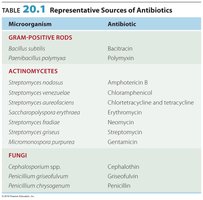
Most antibiotics are produced by bacteria and fungi. The table below summarizes representative sources:
Microorganism | Antibiotic |
|---|---|
Bacillus subtilis | Bacitracin |
Pseudomonas polymyxa | Polymyxin |
Streptomyces nodosus | Amphotericin B |
Streptomyces venezuelae | Chloramphenicol |
Streptomyces aureofaciens | Chlortetracycline, tetracycline |
Streptomyces erythreus | Erythromycin |
Streptomyces fradiae | Neomycin |
Streptomyces griseus | Streptomycin |
Micromonospora purpurea | Gentamicin |
Cephalosporium spp. | Cephalosporin |
Penicillium griseofulvum | Griseofulvin |
Penicillium chrysogenum | Penicillin |
Spectrum of Antimicrobial Activity
Definitions and Clinical Relevance
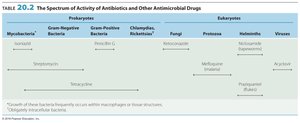
The spectrum of activity describes the range of microbes affected by a drug. Understanding this helps clinicians choose appropriate treatments and avoid superinfections.
Narrow-spectrum antibiotics: Affect a limited range of microbes.
Broad-spectrum antibiotics: Affect a wide range of gram-positive and gram-negative bacteria.
Superinfection: Overgrowth of resistant normal microbiota following antibiotic treatment.
Drug | Effective Against |
|---|---|
Streptomycin | Mycobacteria, Gram-negative bacteria |
Tetracycline | Gram-negative, Gram-positive, Chlamydias, Rickettsias |
Penicillin | Gram-positive bacteria |
Mebendazole | Helminths |
Acyclovir | Viruses |
Modes of Action of Antimicrobial Drugs
Major Mechanisms
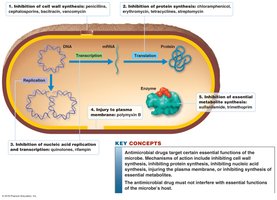
Antimicrobial drugs act through five primary mechanisms, each targeting essential microbial functions.
Inhibition of cell wall synthesis: e.g., penicillins, cephalosporins, vancomycin
Inhibition of protein synthesis: e.g., chloramphenicol, tetracyclines, aminoglycosides
Inhibition of nucleic acid synthesis: e.g., rifamycins, quinolones
Injury to plasma membrane: e.g., polymyxin B
Inhibition of essential metabolite synthesis: e.g., sulfonamides
Common Antimicrobial Drugs
Antibacterial Drugs
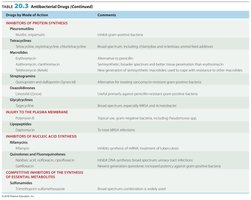
Antibacterial drugs are classified by their mode of action. The table below summarizes key drugs and their targets:
Drug Class | Mode of Action | Comments |
|---|---|---|
Penicillins | Inhibit cell wall synthesis | Effective against gram-positive bacteria |
Tetracyclines | Inhibit protein synthesis | Broad spectrum, including chlamydias and rickettsias |
Macrolides | Inhibit protein synthesis | Effective against gram-positive bacteria |
Polymyxins | Injury to plasma membrane | Broad spectrum, especially gram-negative bacteria |
Rifamycins | Inhibit nucleic acid synthesis | Used for tuberculosis |
Sulfonamides | Inhibit synthesis of essential metabolites | Broad spectrum, often used in combination |
Antifungal, Antiviral, Antiprotozoan, and Antihelminthic Drugs
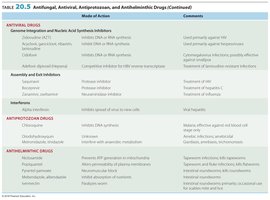
Drugs targeting eukaryotic pathogens and viruses have unique modes of action. The table below summarizes these drugs:
Drug Class | Mode of Action | Comments |
|---|---|---|
Antiviral drugs | Genome integration and nucleic acid synthesis inhibitors | Used primarily against viral infections |
Antiprotozoan drugs | Inhibit DNA synthesis | Used for malaria and other protozoan diseases |
Antihelminthic drugs | Inhibit ATP production or nutrient absorption | Used for tapeworms, roundworms, etc. |
Inhibitors of Cell Wall Synthesis
Penicillins and Their Structure
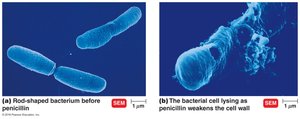
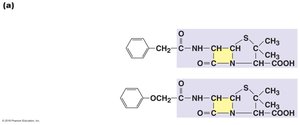
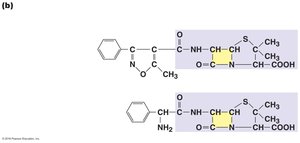
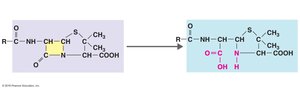
Penicillins contain a β-lactam ring and prevent the cross-linking of peptidoglycans, interfering with cell wall construction, especially in gram-positive bacteria.
Natural penicillins: Penicillin G (injection), Penicillin V (oral)
Semisynthetic penicillins: Modified side chains for resistance to penicillinases
Inhibitors of Protein Synthesis
Mechanisms and Examples
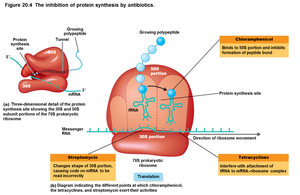
These drugs target bacterial 70S ribosomes, interfering with translation and protein production.
Chloramphenicol: Inhibits peptide bond formation at the 50S subunit.
Aminoglycosides: Change the shape of the 30S subunit, causing misreading of mRNA.
Tetracyclines: Interfere with tRNA attachment to the ribosome.
Macrolides (e.g., erythromycin): Block the polypeptide exit tunnel on the 50S ribosome.
Injury to the Plasma Membrane
Mechanisms and Clinical Use
Drugs such as polymyxin B and daptomycin disrupt the bacterial plasma membrane, leading to cell death. Antifungal drugs target membrane sterols, increasing permeability.
Polymyxin B: Effective against gram-negative bacteria; used topically.
Daptomycin: Used for skin infections; attacks cell membrane.
Antifungal drugs: Polyenes (e.g., amphotericin B), azoles, and allylamines disrupt fungal membranes.
Inhibitors of Nucleic Acid Synthesis
Mechanisms and Examples
These drugs interfere with DNA replication and transcription, preventing microbial growth.
Rifamycin: Inhibits mRNA synthesis; used for tuberculosis.
Quinolones and fluoroquinolones: Inhibit DNA gyrase; broad spectrum.
Inhibitors of Essential Metabolite Synthesis
Sulfonamides and Drug Synergism
Sulfonamides inhibit folic acid synthesis by competing with PABA, a precursor. Combination therapy (e.g., trimethoprim and sulfamethoxazole) enhances effectiveness.
Antimetabolites: Compete with normal substrates for an enzyme.
Drug synergism: The effect of two drugs together is greater than either alone.
Antifungal, Antiviral, Antiprotozoan, and Antihelminthic Drugs
Antifungal Drugs
Antifungal drugs target ergosterol synthesis or cell wall components unique to fungi.
Polyenes (e.g., amphotericin B): Bind to ergosterol, causing membrane permeability.
Azoles: Inhibit ergosterol synthesis; imidazoles are topical, triazoles are systemic.
Echinocandins: Inhibit β-glucan synthesis in fungal cell walls.
Flucytosine: Cytosine analog interferes with RNA synthesis.
Antiviral Drugs
Antiviral drugs block viral entry, uncoating, genome integration, nucleic acid synthesis, assembly, and release.
Entry and fusion inhibitors: Block viral binding and fusion.
Nucleoside analogs (e.g., acyclovir): Inhibit viral DNA/RNA synthesis.
Protease inhibitors: Block cleavage of protein precursors.
Exit inhibitors: Inhibit neuraminidase, preventing viral release.
Interferons: Produced by infected cells to inhibit viral spread.
Antiprotozoan and Antihelminthic Drugs
These drugs target unique metabolic pathways in protozoa and helminths.
Quinine and chloroquine: Treat malaria by preventing heme detoxification.
Artemisinin: Kills Plasmodium species.
Metronidazole: Treats anaerobic bacteria and protozoan infections.
Niclosamide, praziquantel, mebendazole, albendazole, ivermectin: Treat various helminthic infections.
Tests to Guide Chemotherapy
Microbial Susceptibility Testing
Laboratory tests help determine the effectiveness of antimicrobial agents against specific pathogens.
Disk-diffusion method (Kirby-Bauer test): Measures zone of inhibition around antibiotic disks.
E test: Determines minimal inhibitory concentration (MIC).
Broth dilution tests: Determine MIC and minimal bactericidal concentration (MBC).
Antibiograms: Profiles of organism susceptibility/resistance; useful for tracking resistance patterns.
Resistance to Antimicrobial Drugs
Mechanisms of Drug Resistance
Microbes develop resistance through genetic changes and horizontal gene transfer. Understanding these mechanisms is critical for effective therapy.
Persister cells: Survive antibiotic exposure due to genetic traits.
Superbugs: Resistant to multiple antibiotics.
Mechanisms: Enzymatic destruction, prevention of penetration, alteration of target site, rapid efflux.
Antibiotic Misuse and Safety
Consequences and Clinical Considerations
Misuse of antibiotics accelerates resistance and poses risks to patients. Safety is assessed by the therapeutic index, which compares the risk versus benefit of a drug.
Misuse: Includes inappropriate prescriptions, incomplete regimens, and use in animal feed.
Therapeutic index: Quantitative measure of drug safety.
Drug interactions: Some antibiotics can interfere with other medications.
Organ toxicity: Potential damage to heart, liver, nervous system, and risk to fetus.
Example: Rifampin can neutralize the effectiveness of contraceptive pills.
Formula: Therapeutic index is calculated as:
Additional info: The therapeutic window is the range of concentrations where the drug is effective without being toxic.
