 Indietro
Antimicrobial Drugs: Mechanisms, Spectrum, Resistance, and Clinical Applications
Guida di studio - Note intelligenti
 Appunti personalizzati basati sui tuoi materiali, ampliati con definizioni chiave, esempi e contesto.
Antimicrobial Drugs
Introduction to Antimicrobial Drugs
Antimicrobial drugs are essential tools in modern medicine, used to treat infections caused by bacteria, fungi, viruses, protozoa, and helminths. Their development and application are rooted in the principles of selective toxicity, aiming to destroy pathogens without harming the host.
Selective toxicity: The ability of a drug to target pathogens specifically, minimizing damage to host cells.
Chemotherapy: The use of chemicals to treat diseases, especially infections.
Antibiotic: A substance produced by a microbe that inhibits the growth of other microbes.
Antimicrobial drugs: Synthetic or natural substances that interfere with microbial growth.
The History of Chemotherapy
The field of antimicrobial chemotherapy began with key discoveries that revolutionized infection treatment.
Paul Ehrlich: Developed the concept of selective toxicity and the first chemotherapeutic agent (Salvarsan for syphilis).
Alexander Fleming: Discovered penicillin in 1928, produced by Penicillium fungi.
First clinical trials of penicillin occurred in 1940.
Antibiotic resistance is a growing concern in modern medicine.
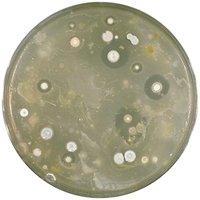
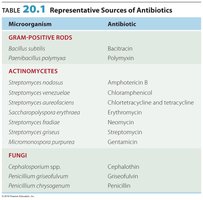
Sources of Antibiotics
Antibiotics are derived from various microorganisms, primarily bacteria and fungi.
Microorganism | Antibiotic |
|---|---|
Gram-Positive Rods | Bacitracin, Polymyxin |
Actinomycetes | Amphotericin B, Chloramphenicol, Tetracycline, Erythromycin, Streptomycin, Gentamicin |
Fungi | Cephalosporin, Griseofulvin, Penicillin |
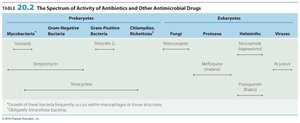
Spectrum of Antimicrobial Activity
Definitions and Clinical Relevance
The spectrum of activity describes the range of microbes affected by a drug.
Narrow-spectrum antibiotics: Target a limited group of bacteria (e.g., only gram-positive).
Broad-spectrum antibiotics: Affect a wide range of bacteria, both gram-positive and gram-negative.
Superinfection: Overgrowth of resistant normal microbiota following antibiotic treatment.
Drug | Effective Against |
|---|---|
Streptomycin | Mycobacteria, Gram-negative bacteria |
Tetracycline | Broad spectrum: Gram-positive, Gram-negative, Chlamydias, Rickettsias |
Acyclovir | Viruses |
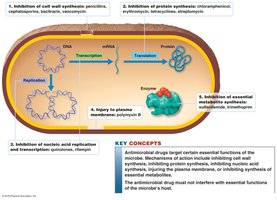
Modes of Action of Antimicrobial Drugs
Major Mechanisms
Antimicrobial drugs act through five primary mechanisms:
Inhibition of cell wall synthesis: Prevents peptidoglycan formation (e.g., penicillins, cephalosporins).
Inhibition of protein synthesis: Targets bacterial ribosomes (e.g., chloramphenicol, tetracyclines).
Inhibition of nucleic acid synthesis: Interferes with DNA/RNA replication and transcription (e.g., rifamycins, quinolones).
Injury to plasma membrane: Disrupts membrane integrity (e.g., polymyxin B).
Inhibition of essential metabolite synthesis: Blocks metabolic pathways (e.g., sulfonamides).
Common Antimicrobial Drugs
Antibacterial Drugs
Antibacterial drugs are classified by their mode of action and spectrum.
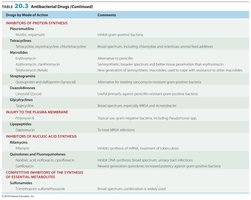
Drug Class | Mode of Action | Comments |
|---|---|---|
Penicillins | Inhibit cell wall synthesis | Effective against gram-positive bacteria |
Tetracyclines | Inhibit protein synthesis | Broad spectrum, including intracellular pathogens |
Macrolides | Inhibit protein synthesis | Effective against gram-positive bacteria |
Polymyxins | Injury to plasma membrane | Effective against gram-negative bacteria |
Rifamycins | Inhibit nucleic acid synthesis | Used for tuberculosis |
Sulfonamides | Inhibit essential metabolite synthesis | Broad spectrum |
Antifungal, Antiviral, Antiprotozoan, and Antihelminthic Drugs
These drugs target unique features of eukaryotic pathogens and viruses.
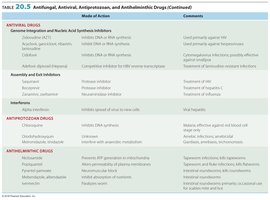
Drug Class | Mode of Action | Comments |
|---|---|---|
Antiviral Drugs | Inhibit genome integration, nucleic acid synthesis, assembly, and exit | Effective against specific viruses |
Antiprotozoan Drugs | Inhibit DNA synthesis, interfere with metabolism | Used for malaria, amebiasis |
Antihelminthic Drugs | Inhibit ATP production, alter membrane permeability | Used for tapeworms, roundworms |
Inhibitors of Cell Wall Synthesis
Penicillins and Related Drugs
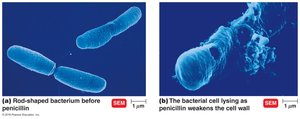
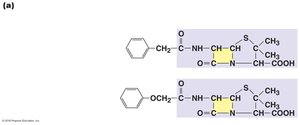
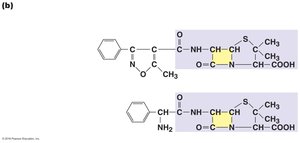
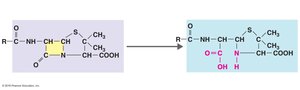
Penicillins contain a β-lactam ring and prevent cross-linking of peptidoglycans, especially in gram-positive bacteria.
Natural penicillins: Penicillin G (injection), Penicillin V (oral); narrow spectrum, susceptible to penicillinases.
Semisynthetic penicillins: Modified side chains for resistance to penicillinases and broader spectrum (e.g., oxacillin, ampicillin).
Inhibitors of Protein Synthesis
Mechanisms and Drug Classes
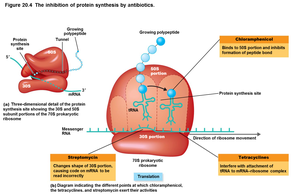
Protein synthesis inhibitors target the bacterial 70S ribosome, affecting translation.
Chloramphenicol: Inhibits peptide bond formation by binding to the 50S subunit; broad spectrum but can suppress bone marrow.
Aminoglycosides: Change the shape of the 30S subunit; can cause auditory damage (e.g., streptomycin, neomycin).
Tetracyclines: Interfere with tRNA attachment; broad spectrum, effective against intracellular pathogens.
Macrolides: Block the polypeptide exit tunnel on the 50S ribosome; narrow spectrum against gram-positives (e.g., erythromycin).
Injury to the Plasma Membrane
Mechanisms and Drug Examples
Some drugs disrupt the plasma membrane, leading to cell death.
Polymyxin B: Topical, effective against gram-negative bacteria.
Daptomycin: Used for skin infections, attacks bacterial cell membrane.
Antifungal drugs: Combine with membrane sterols, increasing permeability.
Inhibitors of Nucleic Acid Synthesis
Mechanisms and Drug Examples
These drugs interfere with DNA replication and transcription.
Rifamycin: Inhibits mRNA synthesis; used for tuberculosis.
Quinolones/Fluoroquinolones: Inhibit DNA gyrase; broad spectrum, relatively nontoxic.
Inhibitors of Essential Metabolite Synthesis
Sulfonamides and Drug Synergism
Sulfonamides inhibit folic acid synthesis, essential for nucleic acid and protein synthesis.
Mechanism: Competitively bind to the enzyme for PABA production.
Drug synergism: Combination of trimethoprim and sulfamethoxazole (TMP-SMZ) enhances efficacy.
Effects of Drug Combinations
Synergism and Antagonism
Synergism: Combined effect of two drugs is greater than either alone.
Antagonism: Combined effect is less than either drug alone.
Antifungal, Antiviral, Antiprotozoan, and Antihelminthic Drugs
Antifungal Drugs
Agents affecting fungal sterols: Polyenes (e.g., amphotericin B), azoles, allylamines.
Agents affecting fungal cell walls: Echinocandins inhibit β-glucan synthesis.
Agents inhibiting nucleic acids: Flucytosine interferes with RNA synthesis.
Antiviral Drugs
Entry and fusion inhibitors: Block viral entry into host cells.
Uncoating, genome integration, and nucleic acid synthesis inhibitors: Prevent viral replication (e.g., acyclovir).
Protease inhibitors: Block viral protein processing.
Exit inhibitors: Inhibit viral release from host cells.
Interferons: Produced by infected cells to inhibit viral spread.
Antiprotozoan and Antihelminthic Drugs
Antiprotozoan drugs: Quinine, chloroquine, artemisinin, metronidazole.
Antihelminthic drugs: Niclosamide, praziquantel, mebendazole, albendazole, ivermectin.
Tests to Guide Chemotherapy
Disk-Diffusion Method (Kirby-Bauer Test)
This method tests the effectiveness of chemotherapeutic agents by measuring the zone of inhibition around antibiotic disks on agar plates.
Zone of inhibition: Indicates sensitivity of the organism to the antibiotic.
E Test (Epsilometer Test)
Determines the minimal inhibitory concentration (MIC) of antibiotics using a gradient diffusion method.
MIC: Lowest concentration preventing bacterial growth.
Broth Dilution Tests
Used to determine MIC and minimal bactericidal concentration (MBC) by observing growth in wells containing drug dilutions.
Antibiograms
Antibiograms profile an organism’s susceptibility to antibiotics and help track resistance patterns, guide empiric therapy, and monitor trends.
Resistance to Antimicrobial Drugs
Mechanisms of Drug Resistance
Drug resistance arises through several mechanisms:
Blocking entry: Prevents drug from entering the cell.
Inactivation by enzymes: Enzymes destroy or inactivate the drug (e.g., β-lactamases).
Alteration of target molecule: Changes in drug target reduce binding.
Efflux of antibiotic: Pumps expel the drug from the cell.
Antibiotic Misuse and Safety
Misuse of antibiotics accelerates resistance development. Safety considerations include therapeutic index, drug interactions, organ toxicity, and risks to the fetus.
Therapeutic index: Ratio of toxic dose to effective dose; higher values indicate safer drugs.
Therapeutic window: Range of effective concentrations with minimal toxicity.
Example: Rifampin can neutralize contraceptive pills; amphotericin B is toxic to kidneys.
Additional info: The notes above expand on brief points with academic context, definitions, and examples to ensure completeness and clarity for exam preparation.
