 Indietro
Bacterial Cell Structure: Shape, Arrangement, and Size
Guida di studio - Note intelligenti
 Appunti personalizzati basati sui tuoi materiali, ampliati con definizioni chiave, esempi e contesto.
Bacterial Cell Structure
Prokaryotic Cell Characteristics
Bacteria are classified as prokaryotes, a group defined by the absence of certain cellular structures found in eukaryotes. Understanding these differences is fundamental to microbiology.
Lack of membrane-bound nucleus: Genetic material is not enclosed within a nuclear membrane.
No cytoskeleton: Prokaryotes do not possess the complex cytoskeletal structures seen in eukaryotic cells.
No membrane-bound organelles: Organelles such as mitochondria and endoplasmic reticulum are absent.
No internal membranous structures: Internal compartmentalization is minimal.
Shape, Arrangement, and Size of Bacterial Cells
Bacterial morphology is diverse, with shape, arrangement, and size being key identifiers. These features influence bacterial function, ecology, and pathogenicity.
Shape: Cocci (spherical) and rods (bacilli) are most common, but variations exist such as coccobacilli (short rods), vibrio (comma-shaped), spirilla (rigid helices), and spirochetes (flexible helices).
Arrangement: Determined by the plane of division and whether cells remain attached after division. Examples include pairs (diplococci), chains (streptococci), clusters (staphylococci), tetrads (groups of four), and sarcinae (cubic groups of eight).
Size: Bacterial size varies from very small (e.g., Mycoplasma, 0.3 μm) to very large (e.g., some filamentous bacteria, up to 600 μm).
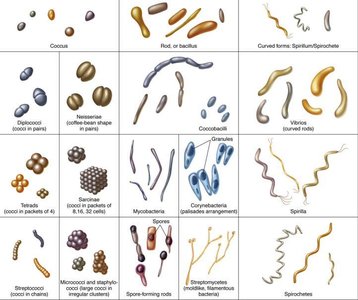
Cocci Shape and Arrangement
Cocci are spherical bacteria with several characteristic arrangements, each with clinical and ecological significance.
Diplococci: Pairs of cocci.
Streptococci: Chains of cocci.
Staphylococci: Grape-like clusters.
Tetrads: Four cocci in a square.
Sarcinae: Cubic configuration of eight cocci.
Examples of Cocci
Streptococcus agalactiae: Gram-positive, forms chains, facultative anaerobe, part of gut microbiome.
Staphylococcus aureus: Gram-positive, round, clusters, found in upper respiratory tract and skin; includes MRSA strains.
Legionella pneumophila: Gram-negative, pleomorphic, flagellated, causes Legionnaires disease.
Vibrio and Curved Rods
Vibrio-shaped bacteria are comma-shaped and often motile. They are important in environmental and clinical microbiology.
Vibrio vulnificus: Gram-negative, curved rod, motile, pathogenic, found in marine environments.
Campylobacter jejuni: Common cause of food poisoning, curved rod.
Caulobacter crescentus: Gram-negative, oligotrophic, model organism for cell cycle studies.
Other Bacterial Shapes
Bacteria exhibit a range of shapes beyond cocci and rods, including club-shaped, filamentous, and spiral forms.
Mycobacterium: Includes M. tuberculosis and M. leprae, causes tuberculosis and leprosy.
Corynebacterium: Club-shaped, causes diphtheria.
Streptomycetes: Filamentous, spore-forming, earthy odor, not pathogenic to humans.
Actinomycetes
Actinomycetes are filamentous, branching bacteria, often gram-positive and anaerobic. They are important in soil ecology and antibiotic production.
Growth pattern: Mycelia, filamentous, branching.
Forms: Rod, coccoid, spores on aerial hyphae.
Antibiotic production: Streptomycin, actinomycin, streptothricin.
Can be infected by actinophages.
Spiral Bacteria
Spiral bacteria are classified by their rigidity and flexibility. They are important in both environmental and clinical contexts.
Spirilla: Rigid helices, e.g., Helicobacter pylori (survives in stomach acid).
Spirochetes: Flexible helices, e.g., Treponema pallidum (causes syphilis, microaerophilic).
Myxobacteria (Slime Bacteria)
Myxobacteria are gram-negative soil bacteria that form fruiting bodies and produce useful chemicals. They exhibit complex social behavior.
Fruiting bodies: Vary in shape and color.
Large genomes: Example: Minicystis rosea (16 million nucleotides).
Swarming behavior: Coordinated movement via molecular signals.
Antibiotic production: Biomedically and industrially important.
Cyanobacteria
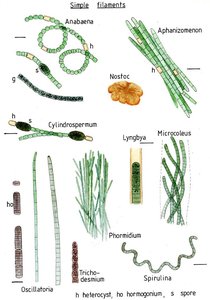
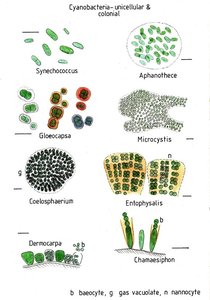
Cyanobacteria are photosynthetic, filamentous bacteria, sometimes called "blue-green algae." They are among the oldest organisms and played a key role in oxygenating Earth's atmosphere.
Gram-negative: Range from unicellular to filamentous.
Colony forms: Filaments, sheets, hollow spheres.
Photosynthesis: First oxygen producers; plastids in plants trace ancestry to cyanobacteria.
Fossil record: Dates back 3.5 billion years.
Bacterial Cell Size
Bacterial cell size varies widely, affecting nutrient uptake and ecological interactions. The surface-to-volume ratio is a key factor in cell physiology.
Smallest: Mycoplasma (0.3 μm).
Average rod: E. coli (1.1–1.5 by 2–6 μm).
Very large: Up to 600 by 80 μm.
Surface-to-volume ratio (S/V): Higher S/V facilitates nutrient uptake; large size and odd shape may protect from predation.
Size–Shape Relationship
The relationship between cell size and shape is important for nutrient uptake and survival. Larger cells or unusual shapes may offer protection from predators.
Formula: Surface-to-volume ratio (S/V) is calculated as:
Higher S/V ratios are advantageous for rapid nutrient exchange.
*Additional info: The diversity in bacterial morphology is closely linked to ecological adaptation and pathogenic potential. Understanding these variations is essential for identifying bacteria and predicting their behavior in different environments.*
