 Indietro
Bacterial Genetics and Horizontal Gene Transfer: Study Notes for Microbiology
Guida di studio - Note intelligenti
 Appunti personalizzati basati sui tuoi materiali, ampliati con definizioni chiave, esempi e contesto.
Bacterial Genetics
Overview of Bacterial Genetics
Bacterial genetics is a fundamental area of microbiology that explores how bacteria inherit, express, and transfer genetic information. Understanding these mechanisms is crucial for studying microbial evolution, antibiotic resistance, and biotechnology applications.
Vertical gene transfer: Transmission of genetic material from parent to offspring during reproduction.
Horizontal gene transfer: Movement of genetic material between organisms other than by descent, enabling rapid acquisition of new traits.
Mechanisms of Horizontal Gene Transfer
Transformation
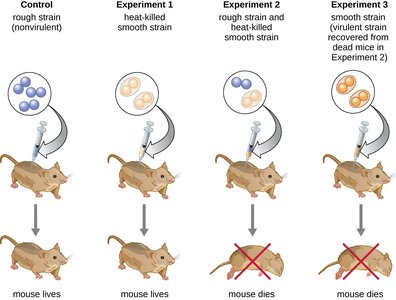
Transformation is the process by which bacteria take up naked DNA from their environment, leading to genetic changes. This mechanism was first demonstrated by Griffith's experiment using Streptococcus pneumoniae.
Definition: Uptake of free DNA fragments or plasmids from the environment by a bacterial cell.
Recombination: DNA fragments may integrate into the chromosome, while plasmids remain separate and replicate independently.
Applications: Acquisition of antibiotic resistance, metabolic capabilities, and virulence factors.
Example: Griffith's experiment showed that nonvirulent bacteria could become virulent by acquiring DNA from dead virulent cells.
Plasmids
Plasmids are small, circular DNA molecules that replicate independently of the bacterial chromosome. They often carry genes for antibiotic resistance, toxin production, or metabolic functions.
Acquisition: Plasmids can be acquired via transformation or conjugation.
Expression: Genes on plasmids can be expressed without recombination.

Transformation Lab Experiment
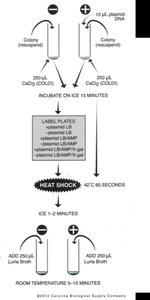
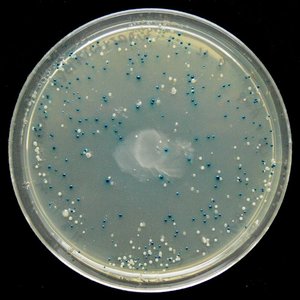
In laboratory settings, transformation is used to introduce new traits into bacteria, such as antibiotic resistance or color change. The pBLU plasmid contains two genes: ampR (confers ampicillin resistance) and lacZ (produces beta-galactosidase, which turns colonies blue in the presence of X-gal).
Experimental setup: Bacteria are mixed with plasmid DNA and subjected to heat shock to facilitate DNA uptake.
Selection: Growth on selective media (LB/amp/X-gal) allows identification of transformed cells.
Conjugation
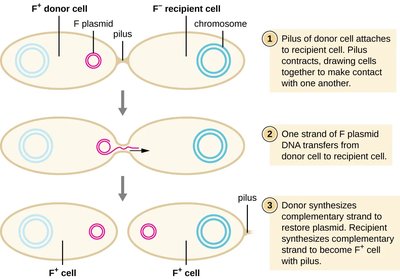
Conjugation is the transfer of DNA from one bacterial cell to another via direct cell-to-cell contact, typically mediated by a conjugation pilus.
F-plasmid: The fertility factor (F-plasmid) enables donor cells (F+) to transfer plasmid DNA to recipient cells (F-).
Result: Both cells become F+ and may acquire new traits.
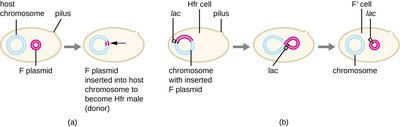
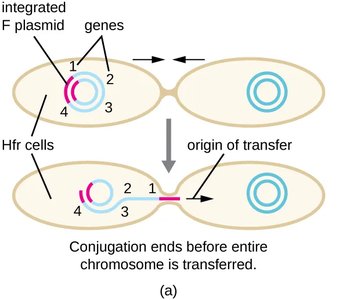
High Frequency Recombination (Hfr) Cells
Hfr cells have the F-plasmid integrated into their chromosome, allowing transfer of chromosomal genes during conjugation.
Mechanism: Transfer begins at the origin of transfer, moving both plasmid and chromosomal DNA to the recipient.
Outcome: Recipient cell may gain new chromosomal genes but does not become F+ unless the entire F-plasmid is transferred.
Transduction
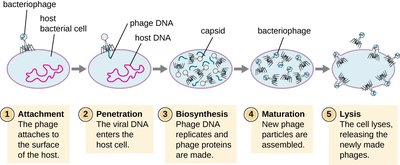
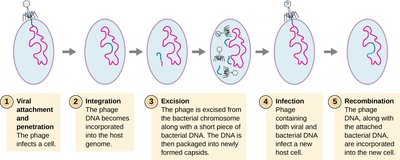
Transduction is the transfer of bacterial DNA from one cell to another via bacteriophage (virus that infects bacteria). There are two types: generalized and specialized transduction.
Generalized transduction: Random fragments of bacterial DNA are packaged into phage capsids during the lytic cycle and transferred to new cells.
Specialized transduction: Specific bacterial genes adjacent to a prophage are transferred during excision of the prophage in the lysogenic cycle.
Comparison of Horizontal Gene Transfer Mechanisms
Mechanism | DNA Source | Transfer Method | Result |
|---|---|---|---|
Transformation | Naked DNA from environment | Uptake by cell | New traits, recombination possible |
Conjugation | Plasmid or chromosomal DNA | Direct cell-to-cell contact | New traits, plasmid transfer, recombination (Hfr) |
Transduction | Bacterial DNA | Bacteriophage-mediated | New traits, recombination |
Implications for Antibiotic Resistance
Spread of Resistance Genes
Horizontal gene transfer mechanisms, especially transformation, conjugation, and transduction, play a critical role in the spread of antibiotic resistance among bacterial populations. This has significant consequences for human health and clinical treatment of infections.
Transformation: Uptake of resistance genes from dead bacteria.
Conjugation: Transfer of resistance plasmids between cells.
Transduction: Phage-mediated transfer of resistance genes.
Example: The rapid dissemination of beta-lactamase genes conferring resistance to penicillins and cephalosporins.
Key Terms and Definitions
Plasmid: Small, circular DNA molecule independent of the chromosome.
Transformation: Uptake of naked DNA by a bacterial cell.
Conjugation: Direct transfer of DNA between bacterial cells via pilus.
Transduction: Transfer of DNA via bacteriophage.
F-plasmid: Fertility factor enabling conjugation.
Hfr cell: Cell with F-plasmid integrated into chromosome.
Beta-galactosidase: Enzyme encoded by lacZ gene, catalyzes lactose hydrolysis.
Beta-lactamase: Enzyme encoded by ampR gene, confers resistance to beta-lactam antibiotics.
Suggested Study Questions
Compare and contrast vertical and horizontal gene transfer.
Describe the mechanism and significance of transformation, conjugation, and transduction.
Explain Griffith's experiment and its implications for bacterial genetics.
Discuss how horizontal gene transfer contributes to antibiotic resistance.
