 Indietro
Bacterial Growth and Culture Media: Study Guide for Microbiology Students
Guida di studio - Note intelligenti
 Appunti personalizzati basati sui tuoi materiali, ampliati con definizioni chiave, esempi e contesto.
Bacterial Growth
Binary Fission and Cell Division
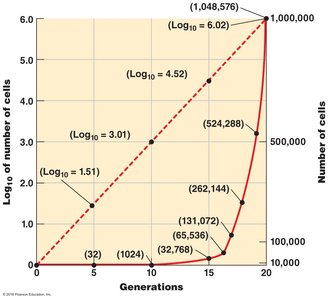
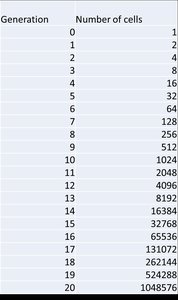
Bacteria primarily reproduce by binary fission, a process in which a single cell divides into two identical daughter cells. This method allows for rapid population growth under optimal conditions. - Binary fission: Asexual reproduction where the cell duplicates its DNA and splits into two. - Generation time: The time required for a bacterial population to double. - Example: Escherichia coli can divide every 20 minutes under ideal conditions.
Calculating Bacterial Growth
Bacterial populations grow exponentially, and their numbers can be calculated using mathematical formulas. - Formula for cell number: where is the final number of cells, is the initial number, and is the number of generations. - Formula for generations: - Generation time: where is total time and is number of generations.
Example: If 5 cells divide 4 times: cells.
Bacterial Growth Curve
The bacterial growth curve describes population changes over time in a closed system. It consists of four phases: - Lag phase: Cells prepare for division, no increase in population. - Log (exponential) phase: Rapid cell division and population increase. - Stationary phase: Growth rate slows, equilibrium between cell division and death. - Death phase: Cells die at an exponential rate. 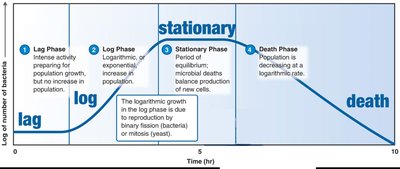
Biofilms
Definition and Characteristics
Biofilms are communities of bacteria embedded in a self-produced matrix of polymers, often attached to surfaces. - Biofilm: A structured community of bacteria surrounded by a complex polymeric matrix. - Characteristics: May contain multiple species, exhibit coordinated activities, and are resistant to environmental stresses. - Example: Dental plaque is a biofilm on teeth. 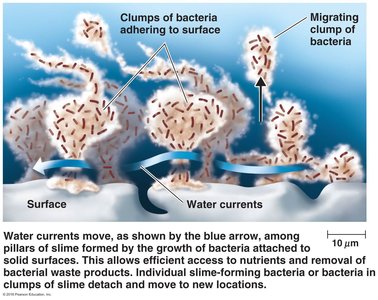
Physical Requirements for Bacterial Growth
Temperature
Microbes grow over a range of temperatures, with optimal growth at specific temperatures. - Psychrophiles: Grow best at 0–15°C. - Psychrotrophs: Grow at 20–30°C, can cause food spoilage. - Mesophiles: Grow best at 25–40°C; most human pathogens. - Thermophiles: Grow best at 50–60°C. - Hyperthermophiles: Grow best above 80°C. 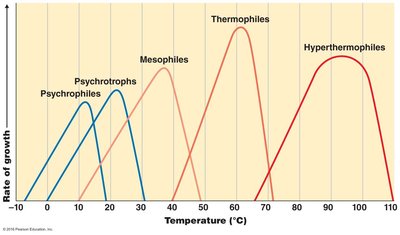
pH and Osmotic Pressure
- pH: Most bacteria grow best at neutral pH (6.5–7.5). - Osmotic pressure: High salt concentrations cause plasmolysis, inhibiting growth. 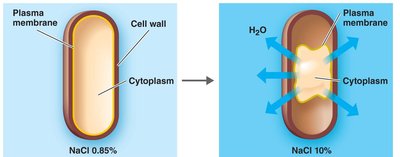
Chemical Requirements for Bacterial Growth
Major Elements
Bacteria require various elements for growth: - Carbon: Main component of cell structures (50% dry weight). - Nitrogen: Needed for proteins and nucleic acids (14% dry weight). - Phosphorus & Sulfur: Components of nucleic acids, proteins, and membranes (4% dry weight). - Trace elements: Iron, copper, molybdenum, zinc. - Growth factors: Vitamins, amino acids, purines, pyrimidines.
Oxygen Requirements
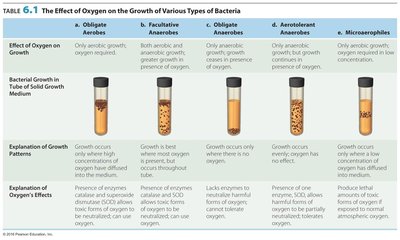
Oxygen is essential for some bacteria, but toxic forms can harm others. - Singlet oxygen, superoxide radicals, peroxide anion, hydroxyl radical, ozone: Toxic forms of oxygen. - Enzymes: Organisms that use O2 have enzymes (e.g., catalase, superoxide dismutase) to neutralize toxic compounds.
Bacterial Oxygen Requirements
Bacteria are classified based on their oxygen requirements:
Type | Growth Pattern | Explanation |
|---|---|---|
Obligate Aerobe | Only aerobic growth; oxygen required | Growth occurs where high concentrations of oxygen have diffused into the medium |
Facultative Anaerobe | Both aerobic and anaerobic growth; greater growth in presence of oxygen | Growth occurs throughout tube, but best where oxygen is present |
Obligate Anaerobe | Only anaerobic growth; oxygen is toxic | Growth occurs only where there is no oxygen |
Aerotolerant Anaerobe | Only anaerobic growth, but tolerates oxygen | Growth occurs evenly; oxygen has no effect |
Microaerophile | Only aerobic growth; oxygen required in low concentration | Growth occurs only where a low concentration of oxygen has diffused into medium |

Growing Bacteria in the Laboratory
Culture Media
Culture media are nutrient materials prepared for the growth of microorganisms. - Chemically defined media: Exact chemical composition is known. - Complex media: Contains extracts or digests from other organisms; exact composition is not known. - Selective media: Suppresses growth of unwanted organisms, encourages growth of target organisms. - Differential media: Allows target organisms to be distinguished from others.
Medium | Type | Key Components |
|---|---|---|
Cary and Blair Transport Medium | Chemically defined | Sodium thioglycollate, disodium phosphate, sodium chloride |
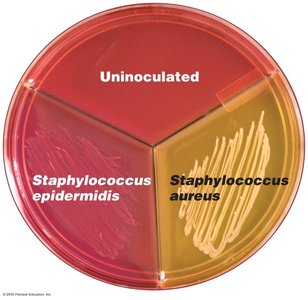
Mannitol Salt Agar | Complex, selective, differential | High salt, D-mannitol, phenol red |
MacConkey Agar | Complex, selective, differential | Bile salts, crystal violet, lactose, neutral red |
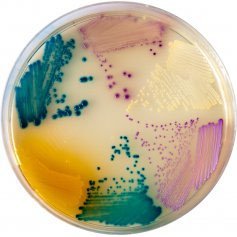
UTI Agar | Complex, selective, differential | Peptic digest, chromogenic mixture |
Culture, Inoculum, and Colony Morphology
- Culture: Microbes growing in or on a culture medium. - Inoculum: Microbes introduced into a culture medium to initiate growth. - Quadrant streak method: Used to obtain isolated colonies for determining colony morphology. 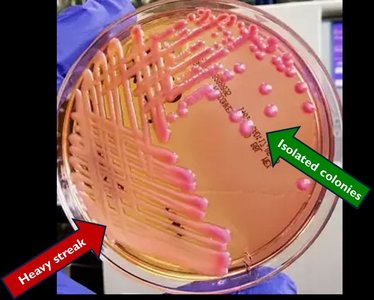
Examples of Media and Colony Appearance
- Mannitol Salt Agar: Selective for staphylococci; differential for mannitol fermentation. - MacConkey Agar: Selective for Gram-negative bacteria; differential for lactose fermentation. - UTI Agar: Used for identification of urinary tract pathogens based on colony color. 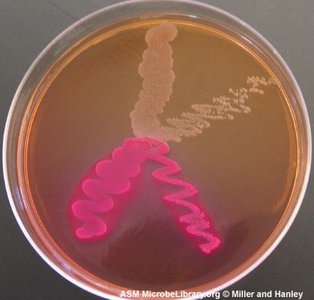
Suggested Study Questions
Chapter 6 Review
- Knowledge and comprehension: Review questions 1, 6, 8 - Multiple choice: 1, 2, 3, 10 - Analysis: 1, 2 Additional info: These questions cover key concepts in bacterial growth, culture media, and laboratory techniques. ----------------------------------------
