 Indietro
BIO 150 Module 3 Microbiology Study Guide: Genetics, Viruses, Disease, and Pathogenicity
Guida di studio - Note intelligenti
 Appunti personalizzati basati sui tuoi materiali, ampliati con definizioni chiave, esempi e contesto.
Microbial Genetics
Core Vocabulary and Concepts
Microbial genetics explores how genetic information is stored, replicated, expressed, and transferred in microorganisms. Understanding these terms is foundational for interpreting genetic processes and their impact on microbial traits.
Genetics: The study of heredity and variation in organisms.
Genome: All genetic material of an organism or virus.
Gene: A DNA sequence encoding a functional product (protein or RNA).
Genotype: The genetic makeup of an organism.
Phenotype: Observable traits resulting from genotype and environment.
Chromosome: DNA molecule carrying many genes; circular in bacteria, linear in eukaryotes.
Plasmid: Small, independently replicating DNA molecule, often carrying traits like antibiotic resistance.
Replication: Copying DNA.
Transcription: Making RNA from a DNA template.
Translation: Using mRNA codons to assemble a polypeptide at a ribosome.
Mutation: Heritable change in nucleotide sequence.
Mutagen: Agent that increases mutation frequency.
Operon: Group of genes regulated together in bacteria.
Gene Expression: From DNA to Protein
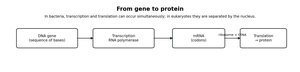
Genetic information flows from DNA to RNA to protein, a process known as the central dogma. In bacteria, transcription and translation can occur simultaneously, while in eukaryotes, they are separated by the nucleus.
Transcription: RNA polymerase synthesizes RNA from a DNA template.
Translation: Ribosomes use mRNA codons to assemble proteins.
mRNA: Messenger RNA carries genetic information from DNA to ribosomes.
DNA Replication
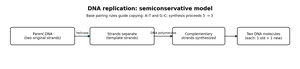
DNA replication is semiconservative, meaning each new DNA molecule contains one parental strand and one newly synthesized strand. Enzymes coordinate the process, ensuring high fidelity and accuracy.
Helicase: Unwinds the double helix.
Primase: Synthesizes RNA primers.
DNA Polymerase: Extends DNA from primers, synthesizing in the 5′ → 3′ direction.
Ligase: Seals gaps between fragments.
Leading Strand: Synthesized continuously.
Lagging Strand: Synthesized discontinuously as Okazaki fragments.
Equation:
Prokaryotic vs. Eukaryotic Genetic Organization
Prokaryotes and eukaryotes differ in chromosome structure, gene regulation, and cellular processes. These distinctions affect how genetic information is expressed and inherited.
Prokaryotes: Usually one circular chromosome, plasmids common, transcription and translation in cytoplasm, operons frequent.
Eukaryotes: Multiple linear chromosomes, mitochondria/chloroplast genomes, transcription in nucleus, translation in cytoplasm, genes often regulated individually.
Mutation and Mutagens
Mutations arise spontaneously or are induced by mutagens. They can alter genetic information, affecting phenotype and sometimes conferring new traits.
Base Substitution: Changes one nucleotide pair; can be silent, missense, or nonsense.
Frameshift Mutation: Insertions/deletions not in multiples of three, altering reading frame.
DNA Repair: Proofreading, mismatch repair, and base excision repair help maintain genetic stability.
Vertical and Horizontal Gene Transfer
Gene transfer can occur vertically (parent to offspring) or horizontally (between organisms). Horizontal gene transfer is crucial for spreading traits like antibiotic resistance.
Vertical Transfer: DNA passed during reproduction.
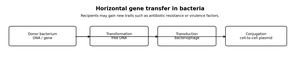
Horizontal Transfer: DNA moves between organisms via transformation, transduction, or conjugation.
Mechanism | What Happens | Key Recognition Clue |
|---|---|---|
Transformation | Cell takes up free DNA | Naked/free DNA |
Transduction | Bacteriophage transfers DNA | Phage/virus transfers DNA |
Conjugation | DNA transfer via cell contact | Plasmid transfer, cell contact |
Viruses, Viroids, and Prions
Viruses vs. Bacteria
Viruses are acellular infectious agents, fundamentally different from bacteria, which are living prokaryotic cells. Viruses require host cells for replication and lack independent metabolism.
Feature | Virus | Bacterium |
|---|---|---|
Organization | Acellular particle | Living cell |
Genetic Material | DNA or RNA | DNA genome |
Structure | Capsid, sometimes envelope | Cell membrane, cytoplasm, cell wall |
Metabolism | No independent metabolism | Has metabolic machinery |
Replication | Uses host machinery | Cell division |
Antibiotics | Not effective | May be susceptible |
Basic Virus Structure and Classification
A virion is a complete infectious virus particle. The capsid is the protein shell, and some viruses have a lipid envelope with glycoprotein spikes. Classification considers genome type, replication strategy, and host range.
General Animal-Virus Replication Cycle
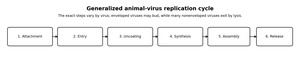
Animal viruses replicate through a series of stages: attachment, entry, uncoating, biosynthesis, assembly, and release. The exact steps vary by virus type.
Attachment: Viral proteins bind host-cell receptors.
Entry: Virus or genome enters the cell.
Uncoating: Capsid is removed, genome exposed.
Biosynthesis: Genome replication and protein synthesis.
Assembly: Formation of new virions.
Release: Virions exit by lysis or budding.
DNA Viruses vs. RNA Viruses
DNA viruses typically replicate in the nucleus using host enzymes. RNA viruses require RNA-dependent RNA polymerase and may replicate in the cytoplasm. Positive-sense RNA can serve as mRNA; negative-sense RNA must be converted to positive-sense.
Bacteriophage Lytic and Lysogenic Cycles
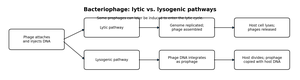
Bacteriophages can follow lytic or lysogenic pathways. The lytic cycle results in host cell lysis and release of new phages, while the lysogenic cycle involves integration of phage DNA as a prophage.
Lytic Cycle: Phage replicates, assembles, and lyses host cell.
Lysogenic Cycle: Phage DNA integrates, host divides, phage DNA copied.
Viroids and Prions
Viroids are infectious RNA molecules without a protein coat, affecting plants. Prions are misfolded proteins causing neurodegenerative diseases in animals and humans.
Agent | Composition | Host/Effect | Key Distinction |
|---|---|---|---|
Virus | DNA/RNA + capsid | Animals, plants, bacteria | Genome-containing particle |
Viroid | RNA only | Plants | No protein coat |
Prion | Protein only | Animals, humans | Induces misfolding |
Principles of Disease and Epidemiology
Essential Terms
Epidemiology studies disease patterns and transmission. Understanding key terms is vital for describing and controlling infectious diseases.
Infection: Entry and multiplication of a microorganism.
Disease: Disturbance in normal body function.
Pathogen: Agent capable of causing disease.
Pathogenicity: Ability to cause disease.
Virulence: Degree of pathogenicity.
Microbiota: Normal microorganisms at a body site.
Reservoir: Natural habitat of an infectious agent.
Morbidity: Illness in a population.
Mortality: Deaths in a population.
Normal Microbiota and Symbiosis
Normal microbiota protect against pathogens and interact with the immune system. Symbiotic relationships include mutualism, commensalism, and parasitism.
Mutualism: Both partners benefit.
Commensalism: One benefits, other unaffected.
Parasitism: One benefits at host's expense.
Koch's Postulates and Causation
Koch's postulates are criteria for linking a pathogen to a disease. Limitations include inability to culture some agents, polymicrobial diseases, and ethical constraints.
Pathogen present in every case.
Pathogen isolated and grown in pure culture.
Culture causes disease in healthy host.
Pathogen reisolated from infected host.
Patterns of Disease Occurrence
Describing disease occurrence helps track and control outbreaks.
Term | Meaning |
|---|---|
Sporadic | Irregular, infrequent cases |
Endemic | Constantly present at baseline |
Outbreak | Localized increase |
Epidemic | Above expected levels |
Pandemic | Global spread |
Incidence | New cases over time |
Prevalence | All existing cases |
Transmission and Reservoirs
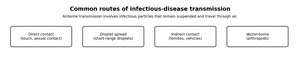
Infectious agents spread via various routes. Reservoirs can be human, animal, or environmental sources.
Direct Contact: Touching, sexual contact.
Droplet Transmission: Respiratory droplets.
Airborne Transmission: Small particles suspended in air.
Indirect Contact: Fomites (contaminated objects).
Vehicle Transmission: Common source (food, water).
Vector-Borne: Living carrier (arthropods).
Healthcare-Associated Infections (HAIs)
HAIs are acquired in healthcare settings. Prevention includes hand hygiene, protective equipment, aseptic technique, and antimicrobial stewardship.
Host Susceptibility and Herd Immunity
Susceptibility depends on immune status, vaccination, age, and other factors. Herd immunity protects populations when enough individuals are immune.
Emerging Disease and Public Health Surveillance
Emerging diseases are new or increasing in incidence. Surveillance tracks disease patterns and guides public health responses.
Microbial Mechanisms of Pathogenicity
Pathogenicity, Virulence, and Infectious Dose
Pathogenicity is the ability to cause disease; virulence is the degree of severity. Infectious dose (ID₅₀) and lethal dose (LD₅₀) quantify pathogen effects.
Stages of Pathogenesis
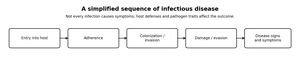
Pathogenesis involves entry, adherence, colonization/invasion, evasion, and damage. Not all infections cause symptoms; host and pathogen traits affect outcomes.
Entry: Portals include respiratory, gastrointestinal, genitourinary, skin, and vectors.
Adherence: Adhesins, pili, and surface proteins bind host cells.
Colonization/Invasion: Multiplication and tissue penetration.
Evasion: Capsules, antigenic variation, intracellular survival, biofilms.
Damage: Direct injury, nutrient depletion, inflammation, toxins.
Structures and Enzymes Supporting Disease
Pathogens use capsules, pili, flagella, cell wall components, and enzymes to invade and evade host defenses.
Capsule: Inhibits phagocytosis, supports attachment.
Pili/Fimbriae: Adherence to host cells.
Flagella: Motility.
Biofilm: Community persistence.
Coagulase: Promotes clot formation.
Kinases: Dissolve clots.
Hyaluronidase: Breaks down connective tissue.
Collagenase: Degrades collagen.
IgA Protease: Cleaves IgA antibodies.
DNases: Degrade DNA in pus or traps.
Host Defense Avoidance
Pathogens evade host defenses through capsules, antigenic variation, enzyme production, intracellular survival, and biofilm formation. Virulence genes may be carried on mobile genetic elements.
Direct Damage, Inflammation, and Toxins
Pathogens cause direct tissue damage and trigger immune-mediated injury. Exotoxins and endotoxins differ in source, composition, and effects.
Feature | Exotoxin | Endotoxin |
|---|---|---|
Source | Secreted proteins | Lipid A of LPS |
Potency | Highly potent, specific | Broad inflammatory effects |
Heat Stability | Varies | Relatively stable |
Immune Response | Antitoxin antibodies | Fever, shock |
Found In | Gram-positive/negative bacteria | Gram-negative bacteria |
Major Exotoxin Action Patterns
A-B Toxins: B binds, A acts enzymatically.
Membrane-Disrupting Toxins: Cause cell lysis.
Superantigens: Nonspecific T-cell activation, massive cytokine release.
Neurotoxins: Affect nerve signaling.
Enterotoxins: Act on GI tract.
Cytotoxins: Damage host cells.
LAL Test and Endotoxin Detection
The Limulus amebocyte lysate (LAL) test detects endotoxin from gram-negative bacteria, important for pharmaceutical safety.
Viral Cytopathic Effects (CPE) and Eukaryotic Pathogens
CPE are visible changes in host cells due to viral infection. Eukaryotic pathogens (fungi, protozoa, helminths) cause disease through invasion, nutrient theft, toxins, and immune injury.
High-Yield Cross-Chapter Comparisons
Replication vs. Transcription vs. Translation: Replication copies DNA; transcription makes RNA; translation builds protein.
Vertical vs. Horizontal Gene Transfer: Parent-to-offspring vs. between organisms.
Transformation vs. Transduction vs. Conjugation: Free DNA vs. phage vs. cell contact.
Virus vs. Viroid vs. Prion: Genome particle vs. RNA only vs. misfolded protein.
Lytic vs. Lysogenic Phage: Immediate lysis vs. prophage persistence.
Incidence vs. Prevalence: New cases vs. all cases.
Endemic vs. Epidemic vs. Pandemic: Baseline vs. increase vs. global spread.
Pathogenicity vs. Virulence: Ability vs. degree of disease.
Exotoxin vs. Endotoxin: Protein toxin vs. LPS lipid A.
Infection vs. Disease: Microbial multiplication vs. disrupted function.
Rapid Recall: Key Facts
Semiconservative replication: each new DNA helix has one old and one new strand.
DNA polymerase synthesizes DNA 5′ → 3′.
Transformation: free DNA; transduction: phage; conjugation: cell contact.
Viruses require host cells for replication.
Positive-sense RNA serves as mRNA; negative-sense RNA must be converted.
Prophage: phage DNA in lysogenic state.
Incidence: new cases; prevalence: all cases.
Herd immunity reduces transmission.
Adherence, evasion, toxins, and inflammation contribute to disease.
Endotoxin: lipid A of LPS; LAL assay detects endotoxin.
Final Review Checklist
Define genetics vocabulary and gene expression.
Describe DNA replication and major enzymes.
Explain mutations and compare prokaryotic/eukaryotic genomes.
Distinguish gene transfer mechanisms.
Compare viruses and bacteria; label virus structures.
Explain virus replication and DNA/RNA strategies.
Contrast lytic/lysogenic cycles; distinguish virus, viroid, prion.
Define microbiota, symbiosis, pathogen, reservoir, morbidity, mortality.
State Koch's postulates and limitations.
Distinguish incidence/prevalence and disease occurrence patterns.
Classify transmission routes; describe HAI prevention and herd immunity.
Explain virulence, infectious dose, portals of entry, adherence, invasion, evasion.
Compare exotoxins/endotoxin; describe LAL test.
Recognize toxin classes, viral CPE, and eukaryotic pathogen mechanisms.
Source Note: Content aligns with BIO 150 Module 3 Learning Objectives and Tortora et al., Microbiology: An Introduction (14th ed., 2023). Diagrams are original study schematics.
