 Indietro
Biochemical Characteristics and Enzyme Testing in Microbiology
Guida di studio - Note intelligenti
 Appunti personalizzati basati sui tuoi materiali, ampliati con definizioni chiave, esempi e contesto.
Biochemical Characteristics in Microbiology
Introduction to Biochemical Testing
Biochemical tests are essential tools in microbiology for identifying bacteria based on their metabolic activities. While many bacteria may appear similar under a microscope, their enzymatic profiles and metabolic pathways can differ significantly. These differences are exploited in the laboratory to distinguish and identify microorganisms.
Biochemical tests detect the ability of bacteria to break down or synthesize specific substances.
Indicators in the media reveal changes due to microbial metabolism, such as acid or gas production.
These tests are crucial for differentiating closely related bacterial species.
Principles of Biochemical Testing
Role of Enzymes in Biochemical Reactions
Enzymes are organic catalysts that accelerate biochemical reactions by lowering the activation energy required. The presence or absence of specific enzymes in bacteria forms the basis for many identification tests.
Enzymes enable bacteria to utilize or modify substrates in the medium.
Detection of enzymatic activity is often visualized by changes in the medium.
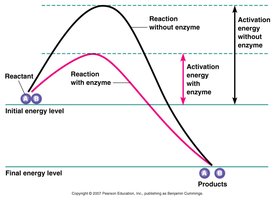
Additional info: The diagram illustrates how enzymes lower the activation energy, making reactions proceed faster under physiological conditions.
Components of Culture Media
Culture media used in biochemical tests typically consist of three main components:
Basic nutrient medium: Supports general bacterial growth.
Substrate: The specific compound upon which the enzyme acts.
Indicator: Reveals the metabolic change, such as a pH shift or color change.
Sterile Technique
To ensure accurate results, it is essential to prevent contamination from environmental microbes. This is achieved through aseptic (sterile) technique, which allows for the isolation and study of pure bacterial cultures.
Pure culture: Contains only one type of microorganism.
Mixed culture: Contains more than one type of microorganism.
Common Biochemical Tests in Microbiology
Fermentation of Carbohydrates
Fermentation tests determine the ability of bacteria to ferment specific sugars, producing acid and/or gas as byproducts.
Acid detection: Uses phenol red indicator, which turns yellow in acidic conditions.
Gas detection: Uses a Durham tube to capture gas bubbles produced during fermentation.
Example: A fermentation tube containing glucose, phenol red, and a Durham tube will turn yellow and show a gas bubble if the bacterium ferments glucose to acid and gas.
Starch Hydrolysis (Amylase Test)
This test detects the production of the enzyme amylase, which hydrolyzes starch into sugars. After incubation, iodine is added to the plate to visualize starch digestion.
Positive test: Clear zone around growth after iodine application (starch digested).
Negative test: No clearing; medium remains blue-black (starch present).
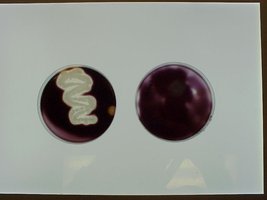
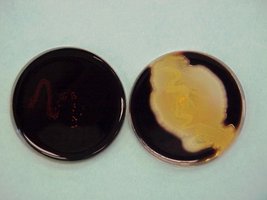
Example: The clear area on starch agar after iodine indicates amylase activity.
Catalase Test
The catalase test identifies bacteria that produce the enzyme catalase, which breaks down hydrogen peroxide into water and oxygen. The release of oxygen is observed as bubbling.
Reaction:
Positive test: Immediate bubbling upon addition of hydrogen peroxide.
Negative test: No bubbling observed.
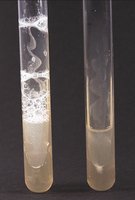
Example: Bubbling after adding H2O2 to a bacterial colony indicates catalase production.
DNase Test (DNA Digestion)
This test detects the production of DNase, an enzyme that hydrolyzes DNA into nucleotides. After incubation, hydrochloric acid is added; clearing around colonies indicates DNA hydrolysis.
Positive test: Clear zone around growth after HCl addition (DNA digested).
Negative test: Medium remains cloudy (intact DNA precipitated).
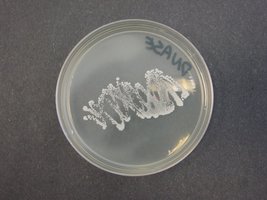
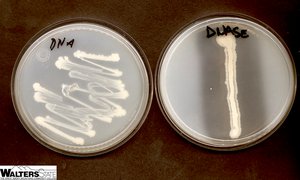
Example: Clearing on DNase agar after HCl addition indicates DNase activity.
SIM Medium (Sulfide, Indole, Motility)
SIM medium allows simultaneous detection of three bacterial characteristics: hydrogen sulfide production, indole production, and motility.
Hydrogen sulfide (H2S) production: Detected by blackening of the medium due to reaction with iron salts.
Indole production: Detected by adding Kovac’s reagent; a red/pink layer indicates a positive result.
Motility: Observed as diffuse growth away from the stab line in the agar deep.
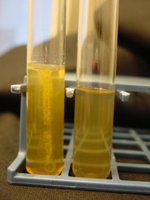
Example: Blackening of SIM medium indicates H2S production; red layer after Kovac’s reagent indicates indole production; spreading growth indicates motility.
Urease Test (Urea Digestion)
The urease test identifies bacteria that produce urease, which hydrolyzes urea to ammonia, carbon dioxide, and water. Ammonia raises the pH, detected by phenol red turning fuchsia.
Reaction:
Positive test: Medium turns fuchsia (alkaline pH).
Negative test: Medium remains yellow or orange.
Example: Fuchsia color in urea broth indicates urease activity.
Lipid Digestion (Lipase Test)
Lipase tests detect the ability of bacteria to hydrolyze lipids into fatty acids and glycerol. Spirit Blue Agar is used, which turns dark blue in acidic conditions due to fatty acid production.
Positive test: Dark blue color around colonies (acidic pH from fatty acids).
Negative test: No color change; medium remains light blue.
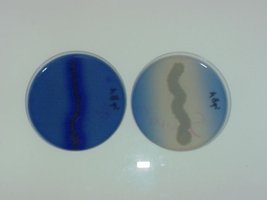
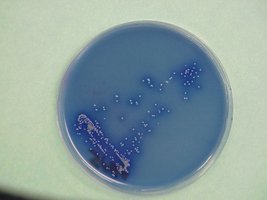
Example: Dark blue zone on Spirit Blue Agar indicates lipase activity.
Protein Digestion (Protease Test)
Protease tests detect the breakdown of proteins (such as casein in milk) into amino acids and peptides. Milk agar is used, which appears white due to casein. Clearing of the medium indicates protease activity.
Positive test: Clear zone around bacterial growth (casein hydrolyzed).
Negative test: Medium remains opaque (casein intact).
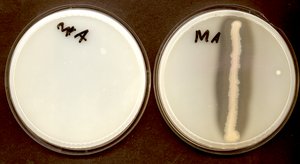
Example: Clearing on milk agar indicates protease production by the bacterium.
Summary Table: Key Biochemical Tests
Test | Enzyme Detected | Substrate | Indicator/Result | Positive Result |
|---|---|---|---|---|
Fermentation | Various (e.g., sucrase, lactase) | Carbohydrate | Phenol red, Durham tube | Yellow color, gas bubble |
Starch Hydrolysis | Amylase | Starch | Iodine | Clear zone after iodine |
Catalase | Catalase | Hydrogen peroxide | Bubbling | Immediate bubbles |
DNase | DNase | DNA | HCl | Clear zone after HCl |
SIM | Desulferase, Tryptophanase | Sulfur, Tryptophan | Iron salts, Kovac’s reagent | Blackening, red layer |
Urease | Urease | Urea | Phenol red | Fuchsia color |
Lipase | Lipase | Lipid | Spirit Blue | Dark blue zone |
Protease | Protease | Casein (milk protein) | Milk agar | Clear zone |
