 Indietro
Catalase and Oxidase Tests in Microbial Identification
Guida di studio - Note intelligenti
 Appunti personalizzati basati sui tuoi materiali, ampliati con definizioni chiave, esempi e contesto.
Catalase and Oxidase Tests
Introduction
The catalase and oxidase tests are essential biochemical assays used in microbiology to differentiate and identify bacteria based on their respiratory enzymes. These tests help determine the presence of specific enzymes involved in the electron transport chain and the organism's ability to detoxify reactive oxygen species.
Catalase Test
Principle of the Catalase Test
The catalase test detects the presence of the enzyme catalase, which breaks down hydrogen peroxide (H2O2) into water and oxygen. This enzyme is crucial for organisms that live in oxygen-rich environments, as it protects cells from oxidative damage caused by reactive oxygen species produced during aerobic respiration.
Respiration transfers chemical energy from glucose to ATP via glycolysis, the citric acid cycle, and oxidative phosphorylation in the electron transport chain (ETC).
The final electron acceptor (FEA) in aerobic respiration is oxygen, while anaerobic organisms use other inorganic molecules such as nitrate (NO3-) or sulfate (SO42-).
During aerobic respiration, incomplete reduction of oxygen can produce toxic byproducts such as hydrogen peroxide and superoxide radicals.
Formation and Detoxification of Reactive Oxygen Species
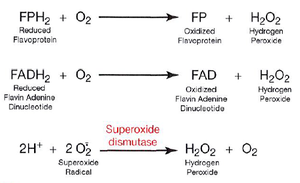
During the electron transport chain, certain carriers can transfer electrons directly to oxygen, forming hydrogen peroxide or superoxide radicals. These compounds are highly toxic and must be neutralized for the cell to survive.
Reduced flavoprotein (FPH2) and FADH2 can transfer electrons to O2, producing H2O2.
Superoxide dismutase converts superoxide radicals (O2-) to hydrogen peroxide.
Catalase then converts hydrogen peroxide into water and oxygen, detoxifying the cell.
Detection of Catalase Activity
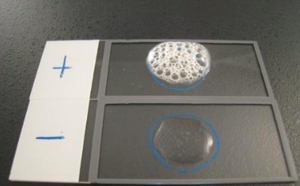
The catalase test is performed by adding hydrogen peroxide to a bacterial culture. The immediate formation of oxygen bubbles indicates a positive result, signifying the presence of catalase. No bubble formation indicates a negative result.
Positive result: Immediate bubbling due to oxygen gas release.
Negative result: No bubbles observed.
The test can be performed on a microscope slide or directly on bacterial growth.
Protective Enzymes in Aerotolerance Groups
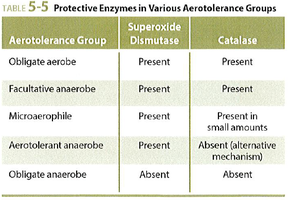
The presence of catalase and superoxide dismutase varies among different bacterial groups, reflecting their ability to tolerate oxygen.
Aerotolerance Group | Superoxide Dismutase | Catalase |
|---|---|---|
Obligate aerobe | Present | Present |
Facultative anaerobe | Present | Present |
Microaerophile | Present | Present in small amounts |
Aerotolerant anaerobe | Present | Absent (alternative mechanism) |
Obligate anaerobe | Absent | Absent |
Applications of the Catalase Test
The catalase test is widely used in clinical microbiology to differentiate between catalase-positive and catalase-negative bacteria. For example:
Catalase-positive: Micrococcus, Staphylococcus
Catalase-negative: Streptococcus, Enterococcus, Lactococcus
It can also aid in the identification of Mycobacterium species.
Oxidase Test
Principle of the Oxidase Test
The oxidase test identifies bacteria that produce the enzyme cytochrome c oxidase, a component of the electron transport chain (Complex IV). This enzyme transfers electrons to oxygen, the final electron acceptor in aerobic respiration.
In Gram-negative bacteria, cytochrome c is found in the periplasm or attached to the periplasmic side of the cytoplasmic membrane.
In Gram-positive bacteria, cytochrome c is membrane-bound.
Detection of Cytochrome c Oxidase
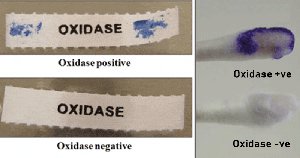
The oxidase test uses a chromogenic reducing agent, such as tetramethyl-p-phenylenediamine, which changes color when oxidized by cytochrome c oxidase. The test is performed by adding the reagent to bacterial growth on solid media or filter paper.
Positive result: Rapid color change (usually to dark purple or blue) indicates the presence of cytochrome c oxidase.
Negative result: No color change within the allotted time indicates absence of the enzyme.
Applications of the Oxidase Test
The oxidase test is used for the presumptive identification of certain bacterial groups:
Oxidase-positive: Neisseria, Moraxella, Pseudomonadaceae
Oxidase-negative: Enterobacteriaceae
Summary Table: Key Reactions and Enzymes
Superoxide dismutase: Converts superoxide radicals to hydrogen peroxide.
Catalase: Converts hydrogen peroxide to water and oxygen.
Cytochrome c oxidase: Transfers electrons to oxygen in the ETC.
Key Equations:
