 Indietro
Cell Structure and Function: Foundations of Microbial Life
Guida di studio - Note intelligenti
 Appunti personalizzati basati sui tuoi materiali, ampliati con definizioni chiave, esempi e contesto.
Cell Structure and Function
Introduction
Cells are the fundamental units of life, forming the basis for all living organisms. Understanding cell structure and function is essential for microbiology, as it provides insight into how microorganisms grow, reproduce, and interact with their environments.
Cells Are the Basic Unit of Life
Cell Theory
The cell theory is a cornerstone of biology, stating that all living things are composed of cells and that all cells arise from preexisting cells. This principle applies to both prokaryotic and eukaryotic organisms.
All living things consist of cells.
All cells are derived from preexisting cells.
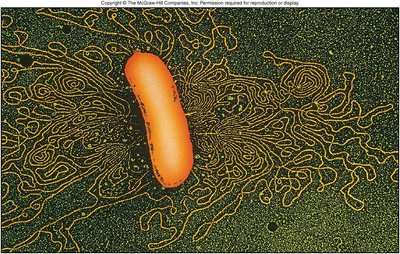
Major Processes of Living Cells
Characteristics of Life
Living cells, whether prokaryotic or eukaryotic, share several key characteristics:
Growth: Increase in size (seen in both prokaryotes and eukaryotes).
Reproduction: Increase in number (prokaryotes and eukaryotes reproduce independently; viruses only reproduce inside host cells).
Responsiveness: Ability to respond to environmental stimuli (prokaryotes, eukaryotes, and some viruses).
Metabolism: Chemical reactions that provide energy and build cellular components (prokaryotes and eukaryotes perform metabolism independently; viruses rely on host cell metabolism).
Cell Structure: All living organisms are composed of cells (prokaryotes and eukaryotes).

Prokaryotes & Eukaryotes
Comparison of Cell Types
Cells are classified into two main types: prokaryotic and eukaryotic. These types differ in structure, complexity, and the presence of internal compartments.
Prokaryotes: "Before nucleus"; lack a membrane-bound nucleus and most internal organelles; generally smaller and simpler (includes Bacteria and Archaea).
Eukaryotes: "True nucleus"; possess a membrane-bound nucleus and many organelles; generally larger and more complex (includes algae, protozoa, fungi, animals, and plants).


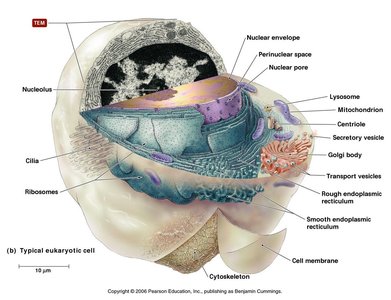
Typical Prokaryotic and Eukaryotic Cell Structure
Prokaryotic cells have a simpler organization, while eukaryotic cells contain specialized organelles for various cellular functions.
Prokaryotic cell: Contains nucleoid, ribosomes, cytoplasm, glycocalyx, cell wall, cell membrane, inclusions, and sometimes flagella.
Eukaryotic cell: Contains nucleus, nucleolus, nuclear envelope, mitochondria, lysosomes, centrioles, Golgi body, endoplasmic reticulum, ribosomes, cytoskeleton, cilia, and cell membrane.
Prokaryotic Cell Morphology
Shapes of Prokaryotic Cells
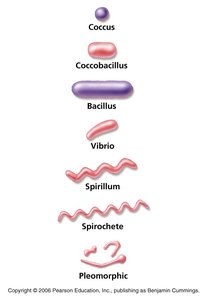
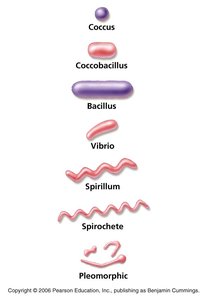
Prokaryotic cells exhibit a variety of shapes, which are important for identification and classification.
Coccus: Spherical
Bacillus: Rod-shaped
Spirillum & Spirochete: Spiral-shaped
Pleomorphic: Variable shape
Coccobacillus: Very short rods
Vibrio: Curved rods
Glycocalyces
Structure and Function
The glycocalyx is a gelatinous, sticky substance surrounding the outside of some cells, composed of polysaccharides, polypeptides, or both. It provides protection and aids in attachment to surfaces.
Capsule: Organized, firmly attached, protects from drying and host defenses.
Slime Layer: Loosely attached, water-soluble, aids in surface attachment.


Flagella
Structure and Function
Flagella are long, whip-like structures responsible for cell movement. Not all prokaryotes possess flagella. They are composed of a filament, hook, and basal body, and are capable of rotation.
Filament: Made of flagellin protein, forms the long, helical structure.
Hook: Connects filament to basal body.
Basal Body: Anchors flagellum to cell wall and membrane; acts as a motor.


Summary Table: Prokaryotic vs. Eukaryotic Cells
Feature | Prokaryotes | Eukaryotes |
|---|---|---|
Nucleus | Absent | Present |
Membrane-bound organelles | Few or none | Many |
Cell size | ~1.0 µm | 10–100 µm |
Cell wall composition | Peptidoglycan (bacteria), various (archaea) | Cellulose (plants), chitin (fungi), various |
Examples | Bacteria, Archaea | Algae, Protozoa, Fungi, Animals, Plants |
Additional info: This summary table is inferred from the provided content and standard microbiology knowledge to reinforce the comparison between cell types.
