 Indietro
Classification and Identification of Microorganisms
Guida di studio - Note intelligenti
 Appunti personalizzati basati sui tuoi materiali, ampliati con definizioni chiave, esempi e contesto.
Classification of Microorganisms
Introduction to Taxonomy and Phylogeny
Taxonomy is the science of classifying organisms to show relationships and similarities among them. Systematics, or phylogeny, is the study of the evolutionary history of organisms, aiming to group organisms based on common ancestry and genetic relationships.
Taxon: A category used in classification (e.g., species, genus, family).
Phylogeny: The evolutionary history and relationships among organisms.
Systematics: The study of the diversity of organisms and their evolutionary relationships.
Historical Classification Systems
Early classification systems, such as the two-kingdom system (plants and animals), were limited in scope. Modern systems incorporate genetic and molecular data for greater accuracy.
Linnaeus: Developed the binomial nomenclature and hierarchical classification.
Whittaker: Proposed the five-kingdom system.
Woese: Introduced the three-domain system based on rRNA sequencing.
The Three-Domain System
Overview of Domains
The three-domain system, developed by Carl Woese, classifies all life into three domains based on differences in ribosomal RNA (rRNA) sequences and other molecular characteristics:
Bacteria: Prokaryotic, peptidoglycan cell walls, diverse metabolism.
Archaea: Prokaryotic, cell walls without peptidoglycan, often extremophiles.
Eukarya: Eukaryotic, includes animals, plants, fungi, and protists.
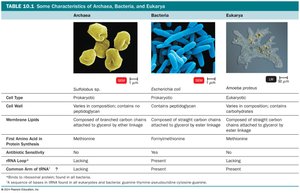
Table Purpose: This table compares key characteristics of the three domains, including cell type, cell wall composition, membrane lipids, first amino acid in protein synthesis, antibiotic sensitivity, and rRNA structure.
Phylogenetic Trees and Evolutionary Relationships
Understanding Phylogenetic Trees
Phylogenetic trees visually represent the evolutionary relationships among organisms. They are constructed using evidence such as fossil records and genome sequencing. Organisms that share a common ancestor are grouped together, and molecular data (especially rRNA and whole genome sequencing) are crucial for determining these relationships.
Fossils: Provide historical evidence for evolutionary relationships.
Genomes: DNA and rRNA sequencing reveal genetic similarities and differences.
Taxonomic Hierarchy and Scientific Nomenclature
Binomial Nomenclature
Scientific names are used to avoid confusion caused by local names. The binomial system assigns each organism a two-part name: the genus and the specific epithet (species).
Genus: The first part of the name, always capitalized.
Species: The second part, not capitalized.
Example: Escherichia coli
Taxonomic Hierarchy
The taxonomic hierarchy is a series of nested categories developed by Linnaeus, ranging from broad to specific:
Domain
Kingdom
Phylum
Class
Order
Family
Genus
Species
Classification of Prokaryotes, Eukaryotes, and Viruses
Prokaryotes
Prokaryotic classification is based on genetic similarity, morphology, and biochemical characteristics. Bergey’s Manual is the standard reference for prokaryotic taxonomy.
Culture: Bacteria grown in laboratory media.
Clone: Population of cells derived from a single parent cell.
Strain: Genetically different cells within a clone.
Eukaryotes
Protista: Mostly unicellular, nutritionally diverse, grouped by rRNA clades.
Fungi: Chemoheterotrophic, chitin cell walls, reproduce via spores or hyphal fragments.
Plantae: Multicellular, cellulose cell walls, photosynthetic.
Animalia: Multicellular, no cell walls, ingest organic matter.
Viruses
Viruses are not classified within the three domains because they are not cellular. Viral species are defined by shared characteristics such as morphology, genome type, and ecological niche.
Methods of Classifying and Identifying Microorganisms
Classification vs. Identification
Classification: Placing organisms into groups of related species based on shared characteristics.
Identification: Determining the identity of an unknown organism by comparing its characteristics to known organisms.
Bergey’s Manual
Bergey’s Manual of Determinative Bacteriology provides identification schemes for bacteria and archaea, using criteria such as morphology, cell wall composition, differential staining, oxygen requirements, and biochemical testing.
Conventional Identification Methods
Morphology: Useful for eukaryotes; includes cell shape, presence of endospores or flagella.
Differential Staining: Gram staining and acid-fast staining; not useful for all bacteria or archaea.
Biochemical Tests: Detect the presence of specific enzymes and metabolic pathways.
Biochemical Tests and Rapid Identification
Biochemical tests are widely used to differentiate bacteria based on enzymatic activities. Rapid identification methods can perform multiple tests simultaneously, providing results within 4 to 24 hours. Each test result is assigned a number, and the combination of results identifies the organism.
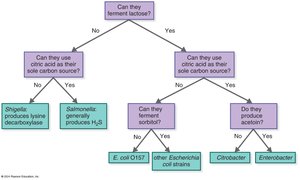
Figure Purpose: This figure shows a dichotomous key used to identify genera of enteric bacteria based on metabolic characteristics.
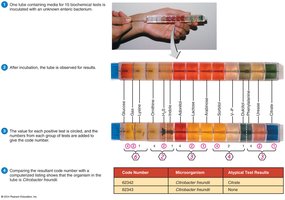
Figure Purpose: This image demonstrates a rapid identification method (EnteroPluri test) for bacteria, showing how multiple biochemical tests are performed in a single tube.
Serological Methods
Serology and Antigen-Antibody Reactions
Serology is the study of serum and immune responses. Microorganisms are antigenic and stimulate antibody production. Serological tests use known antibodies to detect specific microorganisms.
Slide Agglutination Test: Bacteria clump when mixed with specific antibodies.
ELISA (Enzyme-Linked Immunosorbent Assay): Detects antigens or antibodies in a sample. Direct ELISA detects microbial antigens; indirect ELISA detects patient antibodies.
Western Blot: Detects specific proteins using antibodies.
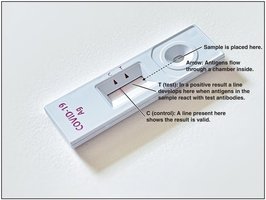
Figure Purpose: This image shows a rapid at-home ELISA test for SARS-CoV-2, illustrating how antigen-antibody reactions are used for diagnosis.
Molecular Methods for Classification and Identification
Whole Genome Sequencing
Whole genome sequencing provides comprehensive genetic information, allowing for precise classification and identification. The percentage of guanine and cytosine (G+C) content is used to compare relatedness:
G+C Content:
Closely related organisms have similar G+C content.
Nucleic Acid Hybridization and Amplification
Nucleic Acid Hybridization: Measures the ability of DNA strands from different organisms to hybridize. Greater hybridization indicates closer relatedness. Hybridization >70% suggests the same species.
Nucleic Acid Amplification Tests (NAATs): Use PCR to amplify DNA from unculturable microorganisms for analysis.
Reverse Transcription PCR: Used to detect RNA viruses such as SARS-CoV-2.
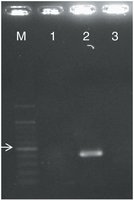
Figure Purpose: This image shows a gel electrophoresis result from a PCR test, used to identify a coronavirus strain by detecting amplified DNA.
Other Molecular Techniques
Southern Blotting: Uses DNA probes to identify microorganisms by hybridization.
DNA Chips (Microarrays): Contain DNA probes to detect pathogens by hybridization, detected by fluorescence.
Ribotyping: Uses rRNA sequencing for identification.
FISH (Fluorescent In Situ Hybridization): Uses fluorescent probes to stain and identify microorganisms in environmental samples.
Identification Tools: Dichotomous Keys and Cladograms
Dichotomous Keys
Dichotomous keys are identification tools based on a series of questions with two possible answers at each step, leading to the identification of an organism.
Cladograms
Cladograms are diagrams that show evolutionary relationships among organisms, often based on rRNA sequences. They help visualize the branching patterns of evolution.
