 Indietro
Combination Differential Media: SIM and Triple Sugar Iron Agar (TSIA) in Microbial Biochemical Testing
Guida di studio - Note intelligenti
 Appunti personalizzati basati sui tuoi materiali, ampliati con definizioni chiave, esempi e contesto.
Combination Differential Media in Microbiology
Overview of Combination Media
Combination differential media are specialized culture media that combine multiple biochemical tests into a single tube, allowing for efficient and cost-effective differentiation of bacterial groups, especially within the family Enterobacteriaceae. Two widely used examples are SIM (Sulfur, Indole, Motility) medium and Triple Sugar Iron Agar (TSIA).
Purpose: To simultaneously assess several metabolic properties of bacteria.
Examples: SIM and TSIA are commonly used in clinical and research microbiology labs.
SIM Medium: Sulfur, Indole, and Motility Testing
Principle and Components
SIM medium is designed to test three bacterial activities: sulfur reduction, indole production, and motility. The medium contains peptones (as amino acid sources), sodium thiosulfate (for sulfur reduction), and a low concentration of agar to allow for motility detection.
Sulfur Reduction: Detects the ability of bacteria to reduce sulfur to hydrogen sulfide (H2S).
Indole Production: Assesses the breakdown of tryptophan to indole.
Motility: Determines if bacteria are motile by observing growth away from the stab line.
Sulfur Reduction in SIM
Sulfur reduction can occur via two main pathways:
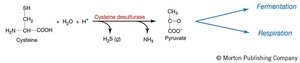
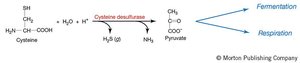
Putrefaction of cysteine to pyruvate, releasing H2S gas.
Reduction of sulfate at the end of the electron transport chain during anaerobic respiration.
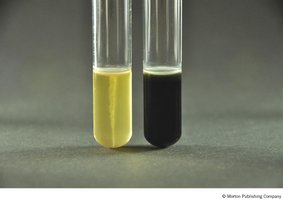
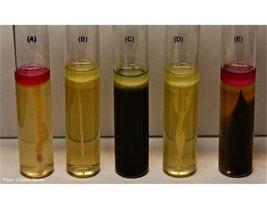
H2S produced reacts with ferrous ammonium sulfate in the medium to form a black precipitate (ferric sulfide, FeS), indicating a positive result for sulfur reduction.
Indole Production in SIM
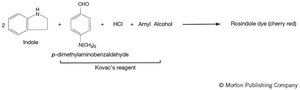
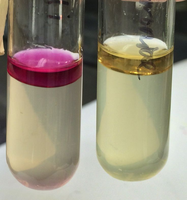
Indole is produced by the bacterial breakdown of tryptophan via the enzyme tryptophanase. Indole is detected by adding Kovac’s reagent, which reacts with indole to produce a red (rosindole) dye at the surface of the medium.
Positive result: Red layer at the top after adding Kovac’s reagent.
Negative result: No color change (remains yellow or unchanged).
Motility in SIM
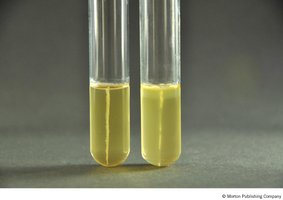
Motility is assessed by stabbing the medium with an inoculating needle. Motile bacteria will spread away from the stab line, causing turbidity throughout the medium, while non-motile bacteria will only grow along the stab line.
Positive motility: Diffuse growth radiating from the stab line.
Negative motility: Growth only along the stab line.
Interpreting SIM Results
All three activities (sulfur reduction, indole production, and motility) are assessed in a single tube. Blackening of the medium indicates sulfur reduction, a red layer after Kovac’s reagent indicates indole production, and turbidity indicates motility. Note that heavy blackening can obscure motility results.
Triple Sugar Iron Agar (TSIA)
Principle and Components
TSIA is a differential medium used to distinguish bacteria based on their ability to ferment glucose, lactose, and/or sucrose, produce gas, and reduce sulfur. The medium contains:
Glucose (low concentration), lactose, and sucrose (high concentrations)
Peptones (amino acids)
Phenol red (pH indicator: yellow at acidic pH, red at neutral, pink at alkaline pH)
Sodium thiosulfate and ferrous sulfate (for sulfur reduction detection)
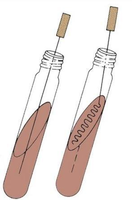
The slant/butt design provides both aerobic (slant) and anaerobic (butt) environments. Inoculation is by stabbing the butt and streaking the slant.
Interpretation of TSIA Results
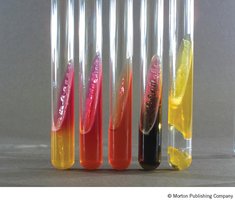
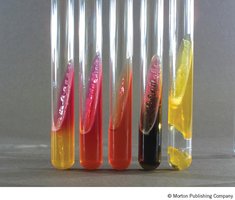
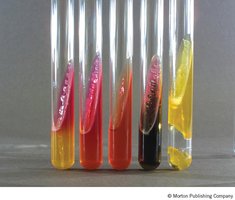
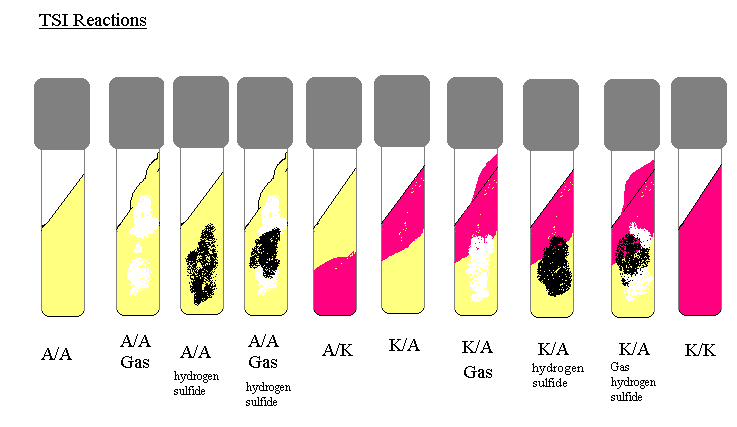
Glucose fermentation only: Butt turns yellow (acidic), slant reverts to red (alkaline) after glucose is depleted and peptones are used aerobically.
Lactose and/or sucrose fermentation: Both slant and butt remain yellow (acidic).
No sugar fermentation: Slant and butt remain red (alkaline) due to peptone utilization.
Gas production: Cracks or bubbles in the agar.
Sulfur reduction: Black precipitate forms, indicating H2S production (requires acidic conditions).
Sulfur Reduction in TSIA
Sulfur reduction in TSIA occurs via the same mechanisms as in SIM: putrefaction of cysteine or reduction of sulfate. H2S reacts with ferrous sulfate to form a black precipitate (FeS), which only forms under acidic conditions (i.e., when fermentation occurs).
Summary Table: TSIA Reactions
Slant/Butt | Interpretation |
|---|---|
Yellow/Yellow (A/A) | Glucose and lactose and/or sucrose fermentation |
Red/Yellow (K/A) | Glucose fermentation only |
Red/Red (K/K) | No fermentation, peptone utilization |
Black precipitate | H2S production (sulfur reduction) |
Cracks/bubbles | Gas production |
Laboratory Application
Typical Lab Protocols
Stab-inoculate SIM tubes with different bacterial species and incubate at 37°C for 48 hours.
Stab-inoculate motility tubes and incubate at 37°C for 48 hours.
Inoculate TSIA slants by stabbing the butt and streaking the slant, then incubate at 37°C for 24 hours.
After incubation, results are interpreted based on color changes, blackening, and growth patterns as described above.
Key Terms and Concepts
Differential Media: Media that distinguish between different groups of microorganisms based on their biological characteristics.
Fermentation: Metabolic process that converts sugar to acids, gases, or alcohol in the absence of oxygen.
Indole: A compound produced by the breakdown of tryptophan, detected by Kovac’s reagent.
Motility: The ability of an organism to move independently using metabolic energy.
Sulfur Reduction: The process by which bacteria reduce sulfur-containing compounds to hydrogen sulfide gas.
Summary
Combination differential media such as SIM and TSIA are essential tools in microbiology for the rapid and efficient identification of bacterial species based on their metabolic properties. Understanding the principles and interpretation of these media is crucial for accurate microbial identification in clinical and research settings.
