 Indietro
Comprehensive Study Guide for Chapter 6: Viruses and Prions
Guida di studio - Note intelligenti
 Appunti personalizzati basati sui tuoi materiali, ampliati con definizioni chiave, esempi e contesto.
Q1. Define virus.
Background
Topic: General Virus Characteristics
This question is testing your understanding of what a virus is and how it differs from other microorganisms.
Key Terms:
Virus: A microscopic infectious agent that can only replicate inside the living cells of an organism.
Obligate intracellular pathogen: Requires a host cell to reproduce.
Step-by-Step Guidance
Review the textbook definition of a virus, focusing on its dependence on host cells for replication.
Consider the structural components and genetic material of viruses.
Think about how viruses differ from bacteria and other pathogens in terms of replication and metabolism.
Try solving on your own before revealing the answer!
Final Answer:
A virus is a non-living, microscopic infectious agent that can only replicate inside the living cells of a host organism. It consists of genetic material (DNA or RNA) surrounded by a protein coat and sometimes a lipid envelope.
Q2. Can viruses synthesize their own nucleic acids and proteins apart from a host?
Background
Topic: Viral Metabolism
This question tests your understanding of viral dependence on host cells for biosynthesis.
Key Terms:
Nucleic acids: DNA or RNA molecules that carry genetic information.
Proteins: Macromolecules essential for structure and function.
Step-by-Step Guidance
Recall the basic structure of viruses and their lack of cellular machinery.
Consider whether viruses have ribosomes or enzymes for nucleic acid/protein synthesis.
Think about how viruses use host cell machinery during infection.
Try solving on your own before revealing the answer!
Final Answer:
No, viruses cannot synthesize their own nucleic acids and proteins apart from a host. They rely entirely on the host cell's machinery for replication and protein synthesis.
Q3. Viruses are obligate intracellular pathogens. What does this mean?
Background
Topic: Viral Replication and Pathogenicity
This question is about the requirement of viruses to infect host cells to reproduce.
Key Terms:
Obligate intracellular pathogen: An organism that must live and reproduce inside a host cell.
Step-by-Step Guidance
Define 'obligate' and 'intracellular' in the context of pathogens.
Explain why viruses cannot replicate outside host cells.
Consider examples of viral replication cycles that illustrate this dependence.
Try solving on your own before revealing the answer!
Final Answer:
Obligate intracellular pathogens are organisms that must infect and live within a host cell to reproduce. Viruses cannot replicate or carry out metabolic processes outside a host cell.
Q4. What is a virus that infects a bacterium called?
Background
Topic: Viral Host Specificity
This question tests your knowledge of terminology related to viruses and their hosts.
Key Terms:
Bacteriophage: A virus that infects bacteria.
Step-by-Step Guidance
Recall the term used for viruses that specifically target bacteria.
Think about the structure and function of these viruses.
Try solving on your own before revealing the answer!
Final Answer:
A virus that infects a bacterium is called a bacteriophage.
Q5. What is a virion?
Background
Topic: Viral Structure
This question is about the physical form of a virus outside a host cell.
Key Terms:
Virion: The complete, infectious form of a virus outside a host cell.
Step-by-Step Guidance
Define the term 'virion' and distinguish it from other viral forms.
Consider the components that make up a virion.
Try solving on your own before revealing the answer!
Final Answer:
A virion is the complete, fully assembled, infectious form of a virus outside a host cell, consisting of genetic material and a protein coat.
Q6. What is a capsid and what macromolecule makes up the capsid?
Background
Topic: Viral Structure
This question tests your understanding of the protective protein shell of viruses.
Key Terms:
Capsid: The protein shell that encases the viral genome.
Macromolecule: Large molecules, such as proteins, nucleic acids, carbohydrates, and lipids.
Step-by-Step Guidance
Define 'capsid' and its function in viral structure.
Identify the macromolecule that forms the capsid.
Try solving on your own before revealing the answer!
Final Answer:
The capsid is the protein shell surrounding the viral genome, and it is made up of protein macromolecules.
Q7. What is a capsomere?
Background
Topic: Viral Structure
This question is about the subunits that make up the capsid.
Key Terms:
Capsomere: Protein subunits that assemble to form the capsid.
Step-by-Step Guidance
Define 'capsomere' and its role in viral structure.
Consider how capsomeres assemble to form the capsid.
Try solving on your own before revealing the answer!
Final Answer:
A capsomere is a protein subunit that assembles with others to form the capsid of a virus.
Q8. List three general virus capsid shapes.
Background
Topic: Viral Morphology
This question tests your knowledge of the structural diversity of viral capsids.
Key Terms:
Capsid shapes: The geometric forms that viral capsids can take.
Step-by-Step Guidance
Recall the main geometric shapes of viral capsids.
Think about examples of viruses with each shape.
Try solving on your own before revealing the answer!
Final Answer:
The three general virus capsid shapes are: helical, icosahedral, and complex.
Q9. What macromolecule comprises the viral envelope?
Background
Topic: Viral Structure
This question is about the composition of the viral envelope.
Key Terms:
Envelope: The lipid bilayer surrounding some viruses.
Macromolecule: Large molecules, such as lipids and proteins.
Step-by-Step Guidance
Identify the main macromolecule in the viral envelope.
Consider the origin of the envelope in enveloped viruses.
Try solving on your own before revealing the answer!
Final Answer:
The viral envelope is primarily comprised of lipids, often derived from the host cell membrane.
Q10. What is a naked virus?
Background
Topic: Viral Structure
This question is about viruses that lack an envelope.
Key Terms:
Naked virus: A virus without a lipid envelope.
Step-by-Step Guidance
Define 'naked virus' and contrast it with enveloped viruses.
Consider the implications for viral stability and transmission.
Try solving on your own before revealing the answer!
Final Answer:
A naked virus is a virus that lacks a lipid envelope and consists only of a capsid and genetic material.
Q11. Where does an enveloped virus obtain its envelope?
Background
Topic: Viral Structure and Replication
This question is about the origin of the viral envelope.
Key Terms:
Envelope: Lipid bilayer surrounding some viruses.
Step-by-Step Guidance
Recall how enveloped viruses acquire their envelope during replication.
Consider the cellular structures involved in envelope formation.
Try solving on your own before revealing the answer!
Final Answer:
An enveloped virus obtains its envelope from the host cell membrane during the process of budding.
Q12. What is another term for viral spikes?
Background
Topic: Viral Structure
This question is about the terminology for surface proteins on viruses.
Key Terms:
Viral spikes: Surface proteins used for attachment to host cells.
Glycoproteins: Proteins with carbohydrate groups attached.
Step-by-Step Guidance
Recall the alternative term for viral spikes.
Consider their function in viral infection.
Try solving on your own before revealing the answer!
Final Answer:
Another term for viral spikes is glycoproteins.
Q13. What macromolecules make up viral spikes?
Background
Topic: Viral Structure
This question is about the composition of viral spikes.
Key Terms:
Glycoproteins: Proteins with carbohydrate groups attached.
Step-by-Step Guidance
Identify the macromolecules that form viral spikes.
Consider the functional groups attached to these proteins.
Try solving on your own before revealing the answer!
Final Answer:
Viral spikes are made up of glycoproteins, which are proteins with attached carbohydrate groups.
Q14. What part of the virus binds to specific factors on a host cell which determines the exact cell type a virus can infect?
Background
Topic: Viral Host Specificity
This question is about the mechanism of viral attachment and host cell recognition.
Key Terms:
Viral spikes/glycoproteins: Surface proteins responsible for binding to host cell receptors.
Step-by-Step Guidance
Identify the viral structure involved in host cell recognition.
Consider how this structure determines host specificity.
Try solving on your own before revealing the answer!
Final Answer:
The viral spikes (glycoproteins) bind to specific receptors on the host cell, determining which cell types the virus can infect.
Q15. The influenza virus that causes swine flu is called H1N1. Name the glycoproteins that produce “HA” and “NA” spikes, which are represented by the letters H and N, respectively, in H1N1.
Background
Topic: Viral Structure and Nomenclature
This question is about the specific glycoproteins found on the influenza virus.
Key Terms:
Hemagglutinin (HA): Glycoprotein responsible for binding to host cells.
Neuraminidase (NA): Glycoprotein involved in viral release from host cells.
Step-by-Step Guidance
Recall the full names of the glycoproteins represented by H and N in H1N1.
Consider their roles in the viral life cycle.
Try solving on your own before revealing the answer!
Final Answer:
“HA” stands for hemagglutinin and “NA” stands for neuraminidase, the two glycoproteins found on the influenza virus.
Q16. In general, can a single virus’s genome contain both DNA and RNA?
Background
Topic: Viral Genetics
This question is about the composition of viral genomes.
Key Terms:
Genome: The complete set of genetic material in an organism or virus.
Step-by-Step Guidance
Consider the types of genetic material found in viruses.
Recall whether viruses can have both DNA and RNA in their genome.
Try solving on your own before revealing the answer!
Final Answer:
No, a single virus’s genome cannot contain both DNA and RNA. It will have either DNA or RNA, but not both.
Q17. Which type of single-stranded RNA virus genome functions directly as mRNA?
Background
Topic: Viral Genetics and Replication
This question is about the classification of RNA viruses and their replication strategies.
Key Terms:
Positive-sense (ssRNA+): RNA that can be directly translated by host ribosomes.
Negative-sense (ssRNA-): RNA that must be converted to positive-sense before translation.
Step-by-Step Guidance
Recall the difference between positive-sense and negative-sense RNA viruses.
Identify which type can be directly translated as mRNA.
Try solving on your own before revealing the answer!
Final Answer:
Positive-sense single-stranded RNA (ssRNA+) viruses have genomes that function directly as mRNA.
Q18. What enzyme is used by single-stranded antisense RNA (ssRNA-) viruses to make mRNA from an RNA template?
Background
Topic: Viral Enzymes and Replication
This question is about the enzymes required for viral replication in ssRNA- viruses.
Key Terms:
RNA-dependent RNA polymerase: Enzyme that synthesizes mRNA from an RNA template.
Step-by-Step Guidance
Recall the enzyme responsible for converting ssRNA- to mRNA.
Consider the role of this enzyme in the viral life cycle.
Try solving on your own before revealing the answer!
Final Answer:
Single-stranded antisense RNA (ssRNA-) viruses use RNA-dependent RNA polymerase to make mRNA from an RNA template.
Q19. What is the function of the enzyme reverse transcriptase?
Background
Topic: Viral Enzymes and Replication
This question is about the role of reverse transcriptase in retroviruses.
Key Terms:
Reverse transcriptase: Enzyme that synthesizes DNA from an RNA template.
Step-by-Step Guidance
Recall the function of reverse transcriptase in retroviral replication.
Consider how this enzyme enables integration of viral genetic material into the host genome.
Try solving on your own before revealing the answer!
Final Answer:
Reverse transcriptase synthesizes DNA from an RNA template, allowing retroviruses to integrate their genetic material into the host genome.
Q20. Why do RNA viruses mutate more quickly than DNA viruses?
Background
Topic: Viral Genetics and Mutation
This question is about the mechanisms of mutation in viral genomes.
Key Terms:
Mutation rate: Frequency at which genetic changes occur.
Proofreading: Mechanism to correct errors during replication.
Step-by-Step Guidance
Consider the differences in replication enzymes between RNA and DNA viruses.
Recall whether RNA polymerases have proofreading ability.
Think about the consequences of higher mutation rates for viral evolution.
Try solving on your own before revealing the answer!
Final Answer:
RNA viruses mutate more quickly because their RNA polymerases lack proofreading ability, leading to more replication errors.
Q21. Do attenuated virus strains cause disease in healthy, non-immunocompromised hosts?
Background
Topic: Vaccines and Viral Pathogenicity
This question is about the safety of attenuated virus strains used in vaccines.
Key Terms:
Attenuated virus: A weakened virus used in vaccines.
Immunocompromised: Individuals with weakened immune systems.
Step-by-Step Guidance
Recall the purpose of attenuated viruses in vaccines.
Consider whether these strains can cause disease in healthy individuals.
Try solving on your own before revealing the answer!
Final Answer:
No, attenuated virus strains generally do not cause disease in healthy, non-immunocompromised hosts.
Q22. Define tropism.
Background
Topic: Viral Host Specificity
This question is about the specificity of viruses for certain cell types or tissues.
Key Terms:
Tropism: The specificity of a virus for a particular host cell, tissue, or organism.
Step-by-Step Guidance
Define 'tropism' in the context of viral infection.
Consider factors that determine viral tropism.
Try solving on your own before revealing the answer!
Final Answer:
Tropism is the specificity of a virus for a particular host cell, tissue, or organism, determined by the interaction between viral surface proteins and host cell receptors.
Q23. The influenza virus undergoes processes called antigenic drift and antigen shift. Define these two processes and describe the outcome of each using the example of influenza.
Background
Topic: Viral Evolution and Epidemiology
This question is about the mechanisms by which influenza viruses change over time.
Key Terms:
Antigenic drift: Gradual changes in viral antigens due to mutations.
Antigenic shift: Sudden changes in viral antigens due to reassortment of genetic material.
Step-by-Step Guidance
Define antigenic drift and antigenic shift.
Describe how each process affects influenza virus evolution and outbreaks.
Consider the implications for vaccine development and disease prevention.
Try solving on your own before revealing the answer!
Final Answer:
Antigenic drift refers to gradual mutations in viral antigens, leading to seasonal flu outbreaks. Antigenic shift is a sudden reassortment of genetic material, resulting in new influenza strains and potential pandemics.
Q24. What type of immunoassay adheres viral antigen to latex beads to determine if a patient sample contains antibodies made to the virus?
Background
Topic: Immunoassays and Diagnostic Testing
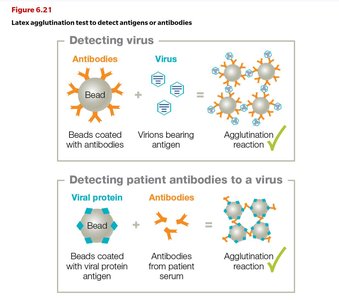
This question is about the use of latex agglutination assays to detect viral antigens or antibodies.
Key Terms:
Agglutination assay: A test that detects antigen-antibody interactions by observing clumping.
Latex beads: Small particles used to enhance visibility of agglutination.
Step-by-Step Guidance
Recall the principle of agglutination assays and how latex beads are used.
Consider the two strategies: beads coated with antibodies to detect antigen, or beads coated with antigen to detect antibodies.
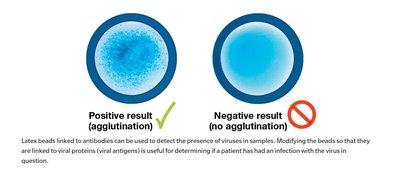
Review the visual results of agglutination (clumping) versus no agglutination.
Try solving on your own before revealing the answer!
Final Answer:
The immunoassay that adheres viral antigen to latex beads to detect patient antibodies is called a latex agglutination assay.
Clumping (agglutination) indicates a positive result, showing the presence of antibodies or antigens in the sample.
