 Indietro
Microbiology Lab 4 Study Guide
Guida di studio - Note intelligenti
 Appunti personalizzati basati sui tuoi materiali, ampliati con definizioni chiave, esempi e contesto.
Enumeration of Microorganisms
Introduction
Microbiologists often need to determine the number of bacteria in a sample to assess microbial growth under various conditions. Enumeration methods are essential for research, clinical diagnostics, and industrial applications. Due to the small size and large numbers of microorganisms, scientific notation is commonly used to express results.
Direct Microscopic Method (Total Cell Count)
Principle and Procedure
The direct microscopic count involves using a specialized counting chamber, such as the Petroff-Hausser chamber, to count bacteria in a known volume under a microscope. This method provides a rapid estimate of cell numbers in a sample.
Counting Chamber: A slide with a precisely defined grid and depth, allowing calculation of cell concentration by counting cells in a defined area and extrapolating to the total volume.
Procedure: A small volume of bacterial suspension is placed in the chamber, and cells within the grid are counted.
Calculation: The number of cells per milliliter is calculated based on the chamber's volume and the counted cells.
Advantages: Rapid, does not require incubation.
Disadvantages: Cannot distinguish between live and dead cells; less accurate for dilute samples.
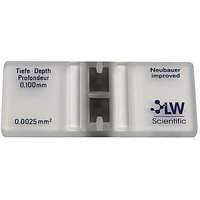
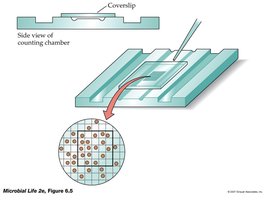
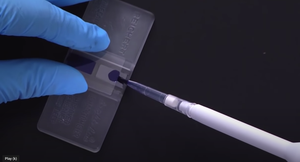
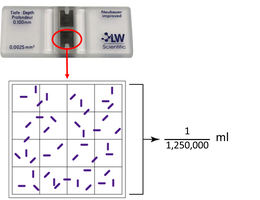
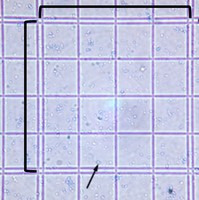
Example: If 50 cells are counted in a grid representing 0.0001 mL, the concentration is cells/mL.
Measuring Turbidity
Principle and Instrumentation
Turbidity measurement estimates bacterial concentration by assessing the cloudiness of a liquid culture. As bacteria multiply, the culture becomes more turbid, scattering and absorbing more light.
Spectrophotometer: An instrument that measures the amount of light transmitted through a bacterial suspension compared to a blank.
Absorbance (Optical Density, OD): The amount of light absorbed by the sample; directly proportional to cell concentration.
Transmittance: The percentage of light passing through the sample; inversely proportional to cell concentration.
Advantages: Rapid, non-destructive, suitable for monitoring growth over time.
Disadvantages: Cannot distinguish live from dead cells; not accurate for very low or very high cell densities.
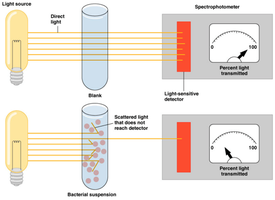
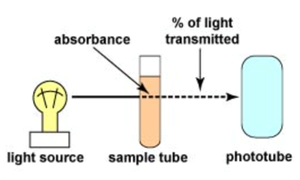
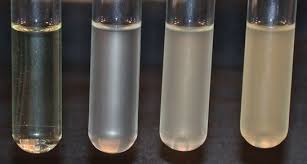
Example: A highly turbid culture will have high absorbance and low transmittance, indicating a high bacterial concentration.
Formula: where is absorbance and is transmittance (as a decimal).
Plate Count (Viable Count)
Principle and Method
The plate count method estimates the number of viable (living) bacteria in a sample by spreading diluted samples onto agar plates and counting the resulting colonies. Each colony arises from a single viable cell or a group of cells (colony forming unit, CFU).
Serial Dilutions: Stepwise dilution of the original sample to obtain countable numbers of colonies on plates.
Countable Plate: Plates with 30-300 colonies are considered statistically reliable for counting.
Colony Forming Units (CFU): The number of viable cells capable of forming colonies.
Advantages: Counts only living cells; suitable for a wide range of samples.
Disadvantages: Time-consuming (requires incubation); may underestimate numbers if cells clump or are non-culturable.
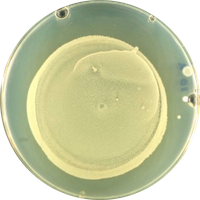
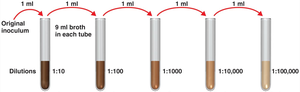
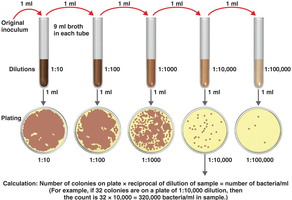
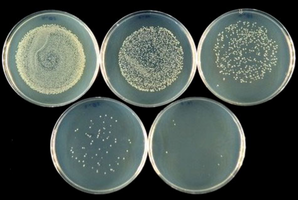
Example: If 50 colonies are counted on a plate inoculated with 0.1 mL of a 1:10,000 dilution, the CFU/mL is calculated as:
For the example above: CFU/mL
Summary Table: Comparison of Enumeration Methods
Method | Measures | Advantages | Disadvantages |
|---|---|---|---|
Direct Microscopic Count | Total cells (live & dead) | Rapid, simple | Cannot distinguish live/dead, less accurate for dilute samples |
Turbidity (Spectrophotometry) | Total cells (live & dead) | Rapid, non-destructive | Cannot distinguish live/dead, not accurate at extremes |
Plate Count (Viable Count) | Viable cells (CFU) | Counts only living cells | Time-consuming, may underestimate if cells clump |
Key Terms and Concepts
Colony Forming Unit (CFU): A unit used to estimate the number of viable bacteria or fungal cells in a sample.
Serial Dilution: A stepwise dilution of a substance in solution.
Absorbance (A): A measure of the amount of light absorbed by a sample.
Transmittance (T): The fraction of light that passes through a sample.
Countable Plate: An agar plate with 30-300 colonies, suitable for accurate counting.
Practice and Application
Be able to set up and perform serial dilutions.
Identify and generate countable plates for viable counts.
Calculate CFU/mL from colony counts and dilution factors.
Understand the principles, advantages, and limitations of each enumeration method.
