 Indietro
Foundations of Microbiology: Cell Types, Microbial Diversity, and Microscopy
Guida di studio - Note intelligenti
 Appunti personalizzati basati sui tuoi materiali, ampliati con definizioni chiave, esempi e contesto.
Introduction to Microbiology
Definition and Scope
Microbiology is the study of microorganisms—organisms and infectious agents too small to be seen clearly without a microscope. These include bacteria, archaea, fungi, protozoa, algae, viruses, viroids, and prions. Microbiology is a foundational discipline within the natural sciences, intersecting with biology, chemistry, medicine, and environmental science.
Microorganisms (Microbes): Tiny living organisms, usually invisible to the naked eye.
Branches of Microbiology: Bacteriology, Virology, Mycology, Parasitology.
Specialties: Medical, Environmental, Evolutionary, Food, and Industrial Microbiology.
Classification of Microorganisms
Cellular vs. Acellular Microbes
Cellular Microorganisms: Made of cells; can be unicellular or multicellular (e.g., bacteria, fungi, protozoa, some algae).
Acellular Infectious Agents: Not made of cells; include viruses (DNA or RNA), viroids, and prions (misfolded proteins).
Key Distinctions:
Cellular: Has cells (e.g., yeast = unicellular fungus; mold = multicellular fungus).
Acellular: Lacks cells (e.g., viruses, prions, viroids).
Three Domain System
Bacteria: Prokaryotic, cell walls with peptidoglycan, reproduce by binary fission, can be photosynthetic or non-photosynthetic.
Archaea: Prokaryotic, cell walls lack peptidoglycan, often live in extreme environments, not pathogenic to humans.
Eukarya: Eukaryotic, includes protozoa, fungi, algae, plants, and animals; if present, cell walls lack peptidoglycan.
Prokaryotic vs. Eukaryotic Cells
Prokaryotic Cells: No nucleus, no membrane-bound organelles (e.g., bacteria, archaea).
Eukaryotic Cells: True nucleus, membrane-bound organelles (e.g., fungi, protozoa, algae, plants, animals).
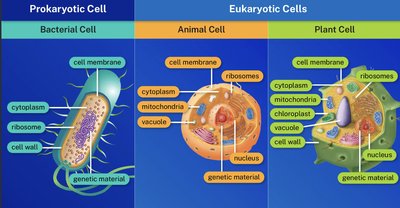
Additional info: The image above visually compares the structural differences between prokaryotic (bacterial) and eukaryotic (animal and plant) cells, highlighting the presence or absence of a nucleus, organelles, and cell wall.
Microbial Groups and Examples
Bacteria: Prokaryotic, diverse metabolism, some pathogenic.
Archaea: Prokaryotic, extremophiles (e.g., methanogens, halophiles, thermophiles).
Protozoa: Unicellular eukaryotes, motile, some pathogenic.
Fungi: Unicellular (yeasts) or multicellular (molds), non-photosynthetic, cell walls of chitin.
Algae: Unicellular or multicellular, photosynthetic, cell walls of cellulose.
Viruses: Acellular, require host cell for replication.
Prions: Infectious proteins, cause neurodegenerative diseases.
Historical Milestones in Microbiology
Key Scientists and Discoveries
Antonie van Leeuwenhoek: First to observe live microorganisms with simple microscopes; "Father of Microbiology."
Robert Hooke: Coined the term "cell"; observed cork cells with a compound microscope.
Louis Pasteur: Disproved spontaneous generation, developed pasteurization, vaccines for rabies and anthrax.
Robert Koch: Developed Koch's postulates, linked specific microbes to specific diseases.
Joseph Lister: Introduced antiseptic surgery using phenol.
Edward Jenner: Developed the smallpox vaccine using cowpox.
Alexander Fleming: Discovered penicillin, the first antibiotic.
Taxonomy and Nomenclature
Classification Hierarchy
Taxonomy: Science of classifying organisms (Domain → Kingdom → Phylum → Class → Order → Family → Genus → Species).
Binomial Nomenclature: Two-part scientific naming system (Genus species), e.g., Escherichia coli.
Cell Structure and Function
Prokaryotic Cell Structures
Capsule: Protective outer coating.
Glycocalyx: Sticky layer for attachment.
Flagellum: Motility structure.
Fimbriae/Pili: Attachment and DNA transfer.
Plasmid: Small circular DNA.
Endospore: Dormant, resistant structure.
Peptidoglycan: Main component of bacterial cell wall.
Bacterial Shapes and Arrangements
Coccus: Spherical
Bacillus: Rod-shaped
Spirillum/Spirochete: Spiral-shaped
Vibrio: Comma-shaped
Arrangements: Diplococci (pairs), Streptococci (chains), Staphylococci (clusters)
Microscopy and Staining
Microscope Types and Principles
Compound Light Microscope: Uses visible light and multiple lenses.
Electron Microscope: Uses electron beams for high resolution (Transmission EM for internal structures, Scanning EM for surfaces).
Brightfield: Dark image on bright background; requires staining.
Darkfield: Bright image on dark background; good for live, unstained specimens.
Phase Contrast: Enhances contrast in unstained cells.
Fluorescence: Uses fluorescent dyes; bright image on dark background.
Confocal: Laser scanning for 3D images.
Key Terms in Microscopy
Magnification: Enlargement of image.
Resolution: Ability to distinguish two points as separate.
Numerical Aperture: Lens's ability to gather light; higher values yield better resolution.
Immersion Oil: Used with high-power objectives to improve clarity.
Formula for Total Magnification:
Staining Techniques
Gram Stain: Differentiates bacteria into Gram-positive (purple, thick peptidoglycan) and Gram-negative (pink/red, thin peptidoglycan, outer membrane).
Capsule Stain: Identifies bacteria with capsules (appear as halos).
Acid-Fast Stain: Identifies bacteria with mycolic acid (e.g., Mycobacterium).
Endospore Stain: Detects bacterial endospores (malachite green, counterstain with methylene blue).
Microbial Metabolism and Growth
Metabolic Pathways
Metabolism: All chemical reactions in a cell.
Catabolism: Breakdown of molecules, releases energy.
Anabolism: Synthesis of molecules, requires energy.
Enzyme: Protein catalyst for reactions.
ATP: Main energy carrier in cells.
Oxygen Requirements
Obligate Aerobe: Requires oxygen.
Obligate Anaerobe: Cannot tolerate oxygen.
Facultative Anaerobe: Grows with or without oxygen.
Aerotolerant Anaerobe: Tolerates oxygen but does not use it.
Microaerophile: Requires low oxygen levels.
Bacterial Growth Phases
Lag Phase: Adaptation, little division.
Log Phase: Rapid cell division.
Stationary Phase: Growth rate equals death rate.
Death Phase: Death rate exceeds growth.
Binary Fission: Main method of bacterial reproduction.
Generation Time: Time for population to double.
Biomolecular Chemistry in Microbiology
Atoms, Molecules, and Bonds
Atom: Basic unit of matter.
Molecule: Two or more atoms bonded together.
Macromolecule: Large molecule (e.g., proteins, nucleic acids).
Monomer: Building block of polymers.
Polymer: Chain of monomers.
Covalent Bond: Shared electrons (strongest bond).
Ionic Bond: Attraction between charged ions.
Hydrogen Bond: Weak attraction between polar molecules.
Major Macromolecules
Proteins: Made of amino acids; functions include enzymes, structure, transport.
Carbohydrates: Energy storage, structure, part of DNA/RNA.
Lipids: Energy storage, membranes, insulation.
Nucleic Acids: DNA and RNA; store and transmit genetic information.
Protein Structure Levels:
Primary: Amino acid sequence.
Secondary: Alpha helices and beta sheets.
Tertiary: 3D folding of one chain.
Quaternary: Multiple polypeptide chains.
Summary Table: Prokaryotic vs. Eukaryotic Cells
Feature | Prokaryotic Cell | Eukaryotic Cell |
|---|---|---|
Nucleus | No true nucleus (DNA in nucleoid) | True nucleus (DNA in nucleus) |
Organelles | No membrane-bound organelles | Has membrane-bound organelles |
Cell Division | Binary fission | Mitosis or meiosis |
Examples | Bacteria, Archaea | Fungi, Protozoa, Algae, Plants, Animals |
Size | Usually smaller | Usually larger |
Key Concepts and Memory Tricks
Prokaryotic = No nucleus
Eukaryotic = True nucleus
Virus = Not a cell
Yeast = Unicellular fungus
Mold = Multicellular fungus
Bacteria + Archaea = Prokaryotes
Protozoa + Fungi = Eukaryotes
