 Indietro
Fundamentals of Microbial Growth and Control
Guida di studio - Note intelligenti
 Appunti personalizzati basati sui tuoi materiali, ampliati con definizioni chiave, esempi e contesto.
Microbial Growth
Cell Division and Population Increase
Microbial growth refers to an increase in the number of cells, not just cell size. When nutritional requirements are met, microbes enlarge and divide, producing daughter cells and increasing the total population.
Binary Fission: Most prokaryotes divide by binary fission, an asexual process where a single cell splits into two genetically identical cells.
Budding: Some fungi and bacteria reproduce by budding, where a cell elongates and forms a small outgrowth (bud) that receives a copy of the chromosome and separates from the mother cell.
Spore Formation: Certain fungi and bacteria form spores, which can be sexual or asexual in fungi and asexual in bacteria. Bacterial endospores are thick-walled, nongrowing structures highly resistant to environmental stress.
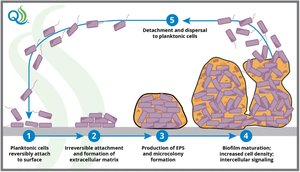
Biofilm Formation: Biofilms are communities of microbes attached to surfaces, protected by a sticky extracellular matrix. They are a major concern in healthcare due to their resistance to antimicrobial treatments and their role in persistent infections.
Stages of Biofilm Formation
Planktonic cells reversibly attach to a surface.
Irreversible attachment and formation of extracellular matrix.
Production of EPS (extracellular polymeric substances) and microcolony formation.
Biofilm maturation: increased cell density and intercellular signaling.
Detachment and dispersal to planktonic cells.
Microbial Growth Curve
Phases of Bacterial Growth
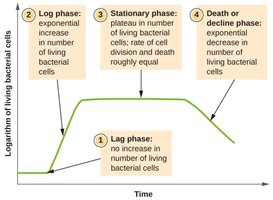
Bacterial populations grown in batch culture exhibit four distinct phases:
Lag Phase: Cells adjust to their environment; no increase in cell number.
Log (Exponential) Phase: Rapid cell division; population increases exponentially.
Stationary Phase: Growth rate slows; cell division and death rates are roughly equal.
Death Phase: Exponential decrease in cell number due to nutrient depletion and waste accumulation.
Environmental Factors Affecting Microbial Growth
Temperature Preferences
Microbes are classified by their optimal temperature ranges:
Psychrophiles: Thrive at −20°C to 10°C (cold environments).
Psychrotrophs: Grow at 0–30°C; associated with foodborne illness.
Mesophiles: Grow best at 10°–50°C; most human pathogens.
Thermophiles: Grow at 40–75°C; found in compost piles and hot springs.
Extreme Thermophiles: Grow at 65–120°C; live in boiling water and volcanic vents.
pH Preferences
Acidophiles: Grow at pH < 5; found in sulfur hot springs and volcanic vents.
Neutralophiles: Grow at pH 5–8; majority of microorganisms, including human pathogens.
Alkaliphiles: Grow at pH 9–11; associated with soda lakes.
Salt and Pressure Preferences
Halophiles: Thrive in high-salt environments (up to 35%).
Facultative Halophiles: Tolerate higher salt but may not grow well.
Barophiles: Prefer high-pressure environments, such as the deep sea.
Oxygen Requirements
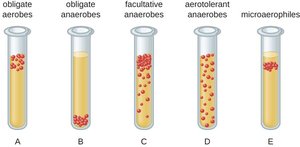
Microbes are classified based on their oxygen requirements:
Obligate Aerobes: Require oxygen for growth.
Obligate Anaerobes: Cannot grow in the presence of oxygen.
Facultative Anaerobes: Grow with or without oxygen, but better with oxygen.
Aerotolerant Anaerobes: Tolerate oxygen but do not use it.
Microaerophiles: Require low levels of oxygen.
Microbial Nutrition and Growth Factors
Essential Nutrients
Macronutrients: Needed in large amounts (e.g., carbon, hydrogen, oxygen, nitrogen).
Micronutrients: Needed in small amounts (e.g., iron, copper, zinc).
Growth Factors: Substances a cell cannot synthesize and must obtain from the environment (e.g., amino acids, vitamins).
Fastidious Organisms: Require multiple growth factors to thrive.
Energy Sources
Phototrophs: Use light energy to make ATP.
Chemotrophs: Break down chemical compounds for energy.
Heterotrophs: Require external organic carbon sources.
Autotrophs: Use carbon fixation to convert CO2 into organic carbon.
Microbial Enumeration and Control
Enumeration Methods
Direct Methods: Plate count (CFU), direct microscopic count, flow cytometry, Coulter counter.
Indirect Methods: Turbidity (spectrophotometry), dry weight, metabolic activity.
Physical and Chemical Control Measures
Sterilization: Eliminates all microbes, including endospores.
Disinfection: Reduces microbial numbers; does not eliminate all microbes.
Decontamination: Removes or reduces microbial populations to render objects safe.
Physical Controls: Heat (autoclaving, boiling, pasteurization), radiation (ionizing and non-ionizing), filtration (HEPA, membrane filters).
Chemical Controls: Germicides (disinfectants, antiseptics), alcohols, phenols, aldehydes, halogens, peroxygens, ethylene oxide.
Resistance of Microbial Forms
Bacterial Endospores: Most resistant to physical and chemical controls.
Prions: Infectious proteins highly resistant to standard sterilization.
Viruses: Envelope viruses are sensitive to heat and detergents; naked viruses are more resistant.
Media Types and Aseptic Techniques
Broth Media: For large batch growth.
Solid Media: For isolating colonies.
Semisolid Media: For motility testing.
Defined Media: Precisely known composition.
Complex Media: Contains complex ingredients; used for fastidious organisms.
Aseptic Techniques: Prevent contamination during sample collection and handling.
Selective and Differential Media
Selective Media: Encourages growth of certain bacteria while suppressing others (e.g., Mannitol Salt Agar, Eosin Methylene Blue Agar).
Differential Media: Allows visual distinction between microbes based on metabolic properties (e.g., Blood Agar).
Summary Table: Microbial Growth Preferences
Term | Meaning |
|---|---|
Psychrophile | Loves cold temperatures, usually 0–15°C |
Psychrotroph | Can grow in the refrigerator but prefers warmer temperatures |
Mesophile | Prefers moderate temperatures, approximately 20–45°C |
Thermophile | Loves hot temperatures, approximately 45–80°C |
Hyperthermophile | Prefers extremely hot temperatures, usually above 80°C |
Acidophile | Prefers acidic conditions, usually below pH 5.5 |
Neutrophile | Prefers near-neutral pH, around 6.5–7.5 |
Alkaliphile | Prefers alkaline conditions, usually above pH 8 |
Halophile | Requires high salt concentrations |
Halotolerant | Can tolerate salt but does not require it |
Barophile (piezophile) | Prefers high-pressure environments |
Obligate aerobe | Requires oxygen |
Obligate anaerobe | Cannot grow in oxygen |
Facultative anaerobe | Grows with or without oxygen |
Aerotolerant anaerobe | Tolerates oxygen but does not use it |
Microaerophile | Requires low oxygen levels |
Key Equations
Generation Time:
Catalase Reaction:
Bacterial Growth Calculation:
Additional info: Academic context and examples were added to clarify and expand brief points, ensuring completeness and self-contained study notes.
