 Indietro
Genetics, Molecular Biology, and Microbial Metabolism: Study Notes for Microbiology
Guida di studio - Note intelligenti
 Appunti personalizzati basati sui tuoi materiali, ampliati con definizioni chiave, esempi e contesto.
Genetic Material and Information Flow
Genome, Chromosome, Gene, Phenotype, and Genotype
The genome is the complete set of genetic material in an organism, primarily found in chromosomes but also in plasmids and organelles like mitochondria and chloroplasts. In cells, genomes are composed of DNA, while viruses may have DNA or RNA genomes. A chromosome is a distinct structure made of tightly packaged DNA. A gene is a segment of DNA on a chromosome that codes for a protein or functional RNA. The genotype is the sum of all genes in an organism, while the phenotype is the observable expression of these genes as traits or functions.
Plasmids: Small, circular DNA molecules found in bacteria, often carrying advantageous genes (e.g., antibiotic resistance).
Genotype vs. Phenotype: Genotype is the genetic code; phenotype is the physical or functional manifestation.
DNA Structure and Replication
DNA is a double-stranded, right-handed helix with a sugar-phosphate backbone and inward-facing nitrogenous bases. The two strands are antiparallel (5' to 3' and 3' to 5'). Base pairing is specific: Adenine (A) pairs with Thymine (T), and Guanine (G) pairs with Cytosine (C). This complementary nature allows DNA to serve as a template for replication.
Semiconservative Replication: Each new DNA molecule contains one original and one new strand.
Replication Fork: The site where DNA is unwound for replication; a target for some antibiotics.
DNA Replication: Steps and Enzymes
DNA replication is a three-step process: initiation, elongation, and termination.
Initiation: Begins at origins; helicase unwinds DNA, forming the replication fork.
Elongation: Primase synthesizes RNA primers; DNA polymerase adds nucleotides (continuous on the leading strand, discontinuous on the lagging strand via Okazaki fragments). DNA polymerase I replaces primers, and ligase seals gaps.
Termination: Forks meet or reach chromosome ends; new strands are proofread for errors.
Central Dogma: DNA to Protein
The central dogma describes the flow of genetic information: DNA is transcribed into RNA, which is then translated into protein. Transcription is the synthesis of RNA from DNA, and translation is the synthesis of proteins from RNA.
Codon: A sequence of three nucleotides in mRNA that codes for an amino acid.
Anticodon: A complementary sequence on tRNA that pairs with the mRNA codon.
Start Codon: AUG (methionine); Stop Codons: UAA, UAG, UGA (signal termination of translation).
Prokaryotic vs. Eukaryotic Transcription and Translation
Prokaryotes: Transcription and translation occur in the cytoplasm; genes are often polycistronic (multiple genes per mRNA); single RNA polymerase.
Eukaryotes: Transcription in the nucleus, translation in the cytoplasm; genes are usually monocistronic; three types of RNA polymerase; more complex regulation.
Genetic Regulation: Operons
Lac Operon (Inducible): Regulates lactose metabolism in E. coli. Operon is off without lactose; on when lactose is present and glucose is absent.
Repressible Operon: Normally on, turned off when the end product is abundant.
Horizontal Gene Transfer
Conjugation: DNA transfer via direct cell contact (e.g., plasmids with antibiotic resistance genes).
Transformation: Uptake of free DNA from the environment by competent cells.
Transduction: DNA transfer by bacteriophages; can be generalized (random DNA) or specialized (specific genes).
Mutations
Silent Mutation: Base change does not alter the amino acid.
Missense Mutation: Base change results in a different amino acid.
Nonsense Mutation: Base change creates a stop codon.
Frameshift Mutation: Insertion or deletion shifts the reading frame.
DNA Technology and Genetic Engineering
Recombinant DNA Technology and Cloning
Recombinant DNA technology involves combining genetic material from different sources to create new genetic combinations. This is achieved by cutting DNA with restriction enzymes, inserting it into vectors (like plasmids), and introducing it into host cells for cloning.
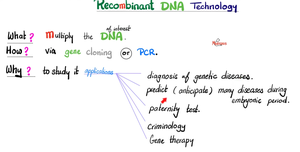
Applications: Diagnosis of genetic diseases, prediction of disease risk, paternity testing, criminology, gene therapy.
Restriction Enzymes and RFLPs
Restriction Endonucleases: Enzymes that cut DNA at specific palindromic sequences; used in genetic engineering and mapping.
Restriction Fragment Length Polymorphisms (RFLPs): Variations in DNA fragment lengths after enzyme digestion; used in DNA fingerprinting, genome mapping, and diagnostics.
Polymerase Chain Reaction (PCR)
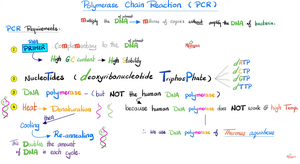
PCR is a technique to amplify specific DNA sequences, enabling detection and analysis of minute DNA amounts. It requires primers, nucleotides, DNA polymerase (from thermophilic organisms), and thermal cycling (denaturation, annealing, extension).
Applications: Disease diagnosis, forensic analysis, genetic research.
DNA Gel Electrophoresis
Separates DNA fragments by size using an electric field in agarose gel.
Smaller fragments move faster toward the positive pole due to DNA's negative charge.
Used for DNA analysis, fingerprinting, and checking PCR products.
Whole Genome Sequencing (WGS)
Genome is fragmented, cloned, and sequenced to provide a complete genetic blueprint.
Applications include disease risk assessment, ancestry analysis, and personalized medicine.
Gene Therapy and Gene Editing (CRISPR)
Gene therapy introduces normal genes into cells to correct genetic defects, often using viral vectors. Gene editing (e.g., CRISPR-Cas9) allows precise modification of DNA sequences at specific locations.
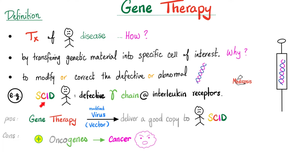
Applications: Treatment of genetic diseases, research, and potential permanent correction of inherited disorders.
Microbial Nutrition and Growth
Essential Nutrients
Macronutrients: Required in large amounts (e.g., CHONPS: Carbon, Hydrogen, Oxygen, Nitrogen, Phosphorus, Sulfur).
Micronutrients: Needed in trace amounts; important for enzyme function and protein structure.
Transport Mechanisms
Osmosis: Water movement across membranes from high to low water concentration.
Diffusion: Movement of molecules from high to low concentration.
Facilitated Diffusion: Transport via membrane proteins; subject to saturation and competition.
Active Transport: Movement against concentration gradient using energy and membrane proteins.
Associations Between Organisms
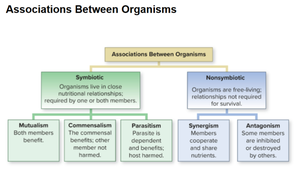
Microorganisms interact in various ways, classified as symbiotic (mutualism, commensalism, parasitism) or nonsymbiotic (synergism, antagonism).
Oxygen Relationships and Enzymes
Aerobes: Require oxygen; possess enzymes like catalase and superoxide dismutase to detoxify reactive oxygen species (ROS).
Anaerobes: Cannot survive in oxygen; lack ROS-detoxifying enzymes.
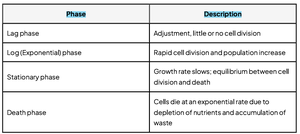
Microbial Growth Curve
Bacterial populations grow in distinct phases: lag, log (exponential), stationary, and death.
Phase | Description |
|---|---|
Lag phase | Adjustment, little or no cell division |
Log (Exponential) phase | Rapid cell division and population increase |
Stationary phase | Growth rate slows; equilibrium between cell division and death |
Death phase | Cells die at an exponential rate due to depletion of nutrients and accumulation of waste |
Microbial Metabolism
Catalysts and Enzyme Regulation
Catalysts: Speed up chemical reactions without being consumed.
Enzyme Regulation: Achieved via inhibitors, activators, allosteric regulation, feedback inhibition, and environmental factors (pH, temperature).
Catabolism: Aerobic Respiration, Anaerobic Respiration, and Fermentation
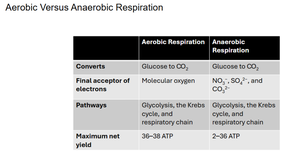
Aerobic Respiration: Uses oxygen as the final electron acceptor; yields up to 38 ATP per glucose; main pathway for energy in most organisms.
Anaerobic Respiration: Uses alternative electron acceptors (e.g., nitrate, sulfate); yields less ATP.
Fermentation: Incomplete oxidation of glucose without oxygen; yields small amounts of ATP; uses organic compounds as electron acceptors.
Aerobic Respiration | Anaerobic Respiration | |
|---|---|---|
Converts | Glucose to CO2 | Glucose to CO2 |
Final acceptor of electrons | Molecular oxygen | NO3-, SO42-, CO32- |
Pathways | Glycolysis, Krebs cycle, respiratory chain | Glycolysis, Krebs cycle, respiratory chain |
Maximum net yield | 36–38 ATP | 2–36 ATP |
Glycolysis, Krebs Cycle, and Electron Transport Chain
Glycolysis: Converts glucose to pyruvic acid; net gain of 2 ATP and 2 NADH; occurs in the cytoplasm and does not require oxygen.
Krebs Cycle: Central metabolic pathway in mitochondria (eukaryotes); produces NADH and FADH2 for the electron transport chain.
Electron Transport Chain: Series of proteins in the membrane that transfer electrons, generating a proton gradient for ATP synthesis.
Quiz Review: Key Concepts
Phenotype: Observable traits; genotype is the genetic code.
Single Nucleotide Polymorphisms (SNPs): DNA sequence variations involving one base pair.
Silent Mutation: Base change does not alter the amino acid sequence.
tRNA: Transfers amino acids to ribosomes during protein synthesis.
Osmosis: In a hypertonic environment, cells lose water.
Gel Electrophoresis: DNA fragments move toward the positive pole; smaller fragments move faster.
Inducible Operons: Not turned off by end product buildup (repressible operons are).
Nucleotide Structure: One phosphate, one sugar, one nitrogenous base.
Saprobe vs. Parasite: Saprobes feed on dead matter; parasites feed on living hosts.
