 Indietro
Genetics of Bacteria and Archaea: Mutation, Recombination, and Gene Transfer
Guida di studio - Note intelligenti
 Appunti personalizzati basati sui tuoi materiali, ampliati con definizioni chiave, esempi e contesto.
Genetics of Bacteria and Archaea
Mutation, Recombination, and Gene Transfer
This chapter explores the mechanisms by which genetic variation arises and spreads in bacteria and archaea, focusing on mutation, recombination, and horizontal gene transfer. These processes are central to microbial evolution, adaptation, and the spread of traits such as antibiotic resistance.
Mutations in Bacteria and Archaea
Types and Causes of Mutations
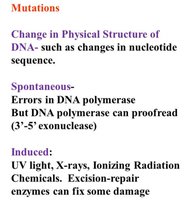
Mutations are heritable changes in the DNA sequence that can affect gene function. They may occur spontaneously or be induced by external factors.
Spontaneous Mutations: Result from errors during DNA replication. DNA polymerase has proofreading (3'→5' exonuclease) activity that corrects most errors.
Induced Mutations: Caused by mutagens such as UV light, X-rays, ionizing radiation, and chemicals. Excision-repair enzymes can fix some damage.
Mutagenic Agents
Mutagens can be classified by their mechanisms:
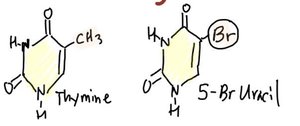
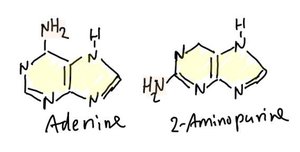
Base Analogs: Chemicals that resemble normal DNA bases and can be incorporated during replication, leading to mispairing.
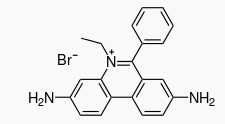
Intercalating Agents: Molecules that insert between DNA base pairs, causing insertions or deletions during replication (e.g., ethidium bromide).
Ethidium Bromide (figure 3)-conjugated C=C bonds-fluoresce: is used to stain DNA, it is a mutagen because it slips in to staked bases and can cause deletion of nucleotide that leads to frameshift mutation (see definition below) (firgure 4)
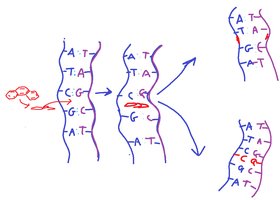
Types of Mutations and Their Effects (slides 4&5)
Synonymous (Silent) Mutation: Alters a codon but does not change the encoded amino acid. (no effect on protein)
Missense Mutation: Changes a codon, resulting in a different amino acid (effect varies).
Nonsense Mutation: Converts a codon to a stop codon, truncating the protein.
Frameshift Mutation: Addition or deletion of nucleotides shifts the reading frame, often garbling the protein product.
DNA Repair Mechanisms (slide 6)
In bacteria, most mutations result in a lack of base-pairing. Bacteria possess several systems to repair DNA damage:
Proofreading by DNA Polymerase: 3'→5' exonuclease activities of DNA polymerase III and I correct most replication errors. Low error rate.
SOS Response: Activated by severe DNA damage (usually happens when both strands are damaged in DNA; involves DNA polymerases IV and V, which have higher error rates but allow survival.
Genetic Recombination
Homologous Recombination (slide 7)
Homologous recombination is the exchange of genetic material between similar or identical DNA molecules, mediated by the RecA protein. It is essential for DNA repair and genetic diversity. It also helps repair damaged chromosomes. All living cells.
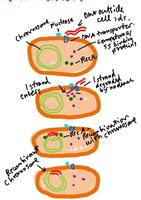
RecA: Facilitates strand invasion and exchange during recombination and transformation.
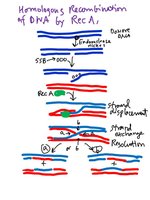
Plasmids and Mobile Genetic Elements
Plasmids (slide8)
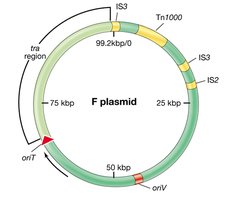
Plasmids are extrachromosomal, circular DNA molecules with their own origin of replication. They often carry genes for antibiotic resistance, virulence, or metabolic functions. tra for transfer and oriT for origin of conjugative transfer
R100 Plasmid: A well-studied plasmid in Escherichia coli carrying multiple resistance genes (e.g., mer (mercuric ion resistance), sul (sulfonamide resistance), str (streptomycin resistance), cat (chloramphenicol resistance), tet(tetracycline resistance)).
Plasmids can be self-transmissible (carry all genes for conjugation) or mobilizable (require help from other plasmids).
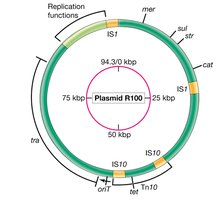
Gene Transfer Mechanisms
Vertical vs. Horizontal Gene Transfer (slide 9)
Genes can be inherited vertically (parent to offspring) or horizontally (between unrelated cells).
Vertical Gene Transfer: Normal inheritance during cell division.
Horizontal Gene Transfer (HGT): Transfer of genetic material between cells by transformation, conjugation, or transduction.
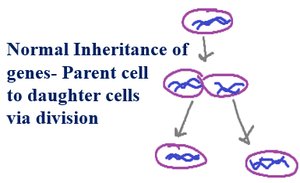
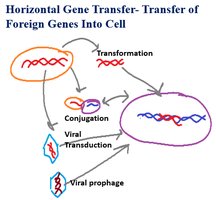
Transformation (slide 10-12)
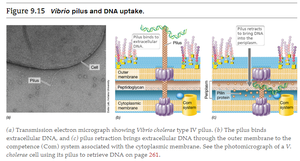
Transformation is the uptake of free DNA from the environment by a competent cell, which may then recombine with the chromosome. Most bacteria are not naturally competent but can be induced to take up DNA.
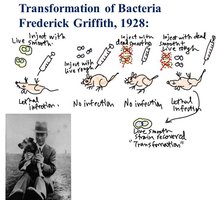
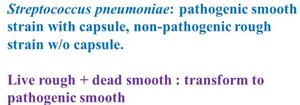
Historical Example: Frederick Griffith's 1928 experiment demonstrated transformation in Streptococcus pneumoniae.
Competence: The physiological state allowing DNA uptake, often regulated and involving specific proteins.
Conjugation (slide 13-17)
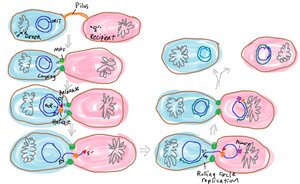
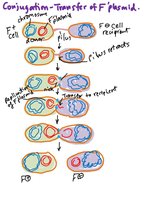
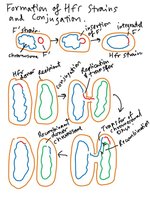
Conjugation is the direct transfer of DNA (usually plasmids) from a donor to a recipient cell via cell-to-cell contact, mediated by a pilus and a type IV secretion system.
F Plasmid: The fertility plasmid in E. coli encodes all genes required for conjugation.
Hfr Strains: Formed when the F plasmid integrates into the chromosome, allowing transfer of chromosomal genes during conjugation.
Transduction (slide 18-19)
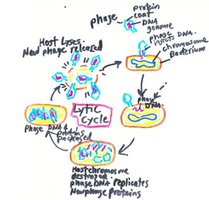
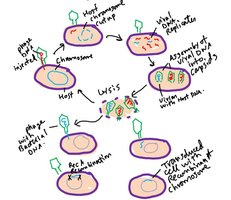
Transduction is the transfer of bacterial DNA by bacteriophages (viruses that infect bacteria). There are two main types:
Generalized Transduction: Any bacterial gene can be transferred when a lytic phage mistakenly packages host DNA.
Specialized Transduction: Only specific genes near the prophage insertion site are transferred by temperate phages.
Transposons and Mobile DNA
Transposons (slide 20)
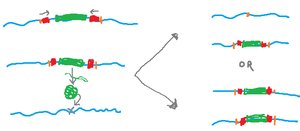
Transposons are DNA elements that can move within and between genomes, often carrying antibiotic resistance or other genes. They encode a transposase enzyme and are flanked by inverted repeats.
Insertion Sequences (IS): Simple transposons carrying only the transposase gene.
Compound Transposons: Two IS elements flanking additional genes, allowing movement as a unit.
Applications of Transposons
Transposons can disrupt genes, creating mutations for research.
Used to generate random mutant libraries for functional genomics.
Complementation and Gene Function
Complementation in Trans
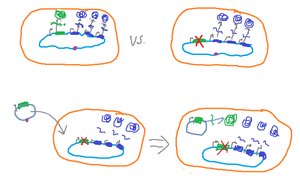
Mutations in protein-coding genes can be complemented by introducing a wild-type gene on a plasmid. This restores function if the mutation is not in regulatory regions (promoters/operators).
Gene Evolution and Horizontal Gene Transfer Detection
Orthologs and Paralogs
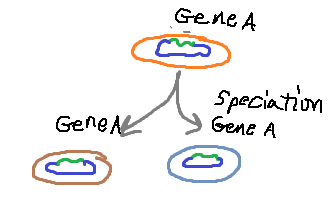
Orthologs: Genes in different species with the same function, derived from a common ancestor.
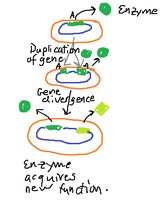
Paralogs: Genes related by duplication within a genome, which may evolve new functions.
Detection of Horizontal Gene Transfer
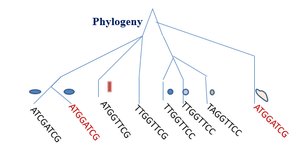
HGT can be inferred when genes in distantly related organisms show unusually high sequence similarity, suggesting recent transfer.
Summary Table: Key Mechanisms of Genetic Change in Bacteria
Mechanism | Description | Key Proteins/Elements | Example/Outcome |
|---|---|---|---|
Mutation | Change in DNA sequence | DNA Pol III/I, SOS system | Antibiotic resistance, metabolic changes |
Transformation | Uptake of free DNA | Competence proteins, RecA | Acquisition of new traits |
Conjugation | Direct DNA transfer via pilus | F plasmid, pilus, relaxase | Spread of plasmids |
Transduction | DNA transfer by phage | Bacteriophage, RecA | Gene transfer between strains |
Transposition | Movement of DNA elements | Transposase, IS elements | Gene disruption, resistance spread |
Discussion Questions
What systems can repair damage to DNA in bacteria? Which one is used as a last resort, and how is it regulated?
Give examples of four kinds of important plasmids. What genes are frequently carried on plasmids, and what genera of bacteria are they found in?
How do Hfr strains in E. coli arise? How do they differ from F+ or F- strains?
How was conjugation between an Hfr strain and F- strain used to create a map of the E. coli chromosome long before genome sequencing?
Describe some of the structures and proteins needed for transformation.
Describe some of the structures and proteins needed for conjugation.
Describe gene transfer by generalized transduction in bacteria.
How can conjugation or transformation be used to create a deletion mutant in one gene?
What are insertion elements and compound transposons in bacteria?
How can transposons be used to create a collection of random mutations of genes in a bacterium?
