 Indietro
Host-Microbe Interactions, Pathogenesis, and Infectious Disease Epidemiology
Guida di studio - Note intelligenti
 Appunti personalizzati basati sui tuoi materiali, ampliati con definizioni chiave, esempi e contesto.
Host-Microbe Interactions and Pathogenesis
Types of Symbiotic Relationships
Microorganisms interact with their hosts in various ways, forming close associations known as symbiotic relationships. These relationships can be classified as follows:
Parasitism: The microbe benefits while the host is harmed. Many pathogens are parasites.
Mutualism: Both the microbe and the host benefit from the relationship. For example, some gut bacteria synthesize vitamins for the host.
Commensalism: The microbe benefits, but the host is neither helped nor harmed.
Normal microbiota (also called normal flora or indigenous microbiota) are the microbes that colonize body surfaces without causing disease under normal conditions. They are divided into:
Resident microbiota: Remain with the host throughout life; most are commensal.
Transient microbiota: Present for short periods; do not persist due to competition, immune responses, or physical/chemical changes in the body.
Normal microbiota can become opportunistic pathogens if the host's defenses are compromised, if they enter sterile sites, or if the microbial balance is disrupted.
Principles of Infectious Disease and Epidemiology
Definitions and Terminology
Infectious disease: Illness caused by a pathogen (virus, bacteria, prion, protozoa, helminth, or fungus).
Opportunistic pathogens: Cause disease only when the host is weakened.
True pathogens: Can cause disease in healthy hosts.
Zoonotic diseases: Spread from animals to humans.
Noncommunicable diseases: Do not spread from person to person.
Communicable diseases: Can be transmitted between individuals.
Signs: Objective, measurable indicators of disease (e.g., fever, heart rate).
Symptoms: Subjective experiences reported by the patient (e.g., pain, fatigue).
Koch's Postulates
Koch's postulates are a set of criteria used to establish a causative relationship between a microbe and a disease:
The same organism must be present in every case of the disease.
The organism must be isolated from the diseased host and grown as a pure culture.
The isolated organism should cause the disease when introduced into a susceptible host.
The organism must then be re-isolated from the inoculated, diseased host.
Sources, Reservoirs, and Transmission
Reservoir: The natural habitat where a pathogen is found (e.g., soil, water, animals, humans).
Source: The immediate origin from which a pathogen is transmitted to a host (e.g., contaminated food, water, infected individuals).
The reservoir and source are not always the same.
Modes of transmission include:
Direct contact: Person-to-person, animal, environmental, or vertical (mother to child).
Indirect contact: Airborne, vehicle (food, water, fomites), or vector (insects).
Stages of Infectious Disease
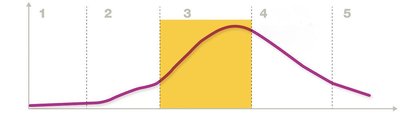
Infectious diseases progress through several stages, which can be visualized on a graph of pathogen load or symptom severity over time:
Incubation period: Time between exposure and onset of symptoms.
Prodromal phase: Early, mild symptoms appear.
Acute phase: Disease is at its peak; most severe signs and symptoms.
Period of decline: Symptoms subside as the immune system overcomes the pathogen.
Convalescent phase: Recovery and return to health.
Pathogenicity, Virulence, and Virulence Factors
Definitions
Pathogenicity: The ability of a microbe to cause disease.
Virulence: The degree or severity of disease caused by a pathogen.
Virulence factors: Molecules or structures that enable pathogens to cause disease, evade the immune system, and acquire nutrients.
Major Groups of Virulence Factors
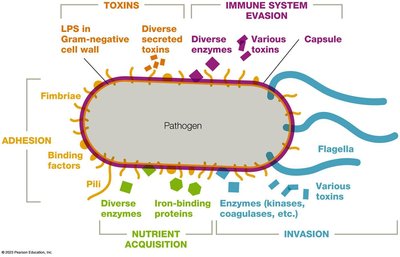
According to Figure 10.2, the five major groups of virulence factors are:
Adhesion: Structures like fimbriae, pili, and binding factors that help pathogens attach to host cells.
Invasion: Enzymes (e.g., kinases, coagulases) and toxins that help pathogens invade tissues.
Nutrient acquisition: Enzymes and proteins (e.g., iron-binding proteins) that help pathogens obtain nutrients from the host.
Toxins: Molecules such as LPS (lipopolysaccharide) in Gram-negative bacteria and secreted exotoxins that damage host cells.
Immune system evasion: Capsules, enzymes, and antigenic variation that help pathogens avoid detection and destruction by the host immune system.
Five Steps to Infection
Pathogens must complete five key steps to establish infection and cause disease:
Entry: Pathogens enter the host through specific portals of entry (e.g., skin, mucous membranes).
Adherence: Pathogens use adhesins (e.g., fimbriae, pili, binding factors) to attach to host cells.
Invasion and nutrient acquisition: Pathogens produce invasins (enzymes) and toxins to invade tissues and acquire nutrients.
Evasion of host immune defenses: Pathogens avoid immune detection by hiding, antigenic variation, or interfering with immune responses.
Transmission: Pathogens exit the host through specific portals of exit to infect new hosts.
Healthcare-Associated Infections (HAIs)
Healthcare-associated infections (HAIs) are diseases acquired as a result of healthcare interventions. They can be transmitted by direct or indirect contact. The five most common HAIs are:
Staphylococcus aureus
Escherichia coli
Clostridioides difficile
Pseudomonas aeruginosa
Prevention strategies include surveillance, prevention, and control programs.
Application Questions and Examples
Vector example: A mosquito that transmits a virus from an animal to a human is the vector.
Opportunistic infection example: A menopausal woman may develop gingivitis from normal microbiota due to hormonal changes, reduced saliva, and weakened local immunity.
Pathogen in sterile site: E. coli can cause fatal infection if it enters sterile body sites (e.g., after intestinal puncture).
Adhesin mutation: Loss of adhesin genes in E. coli reduces its ability to attach to urinary tract cells, decreasing its capacity to cause infection.
