 Indietro
Introduction and Early History of Microbiology: Foundations and Key Discoveries
Guida di studio - Note intelligenti
 Appunti personalizzati basati sui tuoi materiali, ampliati con definizioni chiave, esempi e contesto.
Medical Microbiology Introduction
Microorganisms in Nature and Society
Microorganisms (m.o.) are ubiquitous and play essential roles in various biological and industrial processes. They are both beneficial and harmful, impacting plants, animals, ecosystems, and human industries.
Plants require microorganisms to obtain nitrogen through processes such as nitrogen fixation.
Animals depend on microorganisms for digestion, especially in the gut.
Ecosystems rely on microorganisms to degrade waste and recycle nutrients.
Industrial applications include the production of wine, cheese, vaccines, and antibiotics.
Microorganisms can cause diseases but are also crucial for health and biotechnology.
The Early Years of Microbiology
Discovery of Microorganisms
The field of microbiology began with the careful observations of microscopic organisms by early scientists. Antoni van Leeuwenhoek, a Dutch merchant, was the first to visualize and document tiny organisms, which he called "animalcules." His work laid the foundation for the study of microorganisms.
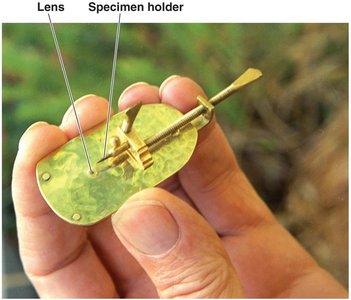
Antoni van Leeuwenhoek made and used simple microscopes, often creating a new microscope for each specimen.
He examined water and observed tiny animals, fungi, algae, and single-celled protozoa.
By the end of the 19th century, these organisms were collectively termed microorganisms.

Leeuwenhoek's Microscope
Leeuwenhoek's microscope was a simple device with a convex lens about the size of a pinhead and a small glass tube as the specimen holder. This innovation allowed him to observe microorganisms for the first time.
Classification of Microorganisms
Carolus Linnaeus developed a taxonomic system for naming and grouping organisms. Leeuwenhoek’s microorganisms were classified into six categories:
Fungi (eukaryotic cells)
Protozoa
Algae
Bacteria
Archaea
Small multicellular animals
Fungi
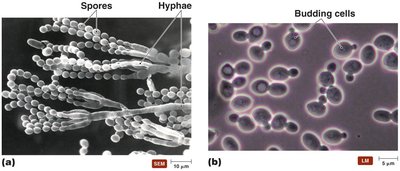
Fungi are eukaryotic organisms that obtain food from other organisms and possess cell walls. They exist in both single and multiple cell forms:
Molds: Multicellular, grow as long filaments (hyphae), reproduce by sexual and asexual spores.
Yeasts: Unicellular, reproduce asexually by budding, some produce sexual spores.
Protozoa
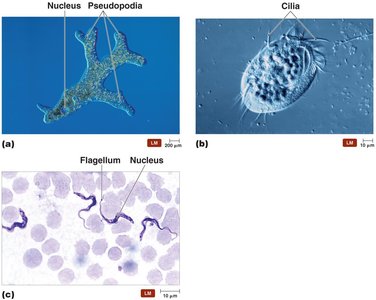
Protozoa are single-celled eukaryotes similar to animals in nutrient needs and cellular structure. Most live freely in water, some in animal hosts, and reproduce both asexually and sexually. They are capable of locomotion by various structures:
Pseudopodia: Cell extensions that flow in the direction of travel.
Cilia: Numerous, short protrusions that propel organisms.
Flagella: Fewer, longer, and more whiplike extensions than cilia.
Algae
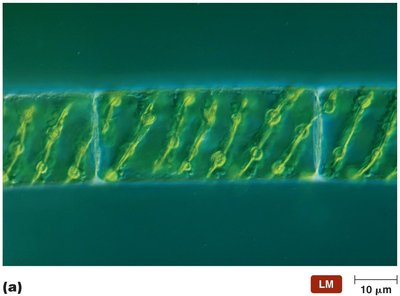
Algae are unicellular or multicellular, photosynthetic organisms with simple reproductive structures. They are categorized based on pigmentation, storage products, and cell wall composition.
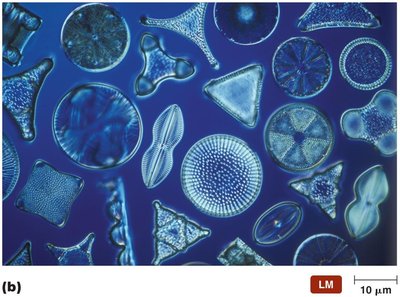
Examples: Spirogyra (filamentous green algae), diatoms (unicellular algae with silica cell walls).
Bacteria and Archaea
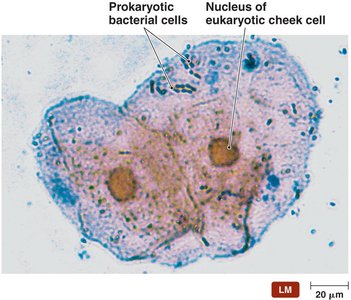
Bacteria and archaea are unicellular organisms lacking nuclei and are much smaller than eukaryotes. They are found everywhere with sufficient moisture and reproduce asexually.
Bacteria: Cell walls contain peptidoglycan; some lack cell walls.
Archaea: Cell walls composed of polymers other than peptidoglycan.
Other Organisms: Parasitic Worms and Viruses
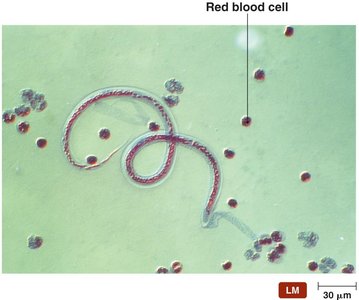
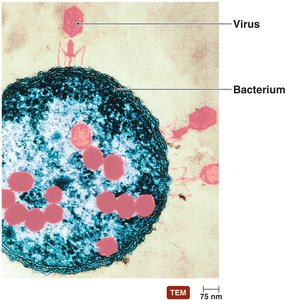
Parasitic worms (helminths) range from microscopic to several meters in length. Viruses are acellular entities that infect bacteria and other organisms.
The Golden Age of Microbiology
Spontaneous Generation Debate
After Leeuwenhoek, the study of microbiology slowed due to limited access to microscopes. The theory of spontaneous generation (abiogenesis) stated that microorganisms arise from non-living matter. This theory was debated for centuries.
Aristotle proposed spontaneous generation, accepted for 2000 years.
Redi’s Experiments
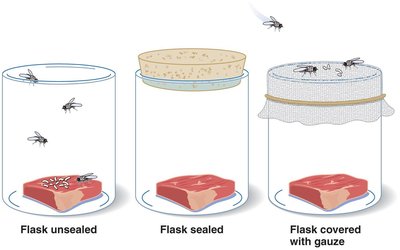
Francesco Redi conducted experiments in 1668 to disprove spontaneous generation. He showed that maggots only appeared in uncovered jars of decaying meat, not in sealed or gauze-covered jars.
Needham and Spallanzani’s Experiments
John Needham advanced spontaneous generation with broth experiments, but results were inconsistent due to improper sealing. Lazzaro Spallanzani concluded that boiled broth would not give rise to life if properly sealed, suggesting microorganisms exist in air and can contaminate experiments.
Pasteur’s Experiments
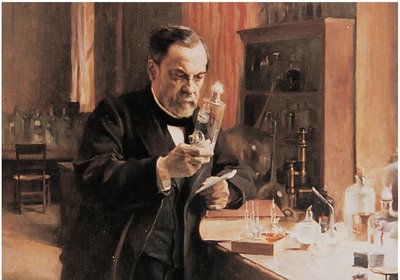
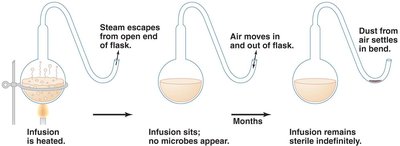
Louis Pasteur’s experiments with "swan-necked" flasks definitively disproved spontaneous generation. When flasks remained upright, no microbial growth appeared; tilting the flask allowed dust and microbes to enter, causing growth.
The Scientific Method
The debate over spontaneous generation led to the development of the scientific method, a systematic approach to inquiry:
Observation leads to a question.
Question generates a hypothesis.
Hypothesis is tested through experiments.
Results prove or disprove the hypothesis.
Accepted hypotheses lead to theories or laws; rejected hypotheses are modified.

Fermentation and Industrial Microbiology
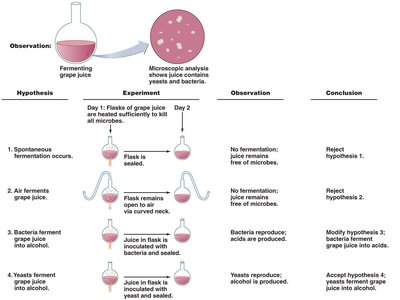
Pasteur and Buchner’s work on fermentation established the field of industrial microbiology. Microbes are intentionally manipulated to manufacture products such as alcohol, cheese, and bread. Buchner demonstrated the presence of enzymes, beginning the study of biochemistry and metabolism.
Industrial Uses of Microbes
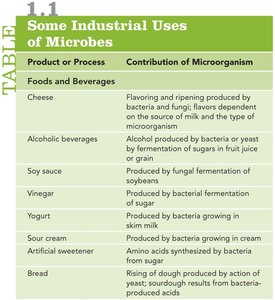
Microorganisms contribute to the production of various foods and beverages:
Product or Process | Contribution of Microorganism |
|---|---|
Cheese | Flavoring and ripening produced by bacteria and fungi |
Alcoholic beverages | Alcohol produced by bacteria or yeast by fermentation of sugars |
Soy sauce | Produced by fungal fermentation of soybeans |
Vinegar | Produced by bacterial fermentation of sugar |
Yogurt | Produced by bacteria growing in skim milk |
Sour cream | Produced by bacteria growing in cream |
Artificial sweetener | Amino acids synthesized by bacteria from sugar |
Bread | Rising of dough produced by action of yeast; sourdough results from bacteria-produced acids |
Germ Theory of Disease
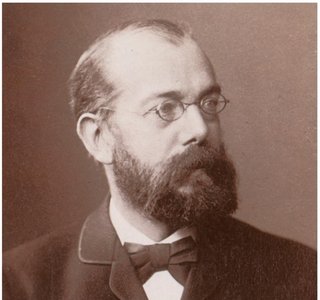
Pasteur developed the germ theory of disease, proposing that microorganisms are responsible for disease. Robert Koch studied causative agents of disease and published work on tuberculosis. Microorganisms that cause specific diseases are called pathogens.
Koch’s Contributions
Simple staining techniques
First photomicrograph of bacteria
Techniques for estimating CFU/ml
Use of steam to sterilize media
Use of Petri dishes
Techniques to transfer bacteria
Bacteria as distinct species
Koch’s Postulates
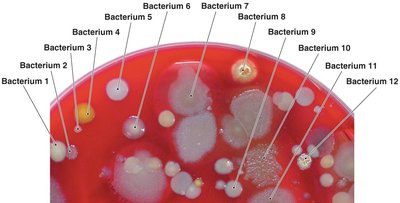
Koch established four postulates to identify the causative agent of a disease:
Suspected causative agent must be found in every case of the disease and be absent from healthy hosts.
Agent must be isolated and grown outside the host.
When agent is introduced into a healthy, susceptible host, the host must get the disease.
Same agent must be found in the diseased experimental host.
Notable Scientists and Disease Agents
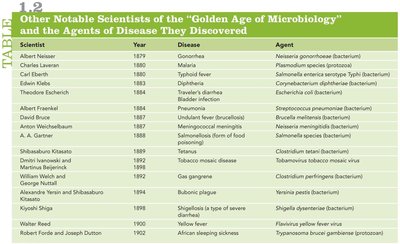
Scientist | Year | Disease | Agent |
|---|---|---|---|
Albert Neisser | 1879 | Gonorrhea | Neisseria gonorrhoeae (bacterium) |
Charles Laveran | 1880 | Malaria | Plasmodium species (protozoan) |
Carl Eberth | 1880 | Typhoid fever | Salmonella enterica Typhi (bacterium) |
Edwin Klebs | 1883 | Diphtheria | Corynebacterium diphtheriae (bacterium) |
Theodore Escherich | 1885 | Traveler's diarrhea | Escherichia coli (bacterium) |
Albert Fraenkel | 1886 | Pneumonia | Streptococcus pneumoniae (bacterium) |
Anton Weichselbaum | 1887 | Bacterial meningitis | Neisseria meningitidis (bacterium) |
A. G. Gern | 1888 | Salmonellosis (form of food poisoning) | Salmonella species (bacterium) |
Dmitri Ivanowski and Martinus Beijerinck | 1892 | Tobacco mosaic disease | Tobacco mosaic virus |
Shibasaburo Kitasato and Emil von Behring | 1894 | Diphtheria | Corynebacterium diphtheriae (bacterium) |
Kiyoshi Shiga | 1898 | Shigellosis (a type of severe diarrhea) | Shigella dysenteriae (bacterium) |
Robert Forde and Joseph Dutton | 1902 | African sleeping sickness | Trypanosoma brucei gambiense (protozoan) |
Gram Staining
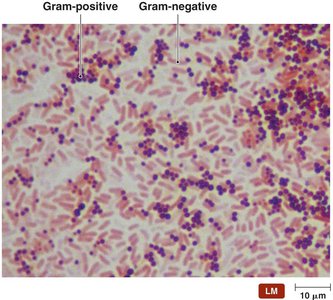
Gram staining is a technique developed to differentiate bacteria into two groups: Gram-positive and Gram-negative, based on their cell wall composition.
Preventing Infection and Disease
Several scientists contributed to methods for preventing infection and disease:
Semmelweis: Promoted handwashing to reduce mortality from puerperal fever.
Lister: Developed antiseptic techniques using phenol.
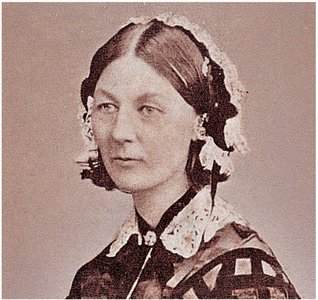
Nightingale: Advanced nursing and hygiene practices.
Snow: Pioneered infection control and epidemiology, notably in cholera outbreaks.
Jenner: Developed the first vaccine, founding immunology.
Ehrlich: Introduced "magic bullets" in chemotherapy.
The Modern Age of Microbiology
Biochemistry and Metabolism
Biochemistry, the study of metabolism, began with Pasteur’s work on fermentation and Buchner’s discovery of enzymes. Microbes serve as model systems for biochemical reactions shared by all living things.
Applications include herbicide and pesticide design, diagnosis and monitoring of illnesses, treatment of metabolic diseases, and drug design.
Microbial Genetics and Molecular Biology
Microbial genetics and molecular biology explore how genes work and how genetic information is translated into protein function. Key discoveries include:
Avery, MacLeod, and McCarty: Genes are contained in DNA.
Beadle and Tatum: Gene activity is related to protein function.
Pauling: Gene sequences reveal evolutionary relationships.
Woese: Cells belong to bacteria, archaea, or eukaryotes.
Recombinant DNA Technology and Gene Therapy
Recombinant DNA technology involves manipulating genes in microbes, plants, and animals for practical applications, such as producing human blood-clotting factors in E. coli. Gene therapy aims to insert or repair genes in humans by introducing desired genes into host cells.
Microorganisms in the Environment
Microorganisms play vital roles in environmental processes:
Bioremediation: Uses living bacteria, fungi, and algae to detoxify polluted environments.
Recycling: Microbes recycle chemicals such as carbon, nitrogen, and sulfur.
Defending Against Disease
Modern microbiology includes the study of serology, immunology, and chemotherapy:
Serology: Study of blood serum and its role in fighting infection.
Immunology: Study of the body’s defense against specific pathogens.
Chemotherapy: Discovery of antibiotics (e.g., penicillin by Fleming) and sulfa drugs (by Domagk).
Future Directions in Microbiology
Microbiology is an ever-evolving field, built on asking and answering questions. As more questions are answered, new ones arise, driving further research and discovery.
