 Indietro
Introduction to Microbiology: History, Classification, and Importance
Guida di studio - Note intelligenti
 Appunti personalizzati basati sui tuoi materiali, ampliati con definizioni chiave, esempi e contesto.
Ch. 1 - A Brief History of Microbiology
What is Microbiology?
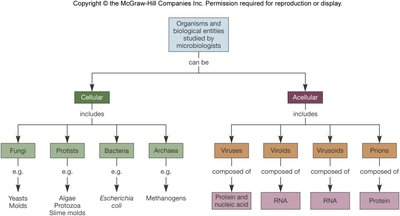
Microbiology is the scientific study of microorganisms, which are organisms too small to be seen with the naked eye. This field encompasses both cellular and acellular entities, including bacteria, archaea, fungi, protozoa, algae, viruses, viroids, virusoids, and prions.
Cellular organisms: Bacteria, Archaea, Fungi, Protozoa, Algae, and helminth larvae.
Acellular entities: Viruses, Viroids, Virusoids, and Prions.
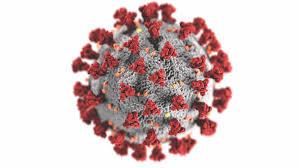
Example: The SARS-CoV-2 virus, responsible for COVID-19, is an acellular entity studied in microbiology.
Classification Schemes
Microorganisms are classified into three domains based on ribosomal RNA gene sequences:
Bacteria: Prokaryotic, usually single-celled, cell wall with peptidoglycan, no nucleus.
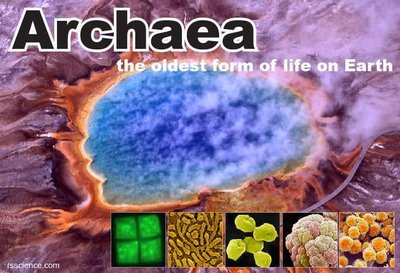
Archaea: Prokaryotic, unique rRNA sequences, lack peptidoglycan, unique membrane lipids, often extremophiles.
Eukarya: Eukaryotic, includes protists, fungi, algae, and protozoa.
Acellular infectious agents are not classified by this system and include viruses, viroids, virusoids, and prions.
Aspects and Importance of Microbiology
Microbiology investigates the biochemistry, morphology, physiology, genetics, ecology, and evolution of microorganisms. It is divided into basic science (understanding life processes) and applied science (benefiting humans in medicine, agriculture, and industry).
Microorganisms: Oldest form of life, found everywhere, major contributors to biogeochemical cycles, essential for other life forms.
Human impact: Cause diseases, decomposition, deterioration of materials, production of useful products, bioremediation, and food/beverage production.
Example: Microbes are responsible for most infectious diseases and play a crucial role in environmental processes.
Characteristics of Life
All living organisms share certain characteristics:
Composed of one or more cells
Highly organized
Respond to environmental changes
Grow and develop
Adapt and evolve
Require and use energy
Undergo metabolism
Regulation and homeostasis
Reproduction
The Science of Microbiology
Microbiology seeks to describe and explain the world of microorganisms, identifying patterns of cause and effect. Early observations of microbes preceded the understanding of their roles in disease and food spoilage.
Ch. 1 - A Brief History of Microbiology
Discovery of Microorganisms
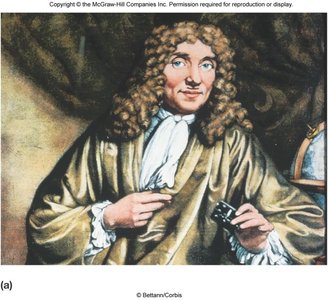
Antony van Leeuwenhoek (1632-1723) was the first to observe and accurately describe microorganisms using a simple microscope.
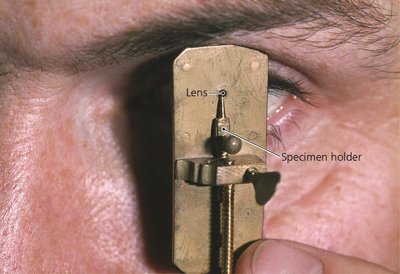
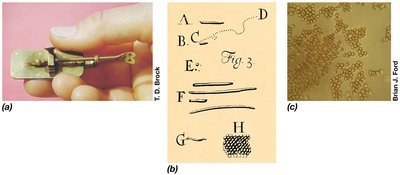
Example: Leeuwenhoek's observations laid the foundation for microbiology as a scientific discipline.
The Golden Age of Microbiology
During the mid-1800s to early 1900s, scientists addressed key questions:
Is spontaneous generation of microbial life possible?
What causes fermentation?
What causes disease?
How can we prevent infection and disease?
The Conflict over Spontaneous Generation
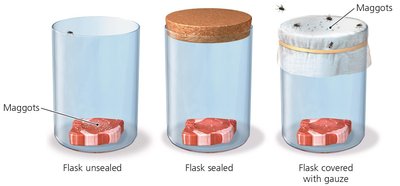
Spontaneous generation was the belief that living organisms could arise from nonliving matter. Francesco Redi (1626-1697) disproved this for macroscopic organisms by showing that maggots on decaying meat came from fly eggs.
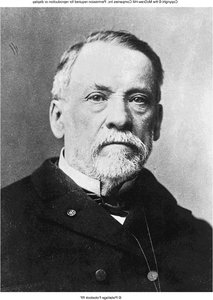
Louis Pasteur and the Disproof of Spontaneous Generation
Louis Pasteur (1822-1895) conducted experiments with swan-necked flasks, demonstrating that microorganisms do not spontaneously generate but come from the environment.
Pasteur's experiments:
Placed nutrient solution in flasks with long, curved necks
Boiled the solutions
Left flasks exposed to air
No growth occurred unless dust entered the flask
Pasteur also:
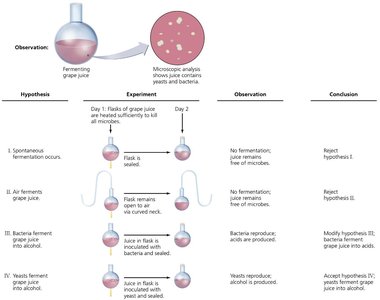
Demonstrated that fermentation is caused by microbial activity
Developed pasteurization
Created vaccines for several diseases
The Germ Theory of Disease
Pasteur developed the Germ Theory, proposing that certain diseases are caused by microorganisms. Establishing this required new techniques for studying microbes.
Agostini Bassi: Disease of silkworms caused by fungus
M. J. Berkeley: Potato blight caused by water mold
Heinrich de Bary: Smut and rust fungi cause cereal crop diseases
Louis Pasteur: Silkworm disease caused by protozoan
Robert Koch and Koch's Postulates
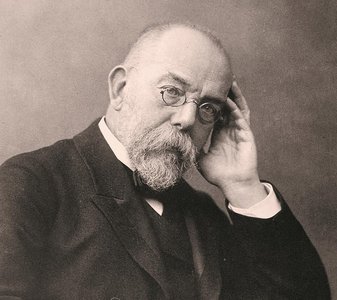
Robert Koch (1843-1910) established the relationship between specific microorganisms and diseases, such as Bacillus anthracis and anthrax, and Mycobacterium tuberculosis and tuberculosis. He developed Koch's postulates to link pathogens to diseases.
Koch's Postulates:
The suspected microorganism must be present in every case of the disease but absent from healthy individuals.
The suspected microorganism must be isolated and grown in pure culture.
The same disease must result when the isolated microorganism is inoculated into a healthy host.
The same microorganism must be isolated again from the diseased host.
Limitations: Some organisms cannot be grown in pure culture, and it is unethical to use humans for certain experiments.
Other contributions by Koch: Developed agar, petri dish, nutrient broth/agar, isolation methods, and staining techniques.
Fields of Microbiology
Microbiology is divided into several disciplines:
Discipline | Subject(s) of Study |
|---|---|
Bacteriology | Bacteria and archaea |
Phycology | Algae |
Mycology | Fungi |
Protozoology | Protozoa |
Parasitology | Parasitic protozoa and animals |
Virology | Viruses |
Microbial metabolism | Biochemistry: chemical reactions within cells |
Microbial genetics | Functions of DNA and RNA |
Environmental microbiology | Relationships between microbes and their environment |
Medical microbiology | Serology, immunology, epidemiology, etiology, infection control, chemotherapy |
Applied environmental microbiology | Bioremediation, public health, agricultural microbiology |
Industrial microbiology | Food/beverage technology, pharmaceutical microbiology, recombinant DNA technology |
Example: Industrial microbiology includes the manufacture of vaccines and antibiotics, and genetic engineering to synthesize useful products.
