 Indietro
Mechanisms of Microbial Genetics: Central Dogma, Transcription, Translation, and Protein Sorting
Guida di studio - Note intelligenti
 Appunti personalizzati basati sui tuoi materiali, ampliati con definizioni chiave, esempi e contesto.
Central Dogma of Molecular Biology
Overview of Genetic Information Flow
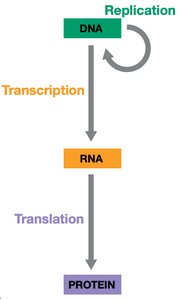
The central dogma of molecular biology describes the directional flow of genetic information within a cell: DNA is replicated, transcribed into RNA, and then translated into protein. This process is fundamental to all living organisms and underpins gene expression and inheritance.
Replication: DNA is duplicated by DNA polymerase to ensure genetic continuity during cell division.
Transcription: Genetic information is transferred from DNA to RNA by RNA polymerase.
Translation: Ribosomes use mRNA as a template to synthesize polypeptides (proteins).
Exceptions: Retroviruses can reverse transcribe RNA into DNA.
Genetic Material and Expression
Genetic material: DNA is responsible for inheritance and directs protein synthesis.
Gene expression: The process by which genetic information is used to synthesize proteins, determining phenotype.
Transcription – RNA Synthesis
Transcriptional Units and Regulation
Transcription is the first step in gene expression, where RNA is synthesized from a DNA template. Genes may be constitutive (always expressed) or regulated (expressed under specific conditions).
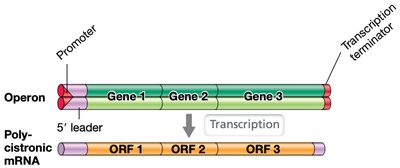
Transcriptional units: Segments of DNA transcribed into a single RNA molecule.
Monocistronic mRNA: Encodes a single gene.
Polycistronic mRNA: Encodes multiple genes (operons), common in prokaryotes.
Transcription in Prokaryotes vs Eukaryotes
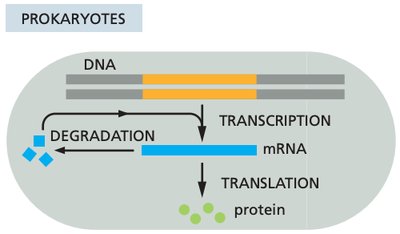
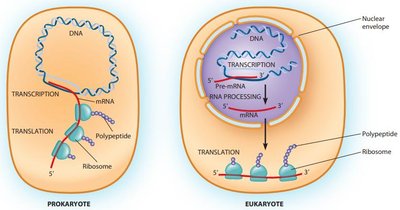
Prokaryotes: Replication, transcription, and translation occur in the cytoplasm; transcription and translation are coupled; polycistronic mRNA is common.
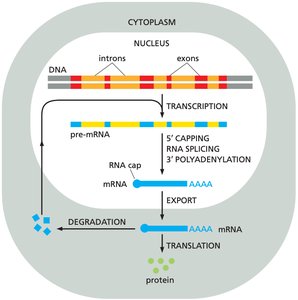
Eukaryotes: Replication and transcription occur in the nucleus; mRNA is processed (5’ cap, splicing, 3’ poly-A tail) and exported to the cytoplasm for translation; monocistronic mRNA is typical.
Transcription Mechanism
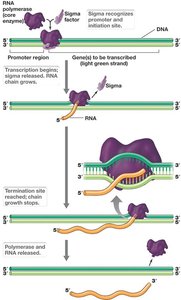
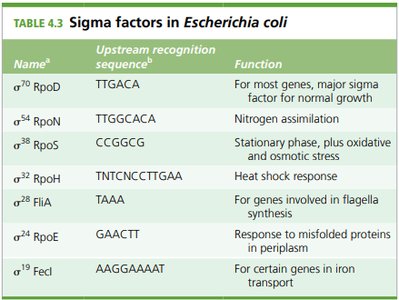
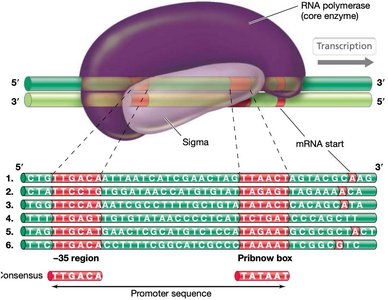
Initiation: Sigma factor recognizes promoter, recruits RNA polymerase, forms transcription bubble, and initiates RNA synthesis.
Elongation: RNA polymerase adds ribonucleotides to the 3’ end of the growing RNA strand.
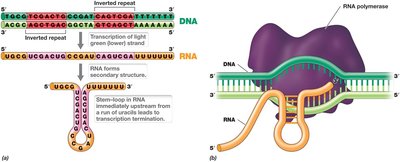
Termination: Can be Rho-dependent (Rho protein releases RNA polymerase) or intrinsic (hairpin loop formation in RNA).
RNA Polymerase and Sigma Factors
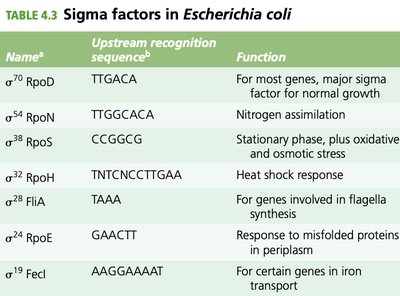
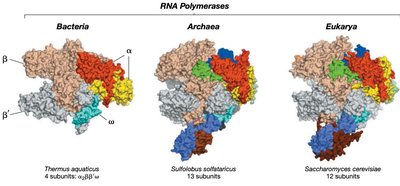
RNA polymerase: Core enzyme synthesizes RNA; sigma factor recognizes promoter regions.
Promoter: Contains conserved sequences (Pribnow box at -10, -35 element) recognized by sigma factors.
RNA Products and Types
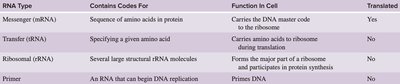
mRNA: Blueprint for protein synthesis (codons).
tRNA: Carries amino acids for translation (anticodon).
rRNA: Catalytic RNA component of ribosomes.
Comparison of Transcription in Bacteria and Eukaryotes
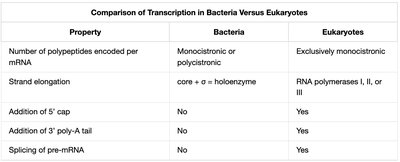
Bacteria: Monocistronic or polycistronic mRNA, no 5’ cap or poly-A tail, no splicing.
Eukaryotes: Exclusively monocistronic mRNA, 5’ cap, poly-A tail, splicing of pre-mRNA.
The Genetic Code
Triplet Code and Codon Dictionary
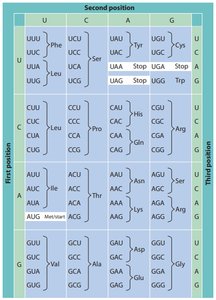
The genetic code is a set of rules by which information encoded in mRNA is translated into proteins. It is universal, unambiguous, and degenerate.
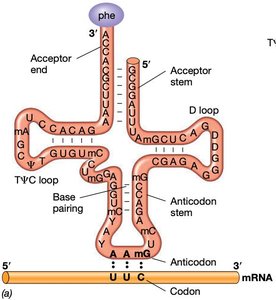
Codon: Three-nucleotide sequence in mRNA specifying an amino acid.
Degeneracy: Multiple codons can specify the same amino acid.
Start codon: AUG (methionine or formyl methionine in prokaryotes).
Stop codons: UAA, UAG, UGA.
Wobble effect: Third base in codon is less important for tRNA binding.

Reading Frames and Mutations
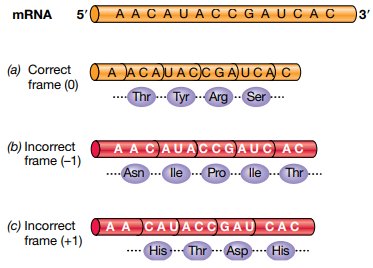
Reading frame: Uninterrupted sequence of nucleotides translated into a polypeptide.
Frame shift mutations: Addition or deletion of nucleotides alters the reading frame, affecting protein synthesis.
Translation – Protein Synthesis
Translation Mechanism and Machinery
Translation is the process by which ribosomes synthesize proteins using mRNA as a template. It involves tRNA, aminoacyl-tRNA synthetase, and ribosomes.
tRNA: Carries amino acids to ribosome; has acceptor stem and anticodon.
Aminoacyl-tRNA synthetase: Enzyme that attaches correct amino acid to tRNA.
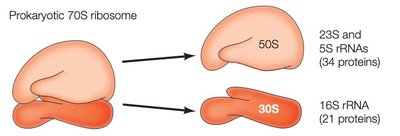
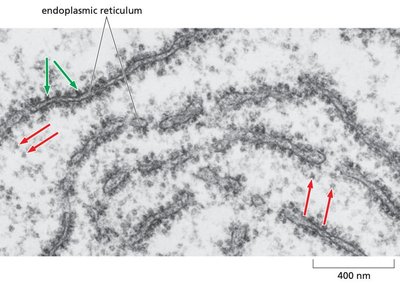
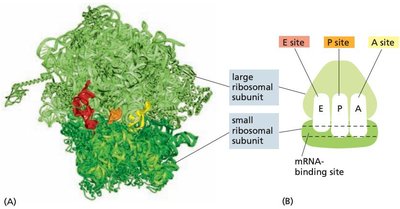
Ribosome: Composed of large and small subunits; catalyzes peptide bond formation.
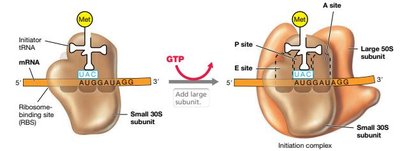
Binding sites: A (aminoacyl), P (peptidyl), E (exit).
Translation Steps
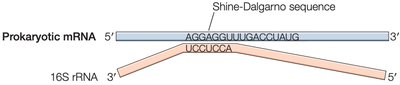
Initiation: Small ribosomal subunit binds to mRNA (Shine-Dalgarno sequence in prokaryotes), initiator tRNA binds to P site, large subunit joins.
Elongation: Cycles of aminoacyl-tRNA binding, peptide bond formation, and translocation; GTP-driven.
Termination: Stop codon recognized by release factors, polypeptide released, translation machinery dissociates.
Translation in Prokaryotes vs Eukaryotes
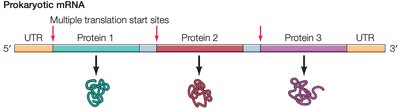
Prokaryotes: Monocistronic and polycistronic mRNA, translation starts at multiple sites.
Eukaryotes: Monocistronic mRNA, translation starts at a single site.
Protein Maturation, Folding, and Sorting
Post-Translational Modifications
Proteins undergo modifications after translation to achieve functional maturity, stability, and proper localization.
Deformylation: Removal of N-formyl group.
Methionine excision: Removal of N-terminal methionine.
Covalent additions: Phosphorylation, glycosylation, methylation, lipidation, acetylation, etc.
Protein Folding – Chaperone Proteins
Chaperones: Assist in proper folding of proteins; ATP-dependent.
Types: Trigger factors, DnaK/DnaJ, GroEL/GroES, heat-shock and cold-shock proteins.
Protein Sorting and Export
Sorting: Proteins are directed to cytosol, membrane, periplasm, outer membrane, or extracellular environment.
Signal sequence: N-terminal peptide directs protein to export pathways.
TAT signal peptide: Contains two arginine residues (RR).
Translocases and Secretion Systems
Sec System
SRP-SecYEG: Signal recognition particle targets ribosome to SecYEG translocon for co-translational translocation.
SecA-SecYEG: SecA targets unfolded protein to SecYEG for post-translational translocation; energy from ATP and PMF.
TAT System (Twin Arginine Translocase)
Transports folded proteins with TAT signal sequence.
Energy: Proton-motive force (PMF).
Secretion Systems in Gram-Negative Bacteria
Two-step systems: Type V (autotransporters), Type II (secretion pore).
One-step systems: Type I (ABC transporter), Type III (injectisome), Type IV (DNA transfer), Type VI (needle-like projection).
Additional Info: Meselson & Stahl Experiment
DNA Replication Mechanism
The Meselson & Stahl experiment used heavy and light nitrogen isotopes to demonstrate the semi-conservative mechanism of DNA replication.
Semi-conservative replication: Each new DNA molecule contains one old and one new strand.
