 Indietro
Microbial Energy Metabolism: Chemotrophy and Phototrophy
Guida di studio - Note intelligenti
 Appunti personalizzati basati sui tuoi materiali, ampliati con definizioni chiave, esempi e contesto.
Microbial Nutrition and Growth: Energy Use, Metabolism, and Growth
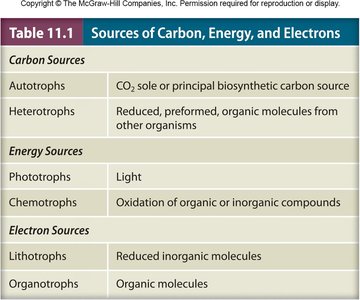
Overview of Microbial Nutritional Types
Microorganisms exhibit diverse nutritional strategies based on their sources of carbon, energy, and electrons. Understanding these strategies is fundamental to microbiology, as they determine how microbes grow, metabolize, and interact with their environments.
Carbon Sources:
Autotrophs use CO2 as their sole or principal biosynthetic carbon source.
Heterotrophs utilize reduced, preformed organic molecules from other organisms.
Energy Sources:
Phototrophs harness light energy.
Chemotrophs obtain energy from the oxidation of organic or inorganic compounds.
Electron Sources:
Lithotrophs use reduced inorganic molecules.
Organotrophs use organic molecules.
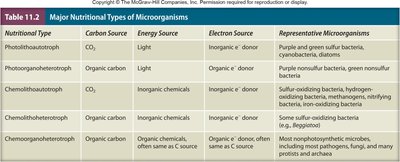
Major Nutritional Types of Microorganisms
Microorganisms are classified into nutritional types based on their carbon, energy, and electron sources. This classification helps in understanding their ecological roles and metabolic capabilities.
Nutritional Type | Carbon Source | Energy Source | Electron Source | Representative Microorganisms |
|---|---|---|---|---|
Photolithoautotroph | CO2 | Light | Inorganic e- donor | Purple and green sulfur bacteria, cyanobacteria, plants |
Photoorganoheterotroph | Organic carbon | Light | Organic e- donor | Purple nonsulfur bacteria, green nonsulfur bacteria |
Chemolithoautotroph | CO2 | Inorganic chemicals | Inorganic e- donor | Sulfur-oxidizing bacteria, hydrogen-oxidizing bacteria, nitrifying bacteria |
Chemoorganoheterotroph | Organic carbon | Organic chemicals | Organic e- donor | Most nonphotosynthetic microbes, including most pathogens, fungi, and many protists and archaea |
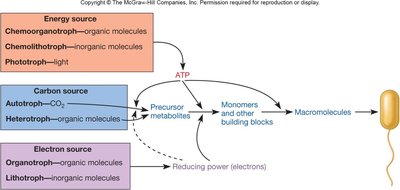
Integration of Energy, Carbon, and Electron Sources
Microbial cells integrate energy, carbon, and electron sources to generate precursor metabolites, which are then used to build monomers and macromolecules essential for growth and maintenance. ATP serves as the universal energy currency, while reducing power (electrons) is required for biosynthetic reactions.
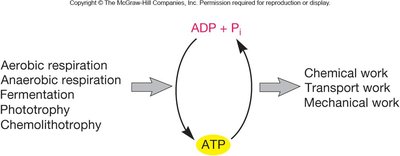
Microbial Metabolism: Fueling Reactions and ATP Generation
ATP: The Energy Currency of the Cell
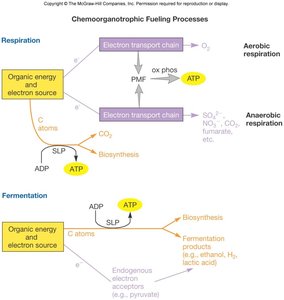
ATP (adenosine triphosphate) is synthesized through various metabolic processes, including aerobic and anaerobic respiration, fermentation, phototrophy, and chemolithotrophy. ATP is then used to drive chemical, transport, and mechanical work within the cell.
Chemoorganotrophic Metabolism
Chemoorganoheterotrophs obtain energy, carbon, and electrons from organic molecules. Their metabolism can proceed via three main processes:
Aerobic cellular respiration – complete oxidation of organic molecules using oxygen as the final electron acceptor.
Anaerobic cellular respiration – complete oxidation using an exogenous acceptor other than oxygen (e.g., nitrate, sulfate).
Fermentation – incomplete oxidation with organic molecules as electron acceptors; does not use an electron transport chain.
ATP Synthesis Mechanisms
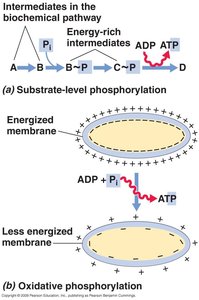
Substrate-level phosphorylation: Direct transfer of a phosphate group from a high-energy intermediate to ADP, forming ATP. Occurs in glycolysis and the citric acid cycle.
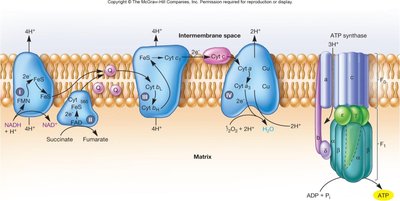
Oxidative phosphorylation: Inorganic phosphate is added to ADP using energy derived from the electron transport chain and proton motive force (PMF). Requires ATP synthase.
Catabolic Pathways: Glycolysis and Fermentation
Glycolysis (Embden-Meyerhof Pathway)
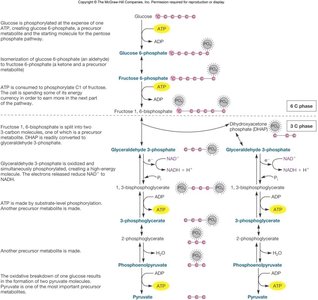
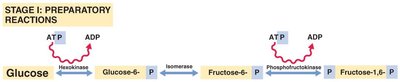
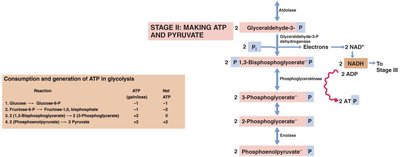
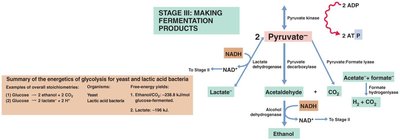
Glycolysis is the most common pathway for glucose degradation to pyruvate and occurs in both aerobic and anaerobic conditions. It consists of three stages: preparatory reactions, ATP and pyruvate production, and formation of fermentation products.
Stage I: Preparatory reactions involve phosphorylation of glucose, consuming ATP.
Stage II: ATP and pyruvate are produced via substrate-level phosphorylation and reduction of NAD+ to NADH.
Stage III: Fermentation products are formed to regenerate NAD+.
Fermentation
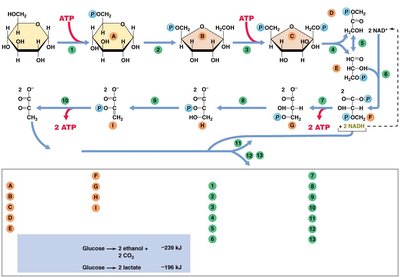
Fermentation is an anaerobic process that results in the incomplete oxidation of organic molecules, producing acids or alcohols as end products. It regenerates NAD+ for glycolysis and yields a net of 2 ATP per glucose molecule.
Acid fermentation: Produces lactic acid (e.g., in lactic acid bacteria).
Alcohol fermentation: Produces ethanol and CO2 (e.g., in yeast).
Respiration: Aerobic and Anaerobic Pathways
Aerobic Cellular Respiration
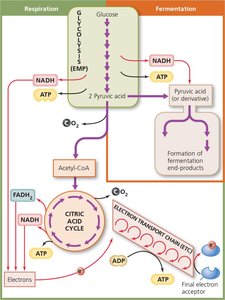
Aerobic respiration involves the complete oxidation of glucose to CO2 and H2O, using oxygen as the final electron acceptor. It consists of four phases:
Glycolysis – breakdown of glucose to pyruvate.
Formation of Acetyl-CoA – conversion of pyruvate to acetyl-CoA.
Citric Acid Cycle (Krebs Cycle) – complete oxidation of acetyl-CoA to CO2.
Electron Transport Chain and Oxidative Phosphorylation – transfer of electrons to oxygen, generating ATP via PMF.
Electron Transport Chain (ETC) and Proton Motive Force (PMF)
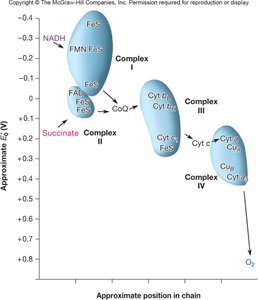
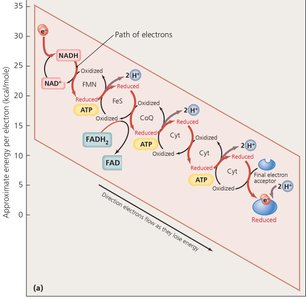
The ETC is a series of electron carriers that transfer electrons from NADH and FADH2 to oxygen (in aerobic respiration), releasing energy to generate a proton gradient (PMF) across the membrane. ATP synthase uses this gradient to synthesize ATP.
Anaerobic Cellular Respiration
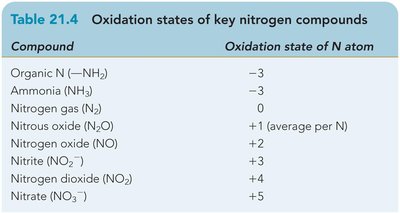
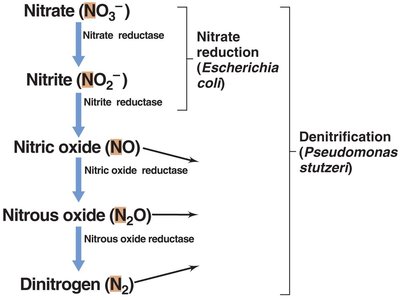
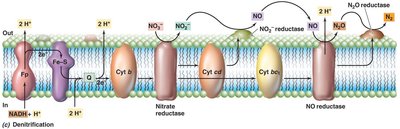
In anaerobic respiration, the final electron acceptor is an oxidized molecule other than oxygen (e.g., nitrate, sulfate, CO2). This process yields less energy than aerobic respiration due to the lower reduction potential of alternative acceptors.
Electron Acceptor | Reduced Products | Examples of Microorganisms |
|---|---|---|
NO3- | NO2-, N2O, N2 | Pseudomonas, Bacillus |
SO42- | H2S | Desulfovibrio |
CO2 | CH4 | Methanogens |
Phototrophy and Chemolithotrophy
Phototrophy
Phototrophs use light energy to drive the synthesis of ATP and reducing power. Photolithoautotrophs use inorganic electron donors (e.g., H2O or H2S) and fix CO2 via the Calvin cycle. Photosynthesis is divided into light reactions (ATP and NADPH production) and dark reactions (carbon fixation).
Oxygenic photosynthesis: Produces O2 (e.g., plants, cyanobacteria).
Anoxygenic photosynthesis: Does not produce O2 (e.g., green and purple bacteria).
Chemolithotrophy
Chemolithoautotrophs obtain energy and electrons from the oxidation of reduced inorganic compounds (e.g., H2, NH3, H2S). They use the electron transport chain for ATP synthesis and fix CO2 for biosynthesis. Energy yields are generally lower than those from organic compound oxidation.
Hydrogen oxidizers: Oxidize H2 to generate energy.
Sulfur oxidizers: Oxidize H2S, S0, or S2O32-.
Nitrifying bacteria: Oxidize NH3 to NO2- and NO2- to NO3-.
Summary Table: Microbial Nutritional Types
Nutritional Type | Carbon Source | Energy Source | Electron Source | Representative Microorganisms |
|---|---|---|---|---|
Photolithoautotroph | CO2 | Light | Inorganic e- donor | Cyanobacteria, plants |
Chemoorganoheterotroph | Organic carbon | Organic chemicals | Organic e- donor | Most pathogens, fungi |
Chemolithoautotroph | CO2 | Inorganic chemicals | Inorganic e- donor | Nitrifying bacteria |
Additional info: This summary integrates key concepts from microbial metabolism, including the diversity of energy, carbon, and electron sources, and the major metabolic pathways used by microorganisms. The included images and tables reinforce the classification and metabolic strategies of microbes, supporting exam preparation and conceptual understanding.
