 Indietro
Microbial Genetics: From DNA to Protein – Replication, Transcription, and Translation
Guida di studio - Note intelligenti
 Appunti personalizzati basati sui tuoi materiali, ampliati con definizioni chiave, esempi e contesto.
Central Dogma of Molecular Biology
Overview of Genetic Information Flow
The central dogma of molecular biology describes the directional flow of genetic information within a cell, from DNA to RNA to protein. This process is fundamental to all living organisms and underlies gene expression and cellular function.
Transcription: The process by which an RNA molecule is synthesized from a DNA template.
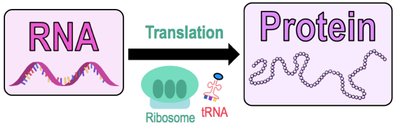
Translation: The process by which a protein is synthesized using the information encoded in messenger RNA (mRNA).
Gene Expression: Sometimes, transcription and translation are collectively referred to as gene expression, which is the process by which genotype results in phenotype.
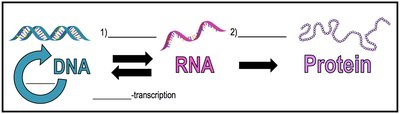
Key Point: While DNA can be transcribed into RNA and RNA can be reverse-transcribed into DNA, the transfer of information from nucleic acid to protein is irreversible.
DNA Replication
Introduction to DNA Replication
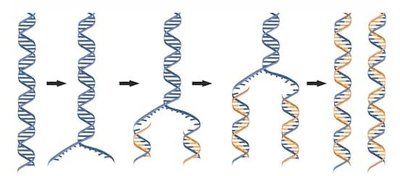
DNA replication is the process by which a cell duplicates its DNA, ensuring that each daughter cell receives an identical copy of the genetic material. This process is highly conserved among prokaryotes and eukaryotes, though more is known about prokaryotic replication.
Parental DNA strands separate and serve as templates for the synthesis of new, complementary strands.
Enzymes and Proteins in DNA Replication
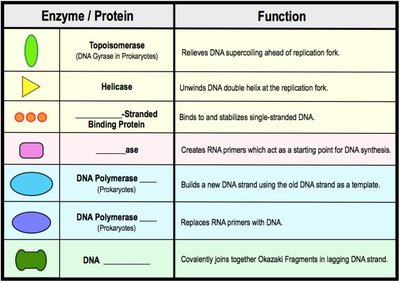
DNA replication requires a coordinated effort of several enzymes and proteins, each with a specific function:
Enzyme / Protein | Function |
|---|---|
Topoisomerase (DNA Gyrase in Prokaryotes) | Relieves DNA supercoiling ahead of the replication fork. |
Helicase | Unwinds DNA double helix at the replication fork. |
Single-Stranded Binding Protein | Binds to and stabilizes single-stranded DNA. |
Primase | Creates RNA primers as starting points for DNA synthesis. |
DNA Polymerase III (Prokaryotes) | Builds a new DNA strand using the old DNA strand as a template. |
DNA Polymerase I (Prokaryotes) | Replaces RNA primers with DNA. |
DNA Ligase | Covalently joins Okazaki fragments in the lagging DNA strand. |
Origin of Replication and Replication Forks
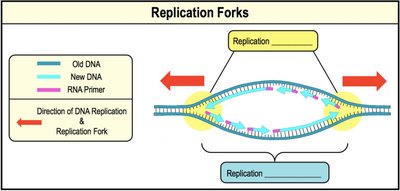
DNA replication begins at specific sequences called origins of replication (ORI). Prokaryotes typically have a single, circular chromosome with one ORI, while eukaryotes have multiple ORIs on their linear chromosomes.
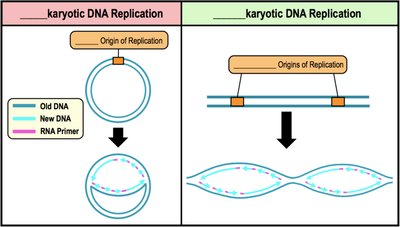
Proteins bind to the ORI and separate the DNA strands, forming a replication bubble with two replication forks at each end. DNA replication proceeds bidirectionally from the ORI.
Unwinding DNA: Topoisomerase, Helicase, and SSBs
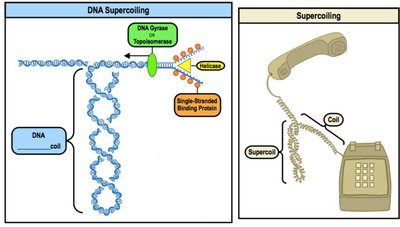
Several proteins are involved in unwinding DNA:
Topoisomerase (DNA Gyrase): Relieves strain caused by supercoiling ahead of the replication fork.
Helicase: Unwinds the DNA double helix by breaking hydrogen bonds between base pairs.
Single-Strand Binding Proteins (SSBs): Prevent reannealing and degradation of separated DNA strands.
Leading and Lagging DNA Strands
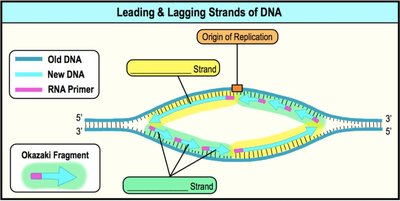
At each replication fork, two new DNA strands are synthesized:
Leading Strand: Synthesized continuously in the same direction as the replication fork movement; requires only one RNA primer.
Lagging Strand: Synthesized discontinuously in the opposite direction as the replication fork movement; formed in short segments called Okazaki fragments, each requiring an RNA primer. DNA ligase joins these fragments.
Steps of DNA Replication
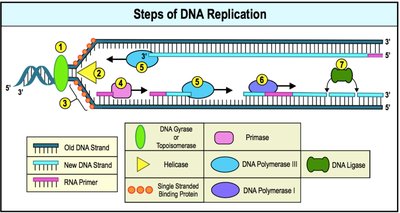
DNA replication in prokaryotes can be summarized in several steps:
Topoisomerase binds to the ORI and relieves supercoiling strain.
Helicase unwinds the DNA strands.
Single-Stranded Binding Proteins stabilize the unwound DNA.
Primase synthesizes RNA primers.
DNA Polymerase III adds nucleotides to the 3' end of primers, elongating both strands.
DNA Polymerase I removes RNA primers and replaces them with DNA.
DNA Ligase joins Okazaki fragments on the lagging strand.
Transcription
Introduction to Transcription
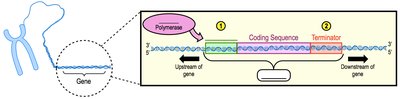
Transcription is the process by which an RNA molecule is synthesized from a DNA template within a gene. Genes are specific DNA sequences that encode functional products, such as proteins or functional RNAs.
Promoter: DNA sequence where transcription begins; site of RNA polymerase attachment.
Terminator: DNA sequence where transcription ends.
Transcription Process and Base Pairing
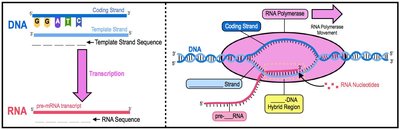
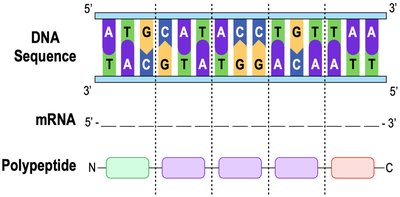
During transcription, the two DNA strands are referred to as the coding strand and the template strand. The RNA sequence is complementary to the template strand and nearly identical to the coding strand (except uracil replaces thymine).
RNA is synthesized from the 5' to 3' end.
Base pairing: Adenine (A) pairs with Uracil (U) in RNA, and Cytosine (C) pairs with Guanine (G).
Steps of Transcription
Transcription occurs in three main steps:
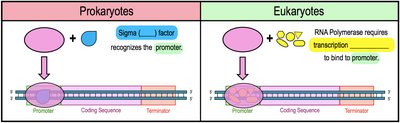
Initiation: RNA polymerase binds to the promoter and unwinds the DNA. In prokaryotes, a sigma (σ) factor helps recognize the promoter; in eukaryotes, transcription factors are required.
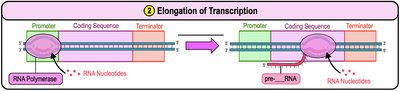
Elongation: RNA polymerase synthesizes the RNA molecule by adding nucleotides complementary to the DNA template.
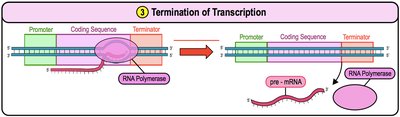
Termination: Transcription ends when RNA polymerase reaches the terminator sequence, releasing the RNA transcript.
Types of RNA
Major Types of RNA and Their Functions
Cells use several types of RNA, each with distinct functions:
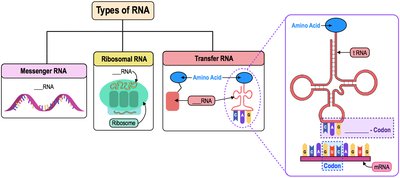
Messenger RNA (mRNA): Carries genetic information from DNA to ribosomes for protein synthesis; contains codons (three-nucleotide sequences coding for amino acids).
Ribosomal RNA (rRNA): Forms the core structural and functional components of ribosomes.
Transfer RNA (tRNA): Brings amino acids to the ribosome during translation; contains anticodons complementary to mRNA codons.
Eukaryotic RNA Processing and Splicing
RNA Processing
Unlike prokaryotic mRNA, eukaryotic pre-mRNA requires further modification before translation:
Addition of a 5' cap (modified guanine nucleotide) to the 5' end.
Addition of a poly-A tail (adenine nucleotides) to the 3' end.
These modifications facilitate export from the nucleus, protect mRNA from degradation, and help ribosome binding.


RNA Splicing
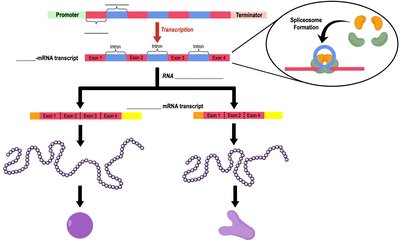
Eukaryotic genes contain exons (coding regions) and introns (noncoding regions). RNA splicing removes introns from pre-mRNA and joins exons to produce mature mRNA. The spliceosome is the complex responsible for this process. Alternative splicing allows a single gene to code for multiple proteins.
The Genetic Code
Codons and Protein Synthesis
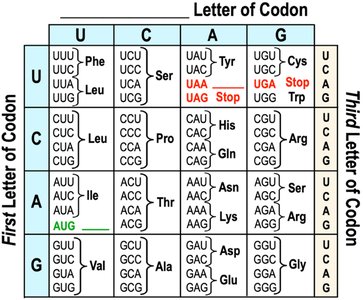
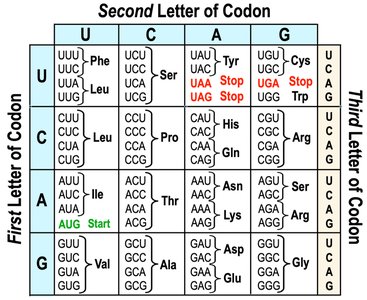
The genetic code is a set of rules by which the nucleotide sequence of mRNA is translated into the amino acid sequence of proteins. Each codon (three nucleotides) specifies one amino acid or a stop signal.
The code is nearly universal and redundant (more than one codon can specify the same amino acid).
Start codon: AUG (Methionine); Stop codons: UAA, UAG, UGA.
First Letter of Codon | Second Letter of Codon | Third Letter of Codon |
|---|---|---|
U, C, A, G | U, C, A, G | U, C, A, G |
Translation
Introduction to Translation
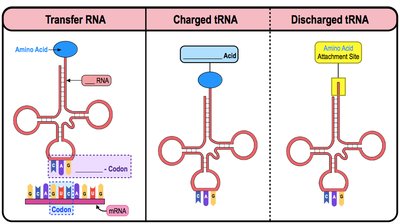
Translation is the process by which ribosomes synthesize proteins using the sequence information encoded in mRNA. tRNA molecules bring amino acids to the ribosome, matching their anticodons to mRNA codons.
Charged tRNA: tRNA attached to an amino acid.
Discharged tRNA: tRNA without an attached amino acid.
Ribosome Structure and Function
Ribosomes are composed of large and small subunits, each made of rRNA and proteins. Prokaryotic ribosomes are 70S (50S + 30S), while eukaryotic ribosomes are 80S (60S + 40S). Each ribosome has three tRNA binding sites:
A (Aminoacyl) Site: Holds the tRNA carrying the next amino acid.
P (Peptidyl) Site: Holds the tRNA with the growing polypeptide chain.
E (Exit) Site: Where discharged tRNAs leave the ribosome.
Steps of Translation
Initiation: The small ribosomal subunit binds mRNA and initiator tRNA (carrying methionine) at the start codon (AUG), followed by the large subunit.
Elongation: Amino acids are added one by one to the C-terminus of the growing chain. The ribosome moves along the mRNA 5' to 3', matching codons with tRNA anticodons.
Termination: When a stop codon is reached, release factors bind, causing the polypeptide to be released and the ribosome to dissociate.
Summary Table: Key Steps and Enzymes in Genetic Information Flow
Process | Main Enzyme(s) | Key Product |
|---|---|---|
Replication | DNA Polymerase, Helicase, Ligase, Primase, Topoisomerase | DNA |
Transcription | RNA Polymerase | RNA (mRNA, tRNA, rRNA) |
Translation | Ribosome, tRNA, rRNA | Protein (Polypeptide) |
Additional info: This guide covers the core molecular genetics concepts essential for understanding microbial genetics, including the central dogma, DNA replication, transcription, RNA processing, the genetic code, and translation. These processes are foundational for all subsequent topics in microbial genetics and gene regulation.
