 Indietro
Microbial Genetics: Structure, Function, and Mechanisms of Genetic Change
Guida di studio - Note intelligenti
 Appunti personalizzati basati sui tuoi materiali, ampliati con definizioni chiave, esempi e contesto.
Microbial Genetics
Big Picture: Genetics
Genetics is the science of heredity, focusing on how genetic information is stored, expressed, and altered in microorganisms. Understanding microbial genetics is essential for explaining disease mechanisms, developing treatments, and harnessing microbes for human benefit.
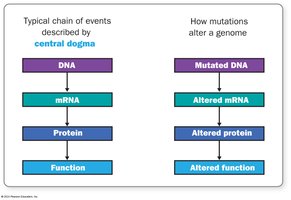
Central Dogma of Molecular Biology: Describes the flow of genetic information from DNA to RNA to protein, which determines cellular function.
Mutations: Changes in genetic material can alter gene expression and protein function, impacting microbial traits.
Gene Expression Controlled by Operons: Operons regulate the transcription of groups of genes, allowing coordinated control of metabolic pathways.
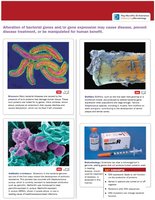
Applications: Alteration of bacterial genes may cause disease, prevent disease, or be manipulated for biotechnology.
Structure and Function of the Genetic Material
Key Definitions
Microbial genetics relies on understanding several fundamental terms:
Genetics: Study of genes, their information, expression, and replication.
Chromosome: Structure containing DNA and proteins, carrying hereditary information.
Gene: Segment of DNA encoding a functional product, usually a protein.
Genome: All genetic information in a cell.
Genomics: Sequencing and molecular characterization of genomes.
Genetic Code: Set of rules for converting nucleotide sequences into amino acid sequences.
Genotype: Genetic makeup of an organism.
Phenotype: Expression of the genotype as observable traits.
Central Dogma and Gene Expression
The central dogma explains how genetic information is transferred and expressed:
DNA is transcribed to mRNA, which is then translated into protein.
When the protein encoded by a gene is produced, the gene is said to be expressed.

DNA and Chromosomes in Bacteria
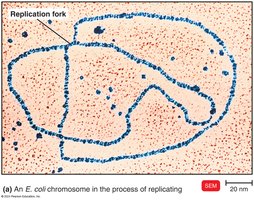
Bacterial chromosomes are typically single, circular DNA molecules associated with proteins. For example, E. coli has a chromosome with 4.6 million base pairs, which is highly supercoiled for efficient packaging.
The Flow of Genetic Information
Vertical Gene Transfer: Transmission of genetic information from parent to offspring.
DNA Replication
Structure and Process
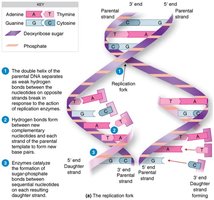
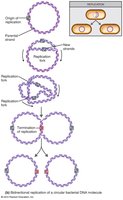
DNA replication is the process by which cells duplicate their genetic material before cell division. The double helix structure consists of two antiparallel strands held together by hydrogen bonds between complementary bases (A-T, C-G).
One strand serves as a template for the synthesis of a new strand.
Replication is bidirectional in most bacteria, starting at a single origin and proceeding in both directions.
DNA polymerase ensures high fidelity through proofreading.
RNA and Protein Synthesis
Types of RNA
RNA is a single-stranded nucleic acid with ribose sugar and uracil instead of thymine. It plays several roles in protein synthesis:
Ribosomal RNA (rRNA): Integral part of ribosomes.
Transfer RNA (tRNA): Transports amino acids during protein synthesis.
Messenger RNA (mRNA): Carries coded information from DNA to ribosomes.
Transcription in Prokaryotes
Transcription is the synthesis of a complementary mRNA strand from a DNA template. It involves three steps:
Initiation: RNA polymerase binds to the promoter sequence.
Elongation: RNA polymerase synthesizes the mRNA strand.
Termination: Transcription stops at the terminator sequence.
The Regulation of Bacterial Gene Expression
The Operon Model
Gene expression in bacteria is often regulated by operons, which are clusters of genes controlled together.
Promoter: DNA segment where RNA polymerase initiates transcription.
Operator: DNA segment controlling transcription.
Operon: Includes promoter, operator, and structural genes.
In inducible operons (e.g., the lac operon), genes are transcribed only when an inducer is present. The lac operon encodes enzymes for lactose metabolism, regulated by the presence or absence of lactose.
Changes in Genetic Material
Mutations and Their Effects
Mutations are permanent changes in the DNA sequence. They can be:
Neutral: No effect on function.
Beneficial: Enhance survival or reproduction.
Harmful: Reduce fitness or cause disease.
Mutagens are agents that cause mutations. Spontaneous mutations occur without mutagens.
Types of Mutations
Spontaneous: Occur naturally.
Induced: Caused by external agents (mutagens).
Chemical and Radiation Mutagens
Chemical Mutagens: Examples include nitrous acid and aflatoxin.
Radiation: Ionizing radiation (X-rays, gamma rays) and UV radiation can damage DNA.
Identifying Chemical Carcinogens: The Ames Test
The Ames test uses bacteria to detect mutagenic and carcinogenic substances. It measures the reversion rate of a mutation in Salmonella with a histidine auxotrophy, indicating mutagenicity.
Test Component | Purpose |
|---|---|
Mutant Bacteria (his-) | Detects reversion to his+ phenotype |
Mutagenic Substance | Tested for mutation-inducing ability |
Rat Liver Extract | Provides activation enzymes |
Reversion Rate | Indicates mutagenic potential |
Genetic Transfer and Recombination
Vertical vs. Horizontal Gene Transfer
Vertical Gene Transfer: Genes passed from parent to offspring.
Horizontal Gene Transfer: Genes transferred between cells of the same generation, resulting in recombinants.
Mechanisms of Horizontal Gene Transfer
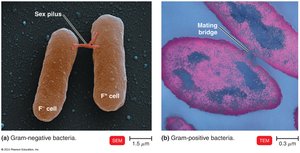
Conjugation: Plasmids transferred via cell-to-cell contact. Gram-negative bacteria use sex pili; Gram-positive use a mating bridge or sticky substance. Donor cells have conjugative plasmids; recipients lack them.
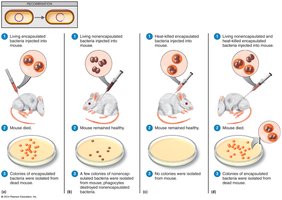
Transformation: Uptake of "naked" DNA from the environment, demonstrated by Griffith's experiment with Streptococcus pneumoniae.
Transduction: DNA transferred via bacteriophage. Can be generalized (random DNA) or specialized (specific genes).
Plasmids
Plasmids are self-replicating, circular DNA molecules found in bacteria. They may carry genes for:
Toxin production
Antibiotic resistance (R factors): Can be transferred horizontally
Catabolism of unusual compounds (dissimilation plasmids)
Plasmid Type | Function |
|---|---|
Conjugative plasmid | Genes for sex pili and plasmid transfer |
Dissimilation plasmid | Enzymes for catabolism of unusual compounds |
Resistance factor (R factor) | Antibiotic resistance genes |
Summary: Microbial genetics encompasses the structure, function, and regulation of genetic material in microorganisms. Understanding these concepts is crucial for studying microbial physiology, pathogenesis, and biotechnology.
