 Indietro
Microbial Genetics: Structure, Function, and Regulation of Genetic Material
Guida di studio - Note intelligenti
 Appunti personalizzati basati sui tuoi materiali, ampliati con definizioni chiave, esempi e contesto.
Microbial Genetics
Introduction to Microbial Genetics
Microbial genetics is the study of the mechanisms of heritable information in microorganisms, focusing on how genes are structured, replicated, expressed, and regulated. Understanding microbial genetics is essential for grasping how microbes adapt, evolve, and interact with their environments.
Genetics: The study of genes, their functions, and how genetic information is transmitted and expressed.
Gene: A segment of DNA that encodes a functional product, typically a protein.
Chromosome: A DNA-containing structure that carries hereditary information; chromosomes contain genes.
Genome: The complete set of genetic information in a cell.
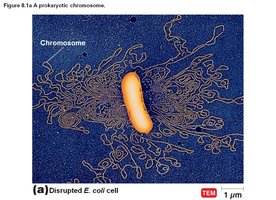
Genomic Terminology
Genomics: The molecular study of genomes, including sequencing, mapping, and analysis.
Genotype: The genetic makeup of an organism.
Phenotype: The observable characteristics or traits of an organism, resulting from the expression of its genotype.
Structure of DNA
DNA Composition and Structure
DNA is a double-stranded polymer composed of nucleotides: adenine (A), thymine (T), cytosine (C), and guanine (G). The structure is a double helix, with a backbone of deoxyribose-phosphate and complementary base pairing (A-T, C-G) held together by hydrogen bonds. The strands are antiparallel and complementary.
Antiparallel: The two DNA strands run in opposite directions (5' to 3' and 3' to 5').
Complementary: Each base on one strand pairs with a specific partner on the other strand (A with T, C with G).
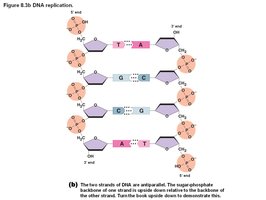
DNA Replication
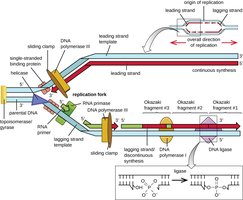
DNA replication is the process by which a cell duplicates its DNA before cell division. It is semiconservative, meaning each new DNA molecule consists of one parental and one newly synthesized strand.
Initiation: Replication begins at specific sites called origins of replication.
Elongation: DNA polymerase synthesizes new DNA in the 5' to 3' direction, using each parental strand as a template.
Leading Strand: Synthesized continuously toward the replication fork.
Lagging Strand: Synthesized discontinuously in short segments called Okazaki fragments, later joined by DNA ligase.
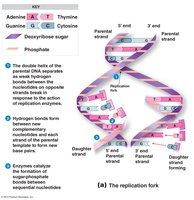
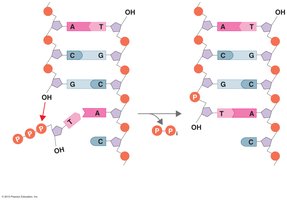
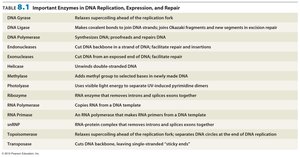
Key Enzymes in DNA Replication
Multiple enzymes coordinate the process of DNA replication, repair, and expression.
Enzyme | Function |
|---|---|
DNA Gyrase | Relieves supercoiling ahead of the replication fork |
DNA Ligase | Joins DNA fragments and repairs breaks |
DNA Polymerase | Synthesizes DNA and proofreads newly made DNA |
Helicase | Unwinds the DNA double helix |
Primase | Synthesizes RNA primers for DNA polymerase |
Topoisomerase | Relieves supercoiling and separates DNA circles |
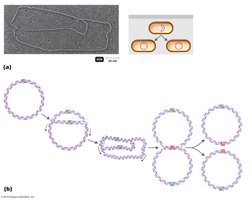
Bidirectional Replication in Bacteria
Bacterial chromosomes typically replicate bidirectionally from a single origin, forming two replication forks that proceed in opposite directions until they meet at the terminus.
Gene Expression: Transcription and Translation
Transcription
Transcription is the synthesis of RNA from a DNA template. It produces messenger RNA (mRNA), transfer RNA (tRNA), and ribosomal RNA (rRNA).
Initiation: RNA polymerase binds to the promoter region, and DNA unwinds.
Elongation: RNA polymerase synthesizes RNA in the 5' to 3' direction by complementary base pairing.
Termination: Transcription stops at the terminator sequence, releasing the RNA transcript.
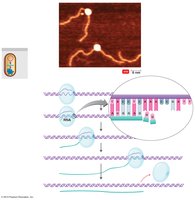
RNA Processing in Eukaryotes
In eukaryotic cells, the initial RNA transcript (pre-mRNA) contains both exons (coding regions) and introns (non-coding regions). Introns are removed, and exons are spliced together to form mature mRNA, which is then exported to the cytoplasm for translation.
Translation
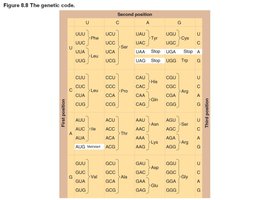
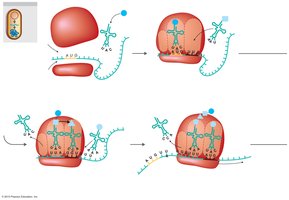
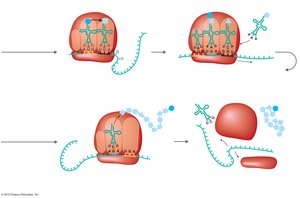
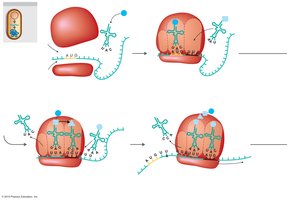
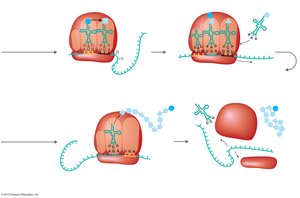
Translation is the process by which ribosomes synthesize proteins using the sequence of codons in mRNA. Each codon (three nucleotides) specifies an amino acid.
Start Codon: AUG (methionine) signals the beginning of translation.
Stop Codons: UAA, UAG, UGA signal the end of translation.
tRNA: Transfers specific amino acids to the ribosome, matching codons with complementary anticodons.
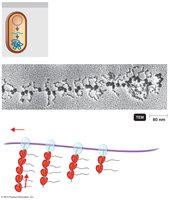
Simultaneous Transcription and Translation in Prokaryotes
In prokaryotes, transcription and translation can occur simultaneously, allowing rapid protein synthesis.
Regulation of Gene Expression
Types of Genes
Constitutive Genes: Expressed at a constant rate.
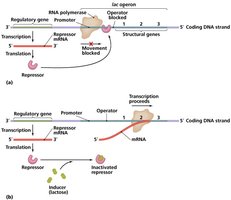
Inducible Genes: Expressed only in response to specific stimuli (e.g., the lac operon).
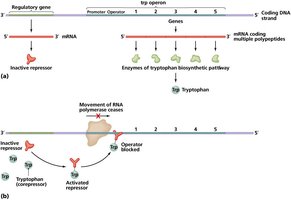
Repressible Genes: Expression can be inhibited by specific signals (e.g., the trp operon).
Catabolite Repression: Inhibition of operons by preferred energy sources (e.g., glucose).
Attenuation in the trp Operon
Attenuation is a regulatory mechanism in the trp operon where transcription is prematurely terminated depending on tryptophan availability. When tryptophan is abundant, a terminator loop forms, halting transcription. When tryptophan is scarce, an antiterminator loop forms, allowing transcription to proceed.
Catabolite Repression and the lac Operon
When both glucose and lactose are present, E. coli preferentially uses glucose. Only after glucose is depleted does the cell induce the lac operon to metabolize lactose, a phenomenon known as diauxic growth. High cAMP levels activate CAP, enhancing lac operon transcription in the absence of glucose.
Mutations and DNA Repair
Types of Mutations
Mutations are changes in the DNA sequence that can affect gene function. They may occur spontaneously or be induced by mutagens.
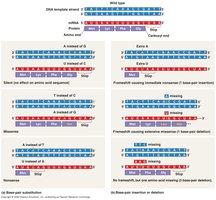
Point Mutations: Single base changes (substitution, insertion, or deletion).
Frameshift Mutations: Insertions or deletions that shift the reading frame, often resulting in nonfunctional proteins.
Missense Mutations: Change one amino acid in a protein.
Nonsense Mutations: Introduce a premature stop codon.
Mutation Rates and Mutagens
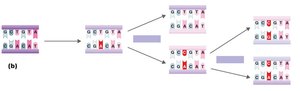
Spontaneous Mutation Rate: Approximately 1 in 109 base pairs or 1 in 106 genes.
Mutagens: Increase mutation rates and include chemicals (e.g., nucleotide analogs, nucleotide-altering chemicals, frameshift mutagens) and radiation (ionizing and nonionizing).
DNA Repair Mechanisms
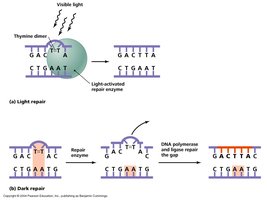
Cells possess several mechanisms to repair DNA damage, including direct repair (e.g., photoreactivation of thymine dimers) and excision repair (removal and replacement of damaged DNA segments).
Genetic Recombination and Horizontal Gene Transfer
Recombination
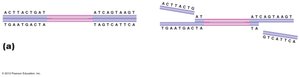
Genetic recombination involves the exchange of genetic material between different DNA molecules, increasing genetic diversity.
Transformation
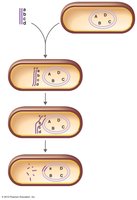
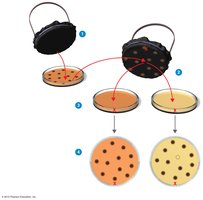
Transformation is the uptake of naked DNA fragments from the environment by a bacterial cell, which may then integrate the DNA into its genome through recombination.
Conjugation
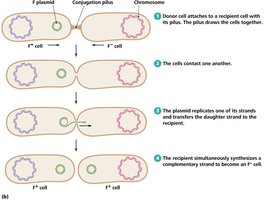
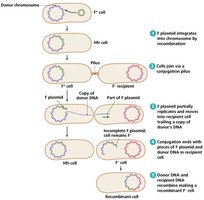
Conjugation is the transfer of genetic material between bacterial cells via direct contact, typically involving plasmids such as the F factor.
Transposons
Transposons are mobile genetic elements that can move from one location to another within a genome, often causing mutations or transferring genes such as antibiotic resistance.
Insertion Sequences (IS): The simplest transposons, containing only the gene for transposase and inverted repeats.
Complex Transposons: Carry additional genes, such as antibiotic resistance.
Transduction
Transduction is the transfer of bacterial genes by bacteriophages (viruses that infect bacteria). It can be generalized (any gene transferred) or specialized (specific genes transferred by lysogenic phages).
*Additional info: Specialized transduction involves only certain phages that integrate into the host genome and transfer specific adjacent genes upon excision.*
