 Indietro
Microbial Genetics: Structure, Function, and Transfer of Genetic Information
Guida di studio - Note intelligenti
 Appunti personalizzati basati sui tuoi materiali, ampliati con definizioni chiave, esempi e contesto.
Microbial Genetics
Introduction to Microbial Genetics
Microbial genetics is the study of the structure, function, and transfer of genetic material in microorganisms. It explores how genes are organized, expressed, and inherited, and how genetic variation arises and spreads within microbial populations.
Genetics: The study of genes, their functions, and inheritance.
Gene: A segment of DNA encoding a functional product, usually a protein.
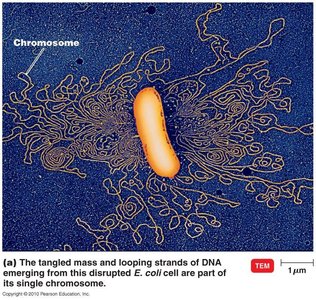
Chromosome: A structure containing DNA that carries hereditary information.
Genome: The complete set of genetic information in a cell.
Genomics: The molecular study of genomes.
Genotype: The genetic makeup of an organism.
Phenotype: The expression of genes, not necessarily the outward appearance.
Flow of Genetic Information
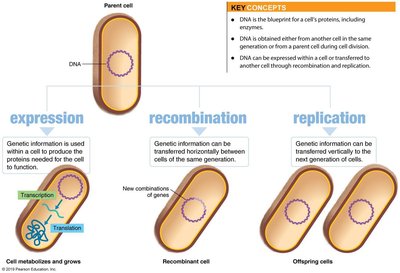
Expression, Recombination, and Replication
Genetic information in microbes can be expressed, recombined, or replicated. These processes are fundamental to cell function, adaptation, and evolution.
Expression: Information is used to produce proteins for cell function (transcription and translation).
Recombination: Genetic information is exchanged between cells, creating new gene combinations.
Replication: Genetic information is copied and passed to offspring cells.
DNA Structure
Organization and Chemical Properties
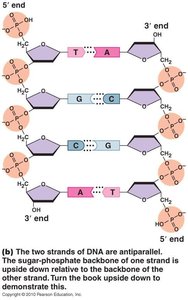
DNA is a double helix composed of nucleotides (adenine, thymine, cytosine, guanine). The strands are antiparallel and held together by hydrogen bonds between complementary bases (A-T, C-G).
Backbone: Deoxyribose-phosphate.
5’ End: Phosphate attached to the 5’ carbon of sugar.
3’ End: Hydroxyl group attached to the 3’ carbon.
Antiparallel: The two DNA strands run in opposite directions.
DNA Replication
Semiconservative Mechanism
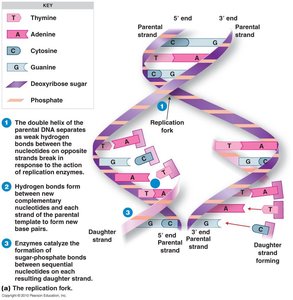
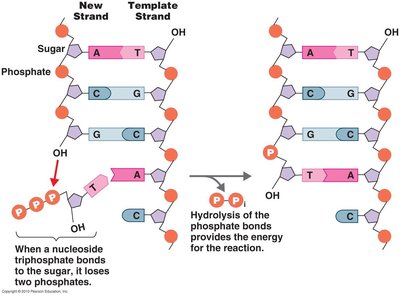
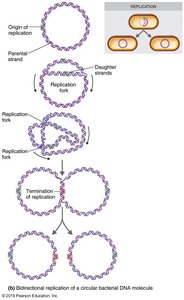
DNA replication is semiconservative: each new DNA molecule consists of one parental and one daughter strand. Replication begins at the origin and proceeds bidirectionally in bacteria.
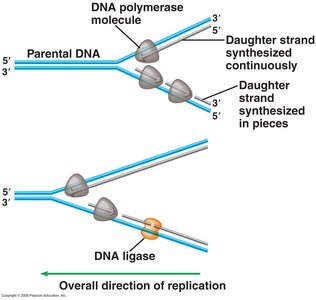
DNA polymerase: Synthesizes new DNA by adding nucleotides to the 3’ end.
Primase: Synthesizes RNA primers to initiate DNA synthesis.
DNA ligase: Joins Okazaki fragments on the lagging strand.
Leading strand: Synthesized continuously.
Lagging strand: Synthesized discontinuously in Okazaki fragments.
Gene Expression: Transcription and Translation
Transcription
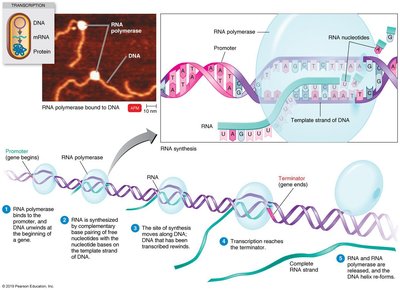
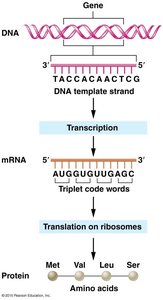
Transcription is the synthesis of RNA from a DNA template. RNA polymerase binds to the promoter, synthesizes RNA in the 5’→3’ direction, and stops at the terminator sequence.
Types of RNA: mRNA (messenger), rRNA (ribosomal), tRNA (transfer).
Promoter: DNA sequence where RNA polymerase binds to initiate transcription.
Terminator: Sequence signaling the end of transcription.
RNA Processing in Eukaryotes
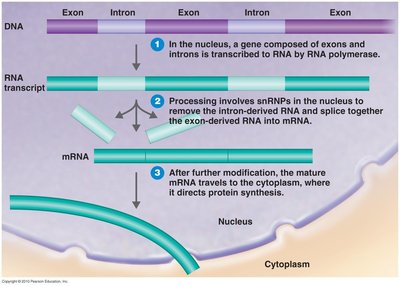
In eukaryotes, the primary RNA transcript undergoes processing: introns are removed, exons are spliced together, and the mature mRNA is exported to the cytoplasm for translation.
Translation
Translation is the process by which mRNA is decoded to synthesize proteins. It occurs on ribosomes and involves tRNA molecules that bring amino acids corresponding to codons on the mRNA.
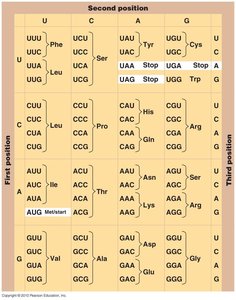
Codon: A sequence of three nucleotides on mRNA that specifies an amino acid.
Start codon: AUG (methionine).
Stop codons: UAA, UAG, UGA (signal termination).
tRNA: Carries amino acids and has an anticodon complementary to the mRNA codon.
Regulation of Gene Expression
Operons: Inducible and Repressible Systems
Gene expression in bacteria is regulated by operons, which are clusters of genes under the control of a single promoter. The lac operon is inducible (turned on by lactose), while the trp operon is repressible (turned off by tryptophan).
Constitutive genes: Expressed at a fixed rate (e.g., glycolysis enzymes).
Inducible genes: Expressed only when needed (e.g., lac operon).
Repressible genes: Turned off when the end product is abundant (e.g., trp operon).
Mutations
Types and Effects
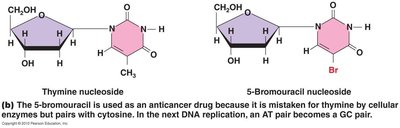
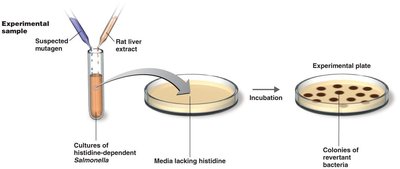
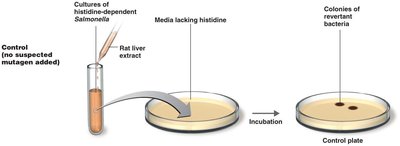
Mutations are changes in the genetic material. They can be spontaneous or induced by mutagens and may be neutral, beneficial, or harmful.
Base substitution (point mutation): Change in one base.
Silent mutation: No change in amino acid.
Missense mutation: Change in amino acid.
Nonsense mutation: Results in a stop codon.
Frameshift mutation: Insertion or deletion of nucleotides, altering the reading frame.
Radiation-Induced Mutations
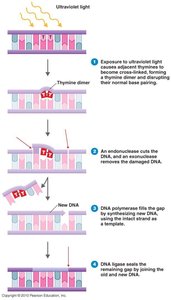
Ionizing radiation (X-rays, gamma rays) causes DNA breaks. Non-ionizing radiation (UV) causes thymine dimers, which can be repaired by cellular mechanisms.
Genetic Transfer and Recombination
Vertical and Horizontal Gene Transfer
Genetic information can be transferred vertically (parent to offspring) or horizontally (between cells of the same generation).
Vertical gene transfer: Occurs during reproduction.
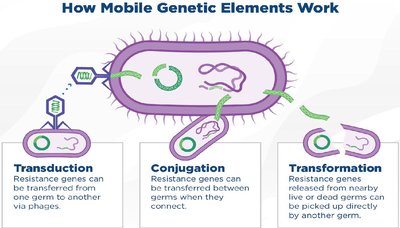
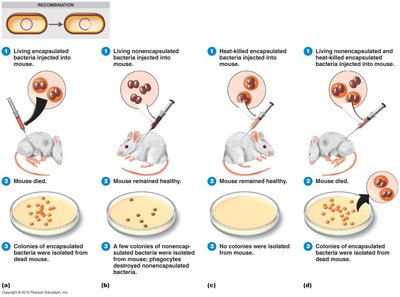
Horizontal gene transfer: Includes transformation, conjugation, and transduction.
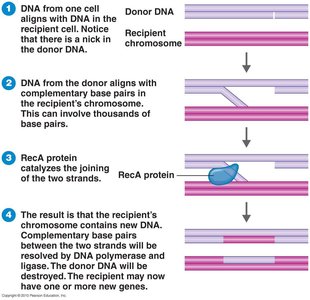
Mechanisms of Horizontal Gene Transfer
Transformation: Uptake of naked DNA from the environment.
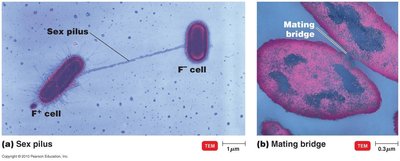
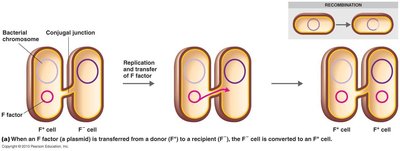
Conjugation: Transfer of DNA via direct cell-to-cell contact, often involving plasmids and sex pili.
Transduction: Transfer of DNA by bacteriophages (viruses that infect bacteria).
Plasmids and Their Roles
Plasmids are self-replicating, circular DNA molecules that often carry genes beneficial for survival, such as antibiotic resistance.
Conjugative plasmid (F factor): Carries genes for sex pili and plasmid transfer.
Dissimilation plasmids: Encode enzymes for catabolism of unusual compounds.
R factors: Encode antibiotic resistance.
Practice Question Example
Transcription and Translation Practice
Given the DNA sequence: A C T T A C G G A C A A C T A G C C
mRNA: U G A A U G C C U G U U G A U C G G
Protein: (Use the codon table to translate the mRNA sequence into amino acids.)
Summary Table: Types of Mutations
Mutation Type | DNA Change | Effect on Protein |
|---|---|---|
Silent | Base substitution | No change in amino acid |
Missense | Base substitution | Change in amino acid |
Nonsense | Base substitution | Stop codon produced |
Frameshift | Insertion/deletion | Reading frame altered |
