 Indietro
Lab 4 Quiz
Guida di studio - Note intelligenti
 Appunti personalizzati basati sui tuoi materiali, ampliati con definizioni chiave, esempi e contesto.
Quorum Sensing
Mechanism and Significance
Quorum sensing is a cell-to-cell communication process that enables bacteria to coordinate gene expression based on population density. It is crucial for regulating collective behaviors such as biofilm formation and virulence.
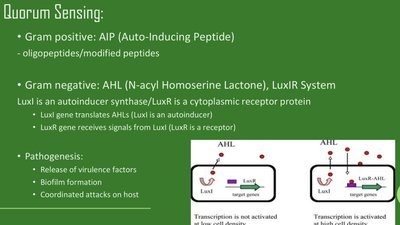
Gram-positive bacteria: Use AIP (Auto-Inducing Peptide), which are oligopeptides or modified peptides.
Gram-negative bacteria: Use AHL (N-acyl Homoserine Lactone) and the LuxIR system. LuxI is an autoinducer synthase, and LuxR is a cytoplasmic receptor protein.
Pathogenesis: Quorum sensing controls the release of virulence factors, biofilm formation, and coordinated attacks on the host.
Example: At low cell density, autoinducer concentration is low and target gene transcription does not occur. At high cell density, autoinducer concentration increases, activating transcription of target genes. 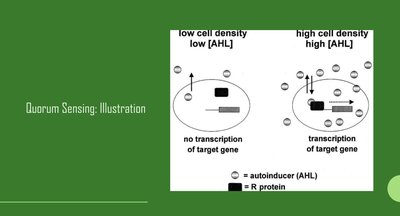
Biofilms
Formation and Role in Disease
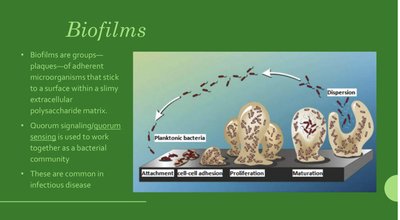
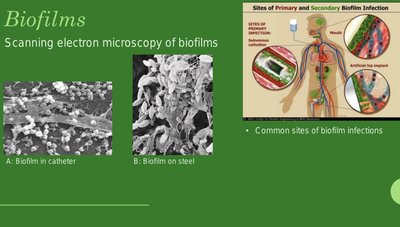
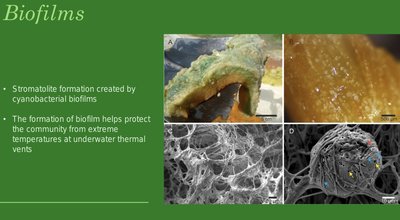
Biofilms are structured communities of microorganisms adhering to surfaces within a self-produced extracellular matrix. They are common in infectious diseases and are regulated by quorum sensing.
Stages of biofilm development: Attachment, cell-cell adhesion, proliferation, maturation, and dispersion.
Quorum signaling: Used for coordinated activity within the biofilm.
Clinical relevance: Biofilms are found on medical devices, teeth, wounds, and contact lenses, contributing to persistent infections.
Example: Biofilms on catheters, dental plaque, and wounds impair healing and resist antibiotics. 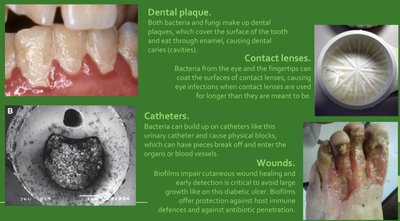
Osmotic Pressure
Effects on Microbial Cells
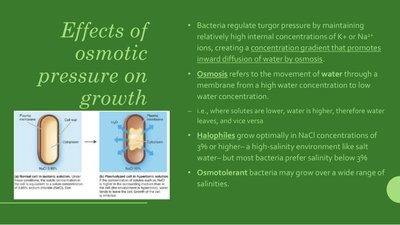
Osmotic pressure influences microbial cell integrity and growth. Bacteria maintain turgor pressure to prevent plasmolysis, which is the shrinking of the cytoplasm away from the cell wall due to water loss.
Osmosis: Movement of water from high to low concentration across a membrane.
Halophiles: Grow optimally in high salt concentrations (≥3% NaCl).
Osmotolerant bacteria: Can grow across a wide range of salinities.
Example: Plasmolysis occurs in hypertonic environments, while turgor pressure is maintained in hypotonic environments. 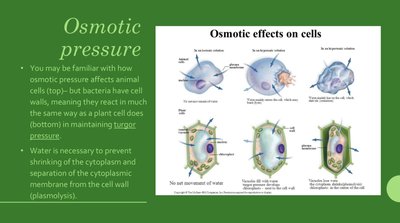
Temperature and Microbial Growth
Thermal Classifications and Effects
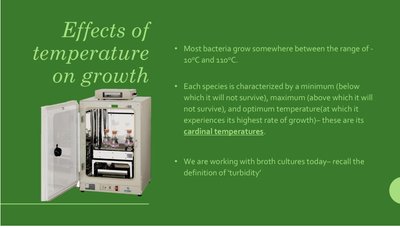
Temperature is a critical factor in microbial growth, with each species having specific minimum, maximum, and optimum growth temperatures (cardinal temperatures).
Psychrophiles: Grow below 20°C, found in polar regions.
Mesophiles: Grow between 15°C and 40°C, common in the human body.
Thermophiles: Grow above 40°C, found in geothermal sites.
Example: Most bacteria grow between 10°C and 110°C, with optimum growth at their cardinal temperatures. 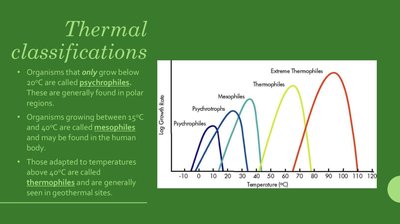
Effects of UV Light on Growth
Microbial Control by Ultraviolet Light
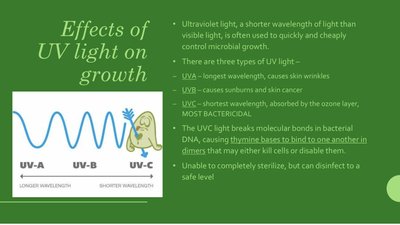
Ultraviolet (UV) light is used to control microbial growth by damaging bacterial DNA.
Types of UV light:
UV-A: Longest wavelength, causes skin wrinkles.
UV-B: Causes sunburn and skin cancer.
UV-C: Shortest wavelength, most bactericidal.
Mechanism: UV-C breaks molecular bonds in DNA, causing thymine bases to bind to one another, which can kill or disable microbes.
Application: UV light can disinfect surfaces but may not completely sterilize.
pH and Microbial Growth
Organismal pH Classifications and Effects
pH affects microbial growth by influencing enzyme activity and membrane integrity.
Acidophiles: Grow well below pH 5.5.
Neutrophiles: Grow best between pH 5.5 and 8.5.
Alkaliphiles: Grow above pH 8.5.
Example: The intracellular pH of bacteria is kept relatively neutral, but environmental pH can affect growth. 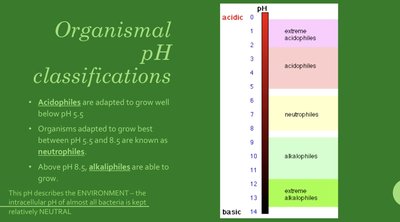
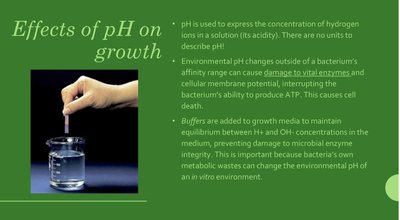
Effects of pH on Growth
pH definition: Concentration of hydrogen ions in solution; no units.
Environmental impact: Changes in pH can damage vital enzymes and cell membranes, interrupting ATP production and causing cell death.
Buffers: Added to growth media to maintain equilibrium and prevent damage to microbial enzyme integrity.
Summary Table: Environmental Factors Affecting Microbial Growth
Factor | Classification | Optimal Range | Example Organisms |
|---|---|---|---|
Temperature | Psychrophiles, Mesophiles, Thermophiles | <20°C, 15-40°C, >40°C | Escherichia coli (mesophile), Bacillus stearothermophilus (thermophile) |
Osmotic Pressure | Halophiles, Osmotolerant | ≥3% NaCl, wide salinity | Halobacterium (halophile) |
pH | Acidophiles, Neutrophiles, Alkaliphiles | <5.5, 5.5-8.5, >8.5 | Acidithiobacillus (acidophile) |
UV Light | UV-A, UV-B, UV-C | UV-C most bactericidal | Surface sterilization |
Additional info: Academic context was added to clarify mechanisms, examples, and classifications for each environmental factor and microbial process.
