 Indietro
Microbial Growth: Physical and Chemical Requirements, Culture Media, and Measurement
Guida di studio - Note intelligenti
 Appunti personalizzati basati sui tuoi materiali, ampliati con definizioni chiave, esempi e contesto.
Microbial Growth
Definition of Microbial Growth
Microbial growth refers to the increase in the number of cells in a microbial population, not the size of individual cells. Growth occurs through cell division, most commonly by binary fission in bacteria.
Physical Growth Requirements
Temperature
Microbes are classified into five groups based on their preferred temperature range:
Psychrophiles: Grow optimally at about 15°C; found in cold environments.
Psychrotrophs: Grow between 0°C and 30°C; responsible for food spoilage in refrigerators.
Mesophiles: Grow best at 25–40°C; most human pathogens are mesophiles.
Thermophiles: Grow best at 50–60°C; found in hot springs and compost heaps.
Extreme Thermophiles (Hyperthermophiles): Grow optimally above 80°C; found in hydrothermal vents.
pH
Most bacteria grow best at a pH between 6.5 and 7.5. Acidophiles are bacteria that thrive in acidic environments.
Osmotic Pressure
Hypertonic Solution: Higher solute concentration outside the cell; causes plasmolysis (cell shrinkage).
Hypotonic Solution: Lower solute concentration outside the cell; may cause cell lysis (bursting).
Halophiles: Tolerate or require high salt concentrations.
Extreme halophiles: Require very high salt concentrations.
Obligate halophiles: Must have high salt to grow.
Facultative halophiles: Can tolerate high salt but do not require it.
Chemical Growth Requirements
Major Elements
Carbon: Structural backbone of organic molecules.
Nitrogen, Sulfur, Phosphorus: Needed for synthesis of proteins, nucleic acids, and other cell components.
Trace Elements
Inorganic elements required in small amounts, often as enzyme cofactors (e.g., iron, copper, zinc).
Oxygen Requirements
Obligate Aerobes: Require oxygen for growth.
Facultative Anaerobes: Can grow with or without oxygen, but grow better with oxygen.
Obligate Anaerobes: Cannot tolerate oxygen; grow only in its absence.
Aerotolerant Anaerobes: Do not use oxygen but can tolerate its presence.
Microaerophiles: Require low concentrations of oxygen.
Organic Growth Factors
Essential organic compounds that microbes cannot synthesize (e.g., amino acids, vitamins, purines, pyrimidines).
Biofilms
Formation and Significance
Biofilms are structured communities of bacteria adhering to surfaces and embedded in a self-produced extracellular matrix. They form on natural and artificial surfaces in moist environments.
Bacteria attach to surfaces and communicate via quorum sensing.
Water currents within biofilms allow nutrient access and waste removal.
Biofilms are found on teeth (dental plaque), contact lenses, and medical devices.
Bacteria in biofilms are protected from antibiotics and the immune system, making infections difficult to treat.
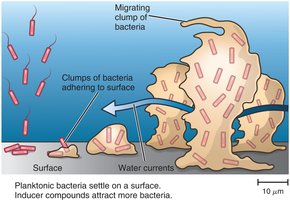
Example: Streptococcus mutans forms dental plaques, leading to dental caries.
Culture Media
Types of Culture Media
Chemically Defined Media: Exact chemical composition is known; used for fastidious organisms.
Complex Media: Contains extracts and digests of yeasts, meat, or plants; composition varies (e.g., Trypticase Soy Agar).
Reducing Media: Contains chemicals that remove oxygen; used for cultivating anaerobes (e.g., sodium thioglycolate broth).
Enriched Media: Contains additional nutrients to support growth of fastidious organisms (e.g., chocolate agar, blood agar).
Selective Media: Suppresses unwanted microbes and encourages desired ones (e.g., Sabouraud Dextrose Agar for fungi).
Differential Media: Distinguishes colonies based on metabolic reactions (e.g., blood agar for hemolysis).
Selective and Differential Media: Both selects and differentiates (e.g., MacConkey Agar, Mannitol Salt Agar).
Common Media and Their Uses
Media | Type | Appearance/Result | Interpretation/Use |
|---|---|---|---|
Trypticase Soy Agar (TSA) | Complex | Growth/cloudy broth | Grows many nonfastidious organisms |
Chocolate Agar | Enriched | Growth of fastidious organisms | Pathogenic Neisseria & Haemophilus |
Colistin Nalidixic Acid Agar (CNA) | Selective | Growth | Selects for Gram-positive, inhibits Gram-negative |
MacConkey Agar | Selective & Differential | Dark pink/clear colonies | Selects for Gram-negative; lactose fermenters appear pink |
Mannitol Salt Agar (MSA) | Selective & Differential | Yellow/clear colonies | Selects for Staphylococcus; differentiates S. aureus (yellow) from others |
Thayer Martin Agar | Enriched & Selective | Growth | Pathogenic Neisseria |
Sabouraud Dextrose Agar | Selective | Growth | Fungi (yeasts and molds) |
Blood Agar | Enriched & Differential | Clear/green zones | Hemolysis patterns for Streptococcus |
Sodium Thioglycolate Broth | Reducing | Turbidity | Obligate anaerobes (e.g., Clostridium) |
Special Culture Techniques
Capnophiles: Require elevated CO2; grown in candle jars or CO2 incubators (e.g., Neisseria, Haemophilus).
Anaerobes: Grown in anaerobic jars or chambers (e.g., Clostridium).
Cell Culture: Used for obligate intracellular bacteria (e.g., Chlamydia, Rickettsia) and viruses.
Biosafety Levels (BSL)
BSL-1: Basic teaching labs; no special precautions.
BSL-2: Moderate risk; lab coat, gloves, eye protection.
BSL-3: Infectious agents; biosafety cabinets, controlled access.
BSL-4: High-risk, life-threatening agents; sealed, negative pressure labs.
Specimen Collection and Transport
Types: Stool, blood, tissue, sterile fluids, urine, respiratory, urogenital, wound, ear, eye, etc.
Unacceptable: Dry swabs, unlabeled, unsterile containers, improper transport.
Special handling: Urine (midstream, sterile container, refrigerate if delayed), sputum (first morning, deep cough).
Obtaining a Pure Culture
Colony: Visible mass of microbial cells from a single cell or group.
Pure Culture: Population from a single cell, spore, or group.
Streak Plate Method: Used to isolate pure cultures by spreading cells over agar surface to obtain isolated colonies.
Growth of Bacterial Cultures
Binary Fission
Bacteria reproduce by binary fission, a process where one cell divides into two identical daughter cells.
Generation Time
The time required for a bacterial population to double in number.
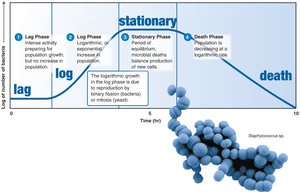
Phases of Bacterial Growth Curve
Lag Phase: Cells adjust to environment; no increase in number.
Log (Exponential) Phase: Rapid cell division; population increases exponentially.
Stationary Phase: Growth rate slows; nutrients deplete, waste accumulates; cell death balances new cells.
Death (Decline) Phase: Cells die faster than new cells form; population declines.
Measuring Microbial Growth
Direct Methods
Plate Counts
Filtration
Direct Microscopic Count
Most Probable Number (MPN)
Indirect Methods
Turbidity (cloudiness of a culture)
Metabolic Activity (e.g., acid or gas production)
Dry Weight (mass of cells)
Key Terms and Definitions
Pure Culture: Population of cells from a single cell or spore.
Colony: Visible mass of microbial cells on solid medium.
Inoculum: Microbes introduced into a culture medium.
Streak Plate Technique: Method to isolate pure cultures.
Binary Fission: Asexual reproduction in bacteria.
Generation Time: Time for population to double.
Summary Table: Media Types and Uses
Media Type | Purpose | Example |
|---|---|---|
Enriched | Supports growth of fastidious organisms | Chocolate agar |
Differential | Distinguishes between organisms | Blood agar |
Selective | Suppresses unwanted, encourages desired | Sabouraud Dextrose Agar |
Selective & Differential | Both selects and distinguishes | MacConkey Agar, Mannitol Salt Agar |
Equations
Generation Time Equation:
Where = final number of cells, = initial number of cells, = number of generations.
Growth Rate Equation:
Where = total time, = number of generations.
Additional info: Some details (e.g., specific supplements for enriched media, exact definitions for all terms) were inferred based on standard microbiology curriculum.
