 Indietro
Microbial Metabolism: Catabolic and Anabolic Pathways
Guida di studio - Note intelligenti
 Appunti personalizzati basati sui tuoi materiali, ampliati con definizioni chiave, esempi e contesto.
Microbial Metabolism
Summary of Glucose Catabolism
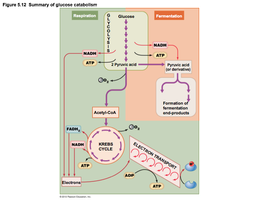
Microbial metabolism involves the breakdown of glucose through several interconnected pathways, primarily respiration and fermentation. These processes allow cells to extract energy and generate precursor metabolites for biosynthesis.
Respiration: Complete oxidation of glucose to CO2 and H2O, yielding maximum ATP.
Fermentation: Partial oxidation of glucose, yielding less ATP and producing organic end-products.
Key intermediates: Pyruvic acid, Acetyl-CoA, NADH, FADH2.
ATP generation: Occurs via substrate-level and oxidative phosphorylation.
Electron carriers: NAD+ and FAD are reduced during catabolism and reoxidized in the electron transport chain or fermentation.
Electron Transport Chain (ETC)
The electron transport chain is a series of carrier molecules that transfer electrons from NADH and FADH2 to a final electron acceptor, generating a proton gradient across the membrane. This gradient powers ATP synthesis.
Location: Inner mitochondrial membrane (eukaryotes), cytoplasmic membrane (prokaryotes).
Carrier molecules: Flavoproteins, ubiquinones, metal-containing proteins, cytochromes.
Aerobic respiration: Oxygen is the final electron acceptor.
Anaerobic respiration: Other molecules (e.g., nitrate, sulfate) serve as final electron acceptors.
Chemiosmosis and ATP Synthesis
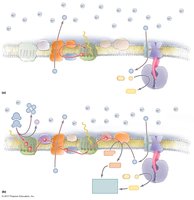
Chemiosmosis refers to the use of the proton gradient generated by the ETC to drive ATP synthesis via ATP synthase. This process is called oxidative phosphorylation.
Proton gradient: Created by redox reactions in the ETC.
ATP synthase: Enzyme that phosphorylates ADP to ATP as protons flow down their gradient.
Yield: Up to 34 ATP molecules per glucose in prokaryotic aerobic respiration.
Summary of Ideal Prokaryotic Aerobic Respiration
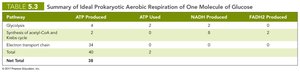
The following table summarizes ATP, NADH, and FADH2 production during aerobic respiration of one glucose molecule in prokaryotes.
Pathway | ATP Produced | ATP Used | NADH Produced | FADH2 Produced |
|---|---|---|---|---|
Glycolysis | 4 | 2 | 2 | 0 |
Synthesis of acetyl-CoA and Krebs cycle | 2 | 0 | 8 | 2 |
Electron transport chain | 34 | 0 | 0 | 0 |
Total | 40 | 2 | 10 | 2 |
Net Total | 38 |
Fermentation
Fermentation is an alternative pathway for energy production when cells cannot use respiration. It regenerates NAD+ by transferring electrons to organic molecules, allowing glycolysis to continue.
Partial oxidation: Only part of the substrate is oxidized.
Final electron acceptor: An organic molecule from within the cell.
ATP yield: Much lower than respiration.
Importance: Maintains NAD+ supply for glycolysis.
Comparison of Catabolic Pathways
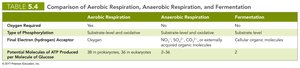
The following table compares aerobic respiration, anaerobic respiration, and fermentation.
Aerobic Respiration | Anaerobic Respiration | Fermentation | |
|---|---|---|---|
Oxygen Required | Yes | No | No |
Type of Phosphorylation | Substrate-level and oxidative | Substrate-level and oxidative | Substrate-level |
Final Electron Acceptor | Oxygen | NO3-, SO42-, CO2, externally acquired organic molecules | Cellular organic molecules |
Potential ATP Yield | 38 in prokaryotes, 36 in eukaryotes | 2-36 | 2 |
Photosynthesis
Overview and Key Structures
Photosynthesis is the process by which organisms convert light energy into chemical energy, synthesizing carbohydrates from CO2 and H2O. Chlorophylls are the main pigments involved, and photosystems are complexes that harvest light.
Chlorophyll: Pigment with a hydrocarbon tail and magnesium-centered active site.
Photosystems: Light-harvesting matrices embedded in thylakoid membranes.
Types: Photosystem I (PS I) and Photosystem II (PS II).
Arrangement: In stacks called grana; stroma is the surrounding space.
Light-Dependent Reactions
Light-dependent reactions use energy from light to drive electron transport, creating a proton gradient for ATP synthesis (photophosphorylation). These reactions can be cyclic or noncyclic.
Cyclic photophosphorylation: Electrons return to the original photosystem, generating ATP only.
Noncyclic photophosphorylation: Electrons are transferred to NADP+, generating both ATP and NADPH.
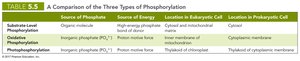
Comparison of Phosphorylation Types
The following table compares substrate-level, oxidative, and photophosphorylation.
Source of Phosphate | Source of Energy | Location in Eukaryotic Cell | Location in Prokaryotic Cell | |
|---|---|---|---|---|
Substrate-level | Organic molecule | High-energy phosphate bond of substrate | Cytosol and mitochondrial matrix | Cytosol |
Oxidative | Inorganic phosphate (PO43-) | Proton motive force | Inner membrane of mitochondrion | Cytoplasmic membrane |
Photophosphorylation | Inorganic phosphate (PO43-) | Proton motive force | Thylakoid of chloroplast | Thylakoid or cytoplasmic membrane |
Light-Independent Reactions (Calvin-Benson Cycle)
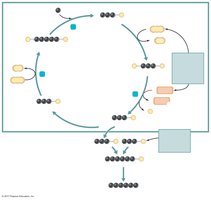
These reactions do not require light directly and use ATP and NADPH from light-dependent reactions to fix carbon dioxide into organic molecules.
Key steps: Fixation of CO2, reduction, regeneration of RuBP.
Product: Glyceraldehyde 3-phosphate (G3P), which can be used to form glucose and other carbohydrates.
Other Catabolic and Anabolic Pathways
Alternative Catabolic Pathways
Microbes can catabolize lipids and proteins, converting them into precursor metabolites for glycolysis and the Krebs cycle.
Lipids: Broken down into fatty acids and glycerol.
Proteins: Broken down into amino acids, which are deaminated and fed into the Krebs cycle.
Anabolic Pathways and Amphibolic Reactions
Anabolic reactions synthesize macromolecules using energy and precursor metabolites. Many pathways are reversible (amphibolic), allowing cells to adapt to metabolic needs.
Energy source: ATP from catabolic reactions.
Examples: Gluconeogenesis, biosynthesis of carbohydrates, lipids, and amino acids.
Amphibolic pathways: Can proceed in either direction depending on cellular requirements.
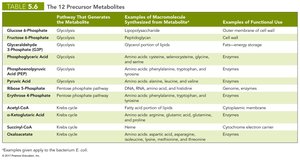
Precursor Metabolites
The following table lists the 12 precursor metabolites, their pathways, and their functional uses.
Metabolite | Pathway | Macromolecule Synthesized | Functional Use |
|---|---|---|---|
Glucose 6-phosphate | Glycolysis | Polysaccharide | Outer membrane of cell wall |
Fructose 6-phosphate | Glycolysis | Peptidoglycan | Cell wall |
Glyceraldehyde 3-phosphate (G3P) | Glycolysis | Glycerol portion of lipids | Fat—energy storage |
Pyruvic acid | Glycolysis | Amino acids, valine, alanine, leucine | Enzymes |
Phosphoenolpyruvic acid (PEP) | Glycolysis | Amino acids, phenylalanine, tryptophan | Enzymes |
Ribose 5-phosphate | Pentose phosphate pathway | DNA, RNA, histidine, tryptophan | Genetic material |
Acetyl-CoA | Krebs cycle | Fatty acid portion of lipids | Membranes |
Succinyl-CoA | Krebs cycle | Porphyrins | Cytochrome membrane |
Integration and Regulation of Metabolic Function
Metabolic Regulation
Cells regulate metabolism by controlling enzyme synthesis and activity, channel and transport protein production, and feedback inhibition. Eukaryotic cells compartmentalize metabolic pathways within organelles.
Enzyme regulation: Allosteric sites and feedback inhibition.
Gene expression: Control of protein production timing and amount.
Metabolic expression: Control of enzyme activity post-production.
Amphibolic pathway regulation: Different coenzymes required for each direction.


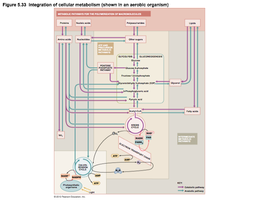
Integration of Cellular Metabolism
Cellular metabolism is highly integrated, with catabolic and anabolic pathways interconnected. Cells prioritize energy-efficient substrates and regulate synthesis based on metabolite availability.
Channel and transport proteins: Synthesized or degraded as needed.
Enzyme synthesis: Induced only when substrate is available.
Energy source prioritization: Most efficient substrate used first.
Metabolite synthesis: Ceased if metabolite is available externally.
Human Metabolism Overall
Human metabolism encompasses all catabolic and anabolic reactions, integrating energy production, biosynthesis, and regulation to maintain cellular and organismal function.
