Indietro
Microbial Metabolism: Catabolic and Anabolic Pathways
Guida di studio - Note intelligenti
 Appunti personalizzati basati sui tuoi materiali, ampliati con definizioni chiave, esempi e contesto.
Microbial Metabolism
Overview of Glucose Catabolism
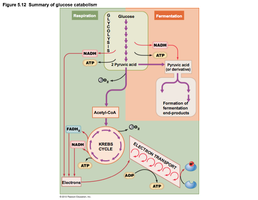
Microbial metabolism encompasses the chemical processes that occur within microorganisms to maintain life. The catabolism of glucose is central to energy production in cells, involving glycolysis, the Krebs cycle, and the electron transport chain (ETC). Cells may also utilize fermentation when oxygen or other electron acceptors are unavailable.
Glycolysis: The breakdown of glucose to pyruvate, generating ATP and NADH.
Krebs Cycle: Oxidizes acetyl-CoA to CO2, producing NADH, FADH2, and ATP.
Electron Transport Chain (ETC): Uses electrons from NADH and FADH2 to generate a proton gradient for ATP synthesis.
Fermentation: An anaerobic process that regenerates NAD+ and produces organic end-products.
Electron Transport Chain (ETC)
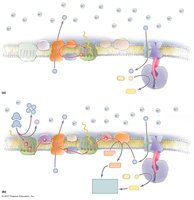
The ETC is the site of the most significant ATP production in aerobic and anaerobic respiration. It consists of a series of carrier molecules that transfer electrons to a final electron acceptor, using the released energy to pump protons and establish a proton gradient.
Location: Inner mitochondrial membrane (eukaryotes), cytoplasmic membrane (prokaryotes).
Carrier Molecules: Flavoproteins, ubiquinones, metal-containing proteins, cytochromes.
Aerobic Respiration: Oxygen is the final electron acceptor.
Anaerobic Respiration: Other molecules (e.g., NO3-, SO42-, CO2) serve as final electron acceptors.
Chemiosmosis and ATP Synthesis
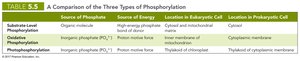
Chemiosmosis refers to the use of a proton gradient generated by the ETC to drive ATP synthesis via ATP synthase. This process is called oxidative phosphorylation.
Proton Motive Force: Protons flow down their gradient through ATP synthase, phosphorylating ADP to ATP.
ATP Yield: Approximately 34 ATP molecules are produced from one molecule of glucose in prokaryotic aerobic respiration.
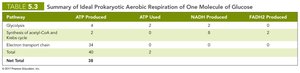
Summary of Ideal Prokaryotic Aerobic Respiration
The following table summarizes the ATP, NADH, and FADH2 yields from each stage of aerobic respiration in prokaryotes:
Pathway | ATP Produced | ATP Used | NADH Produced | FADH2 Produced |
|---|---|---|---|---|
Glycolysis | 4 | 2 | 2 | 0 |
Synthesis of acetyl-CoA and Krebs cycle | 2 | 0 | 8 | 2 |
Electron transport chain | 34 | 0 | 0 | 0 |
Total | 40 | 2 | 10 | 2 |
Net Total | 38 | |||
Comparison of Aerobic Respiration, Anaerobic Respiration, and Fermentation
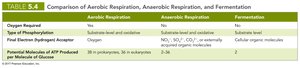
The following table compares the three major catabolic pathways:
Aerobic Respiration | Anaerobic Respiration | Fermentation | |
|---|---|---|---|
Oxygen Required | Yes | No | No |
Type of Phosphorylation | Substrate-level and oxidative | Substrate-level and oxidative | Substrate-level |
Final Electron Acceptor | Oxygen | NO3-, SO42-, CO2, or externally acquired organic molecules | Cellular organic molecules |
Potential ATP Yield per Glucose | 38 (prokaryotes), 36 (eukaryotes) | 2–36 | 2 |
Fermentation
Fermentation is an anaerobic process that allows cells to regenerate NAD+ from NADH, enabling glycolysis to continue in the absence of a functional ETC. It results in the partial oxidation of substrates and the production of organic end-products such as lactic acid or ethanol.
Purpose: Regenerate NAD+ for glycolysis.
End-Products: Organic acids, alcohols, gases.
Alternatives to Glycolysis
Some microbes utilize alternative pathways to glycolysis, which yield fewer ATP but provide important precursor metabolites for biosynthesis.
Pentose Phosphate Pathway: Generates NADPH and pentoses for nucleotide synthesis.
Entner-Doudoroff Pathway: Found in some bacteria, yields NADPH and ATP.
Catabolism of Other Molecules
Microbes can catabolize lipids and proteins to generate energy and precursor metabolites. Lipids are broken down by lipases, and proteins by proteases, with their components entering glycolysis or the Krebs cycle after modification (e.g., deamination of amino acids).
Photosynthesis
Photosynthesis is the process by which organisms synthesize organic molecules from CO2 using light energy. It involves light-dependent reactions (producing ATP and NADPH) and light-independent reactions (Calvin-Benson cycle for carbon fixation).
Chlorophylls: Pigments that absorb light energy.
Photosystems: Complexes of pigments and proteins that capture light energy.
Photophosphorylation: ATP synthesis driven by light-induced electron flow (cyclic or noncyclic).
Light-Independent Reactions (Calvin-Benson Cycle)
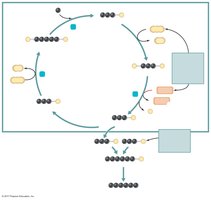
The Calvin-Benson cycle uses ATP and NADPH from the light-dependent reactions to fix CO2 into organic molecules. The main steps are CO2 fixation, reduction, and regeneration of ribulose bisphosphate (RuBP).
Other Anabolic Pathways
Anabolic reactions synthesize complex molecules from simpler ones, requiring energy and precursor metabolites. Many anabolic pathways are the reverse of catabolic pathways and are termed amphibolic if they can proceed in both directions.
Gluconeogenesis: Synthesis of glucose from non-carbohydrate precursors.
Biosynthesis of Fats: Fatty acids and glycerol are synthesized from acetyl-CoA and DHAP, respectively.
Integration and Regulation of Metabolic Function
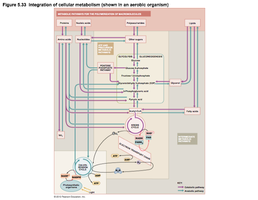
Cells regulate metabolism by controlling enzyme synthesis and activity, substrate availability, and feedback inhibition. Eukaryotic cells compartmentalize metabolic pathways within organelles, while prokaryotes regulate pathways through gene expression and enzyme activity.
Allosteric Regulation: Enzyme activity is modulated by effectors binding to sites other than the active site.
Feedback Inhibition: End-products inhibit pathway enzymes to prevent overproduction.
Amphibolic Pathways: Pathways that function in both catabolism and anabolism, regulated by different coenzymes.
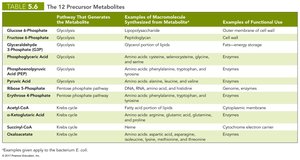
Summary Table: The 12 Precursor Metabolites
Precursor Metabolite | Pathway That Generates | Examples of Macromolecules Synthesized | Examples of Functional Use |
|---|---|---|---|
Glucose 6-phosphate | Glycolysis | Lipopolysaccharide | Outer membrane of cell wall |
Fructose 6-phosphate | Glycolysis | Peptidoglycan | Cell wall |
Glyceraldehyde 3-phosphate (G3P) | Glycolysis | Glycerol portion of lipids | Fat storage |
Phosphoglyceric acid | Glycolysis | Amino acids: serine, glycine, cysteine | Enzymes |
Phosphoenolpyruvic acid (PEP) | Glycolysis | Amino acids: phenylalanine, tryptophan, tyrosine | Enzymes |
Pyruvic acid | Glycolysis | Amino acids: alanine, leucine, valine | Enzymes |
Ribose 5-phosphate | Pentose phosphate pathway | DNA, RNA, certain amino acids | Genetic information, enzymes |
Acetyl-CoA | Krebs cycle | Fatty acids, some amino acids | Membranes, enzymes |
Succinyl-CoA | Krebs cycle | Porphyrins (e.g., heme) | Cytochrome membrane |