 Indietro
Microbial Metabolism: Catabolism, Anabolism, and Energy Pathways
Guida di studio - Note intelligenti
 Appunti personalizzati basati sui tuoi materiali, ampliati con definizioni chiave, esempi e contesto.
Microbial Metabolism
Overview of Metabolism
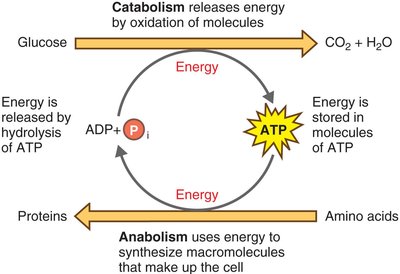
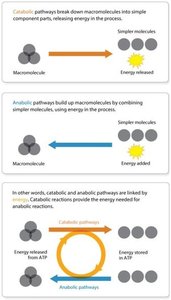
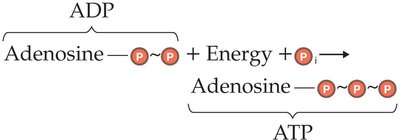
Metabolism encompasses all chemical reactions occurring within a microorganism, divided into two main types: catabolism and anabolism. These processes are interconnected through the molecule ATP, which stores and transfers energy within the cell.
Catabolism: The breakdown of complex molecules into simpler ones, releasing energy (often captured as ATP).
Anabolism: The synthesis of complex molecules from simpler ones, requiring energy input (usually from ATP hydrolysis).
ATP (Adenosine Triphosphate): The primary energy currency of the cell, linking catabolic and anabolic reactions.
Enzymes and Metabolic Pathways
Role and Mechanism of Enzymes
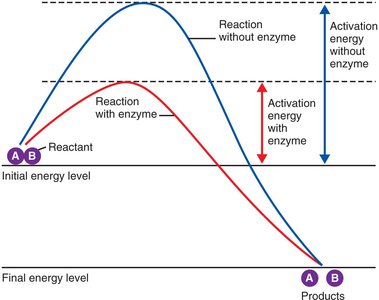
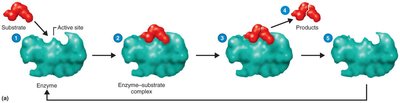
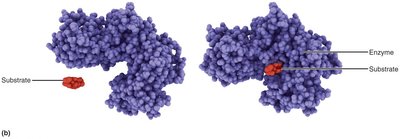
Enzymes are biological catalysts, typically proteins, that accelerate metabolic reactions by lowering the activation energy required. Each enzyme is specific to a particular substrate and reaction.
Metabolic Pathway: A sequence of enzyme-catalyzed reactions in a cell.
Enzyme Specificity: Determined by the shape of the enzyme's active site, allowing only specific substrates to bind.
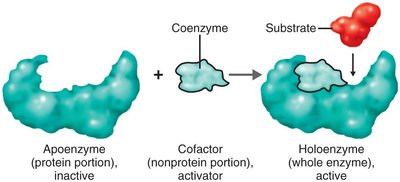
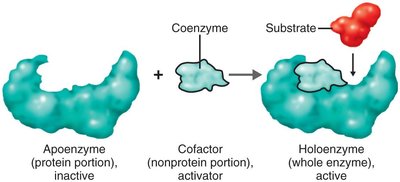
Enzyme Structure: Many enzymes require a non-protein component (cofactor) to be active. The complete, active enzyme is called a holoenzyme.
Enzyme Components
Apoenzyme: The protein portion, inactive alone.
Cofactor: Non-protein component (can be inorganic ions like Fe2+, Zn2+, or organic molecules called coenzymes such as NAD+, FAD, Coenzyme A).
Holoenzyme: The active enzyme, consisting of the apoenzyme plus its cofactor.
Factors Influencing Enzyme Activity
Enzyme activity is affected by several environmental and chemical factors:
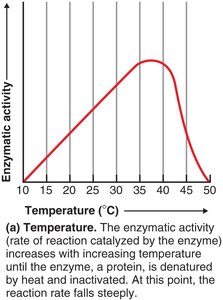
Temperature: Enzyme activity increases with temperature up to an optimum, then decreases due to denaturation.
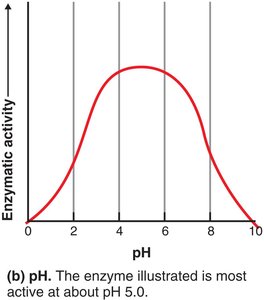
pH: Each enzyme has an optimal pH; activity decreases above or below this value.
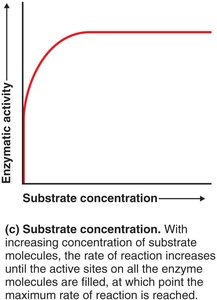
Substrate Concentration: Activity increases with substrate concentration until all enzyme active sites are saturated.
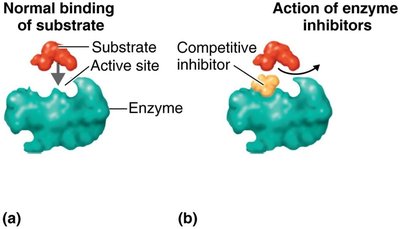
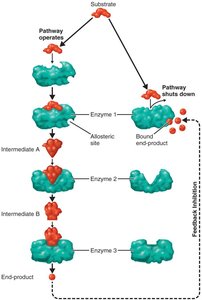
Inhibitors: Chemicals that decrease enzyme activity. Competitive inhibitors bind the active site, while non-competitive inhibitors bind elsewhere (allosteric site).
ATP Generation and Energy Transfer
ATP Synthesis Mechanisms
ATP is generated in cells by three main mechanisms:
Substrate-Level Phosphorylation: Direct transfer of a phosphate group from a substrate to ADP, forming ATP.
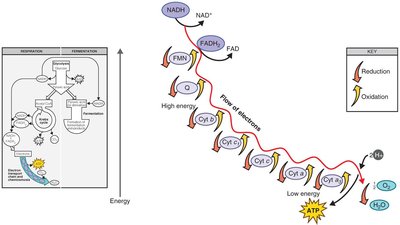
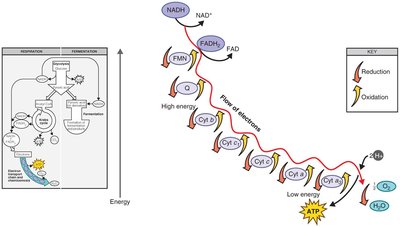
Oxidative Phosphorylation: ATP is produced using energy derived from the transfer of electrons through an electron transport chain to a final electron acceptor (e.g., O2), coupled with chemiosmosis.
Photophosphorylation: In photosynthetic organisms, light energy is used to generate ATP.
Oxidation-Reduction (Redox) Reactions
Redox in Metabolism
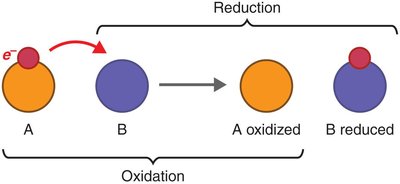
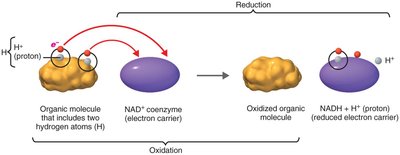
Redox reactions are central to energy transfer in cells. Oxidation is the loss of electrons, while reduction is the gain of electrons. In biological systems, these reactions often involve the transfer of hydrogen atoms.
Redox Pair: One molecule is oxidized (loses electrons), another is reduced (gains electrons).
Electron Carriers: NAD+, NADP+, and FAD are common coenzymes that shuttle electrons during metabolic reactions.
Carbohydrate Catabolism
Glycolysis
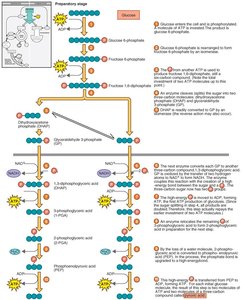
Glycolysis is the oxidation of glucose to pyruvic acid, producing ATP and NADH. It consists of two main stages: the preparatory stage (investment of ATP) and the energy-conserving stage (production of ATP and NADH).
Preparatory Stage: 2 ATP are used to phosphorylate glucose and split it into two three-carbon sugars.
Energy-Conserving Stage: The three-carbon sugars are oxidized, generating 4 ATP (net gain of 2 ATP) and 2 NADH.
Alternative Pathways
Pentose Phosphate Pathway: Breaks down five-carbon sugars and glucose, producing NADPH and precursors for biosynthesis.
Entner-Doudoroff Pathway: Alternative to glycolysis, found in some bacteria, producing NADPH, NADH, and ATP.
Krebs Cycle (Citric Acid Cycle, TCA Cycle)
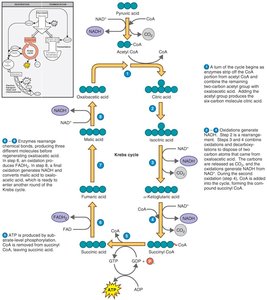
The Krebs cycle completes the oxidation of glucose derivatives, producing ATP, NADH, FADH2, and CO2. Acetyl-CoA enters the cycle, and through a series of reactions, high-energy electron carriers are generated for use in the electron transport chain.
For each acetyl-CoA: 1 ATP, 3 NADH, and 1 FADH2 are produced.
Electron Transport Chain and Chemiosmosis
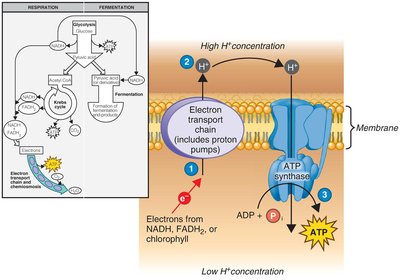
The electron transport chain (ETC) is a series of membrane-bound carriers that transfer electrons from NADH and FADH2 to a final electron acceptor (O2 in aerobic respiration), generating a proton gradient used to synthesize ATP via ATP synthase (chemiosmosis).
Prokaryotes: ETC is located in the plasma membrane.
Eukaryotes: ETC is located in the inner mitochondrial membrane.
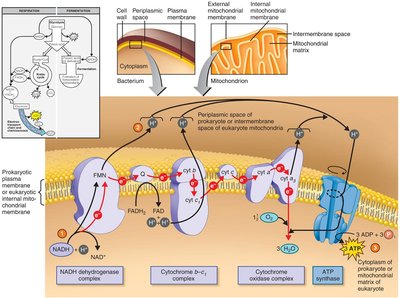
ATP Yield from Aerobic Respiration
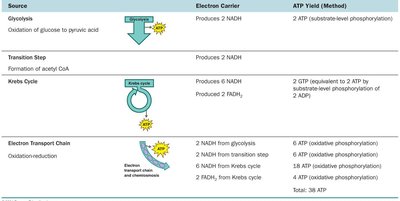
The complete aerobic oxidation of one glucose molecule yields up to 38 ATP in prokaryotes.
Source | Electron Carrier | ATP Yield (Method) |
|---|---|---|
Glycolysis | 2 NADH | 2 ATP (substrate-level phosphorylation) |
Transition Step | 2 NADH | - |
Krebs Cycle | 6 NADH, 2 FADH2 | 2 GTP (equivalent to 2 ATP, substrate-level phosphorylation) |
Electron Transport Chain | All NADH, FADH2 | 34 ATP (oxidative phosphorylation) |
Total | 38 ATP |
Anaerobic Respiration
In anaerobic respiration, the final electron acceptor is not oxygen but another inorganic molecule (e.g., nitrate, sulfate, carbonate). Less ATP is produced compared to aerobic respiration.
Fermentation
Overview and Types
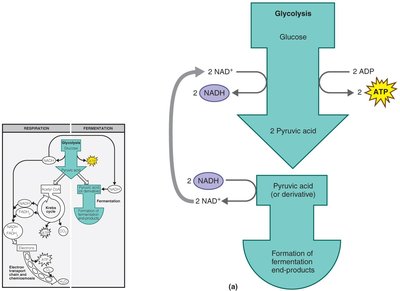
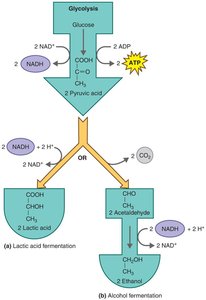
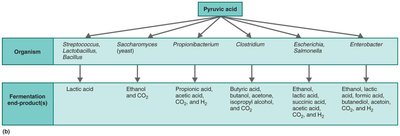
Fermentation is an anaerobic process that allows ATP production by substrate-level phosphorylation when the electron transport chain is unavailable. The final electron acceptor is an organic molecule.
Alcohol Fermentation: Converts pyruvic acid to ethanol and CO2 (e.g., Saccharomyces).
Lactic Acid Fermentation: Converts pyruvic acid to lactic acid (e.g., Streptococcus, Lactobacillus).
Homolactic: Only lactic acid is produced.
Heterolactic: Lactic acid and other compounds are produced.
Catabolism of Other Organic Molecules
Lipid and Protein Catabolism
Microbes can also catabolize lipids and proteins for energy:
Lipids: Broken down by lipases into glycerol and fatty acids. Glycerol enters glycolysis; fatty acids undergo beta-oxidation to form acetyl-CoA for the Krebs cycle.
Proteins: Degraded by proteases and peptidases into amino acids, which are deaminated and converted into intermediates for the Krebs cycle.
Summary Table: ATP Yield During Prokaryotic Aerobic Respiration
Pathway | ATP Produced |
|---|---|
Glycolysis | 2 (substrate-level) |
Krebs Cycle | 2 (substrate-level) |
Electron Transport Chain | 34 (oxidative phosphorylation) |
Total | 38 |
Additional info: These notes provide a comprehensive overview of microbial metabolism, focusing on the central pathways and regulatory mechanisms relevant to college-level microbiology.
