 Indietro
Microbial Metabolism II: Catabolic and Anabolic Pathways, Photosynthesis, and Metabolic Diversity
Guida di studio - Note intelligenti
 Appunti personalizzati basati sui tuoi materiali, ampliati con definizioni chiave, esempi e contesto.
Microbial Metabolism II
Overview of Microbial Metabolism
Microbial metabolism encompasses the biochemical reactions that allow microorganisms to break down and synthesize biological molecules, generate energy, and adapt to diverse environments. This section focuses on the integration of catabolic and anabolic pathways, the breakdown and synthesis of biomolecules, and the diversity of metabolic strategies among microbes.
Lipid Catabolism
Breakdown of Lipids for Energy
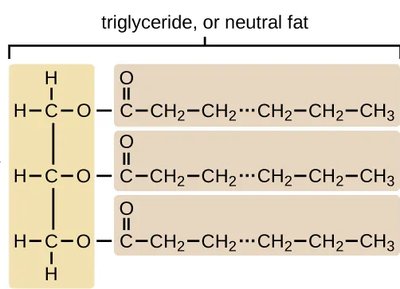
Lipids are hydrolyzed by extracellular lipases into glycerol and fatty acids, which are then processed through central metabolic pathways to generate ATP.
Glycerol: Converted to dihydroxyacetone phosphate, then to glyceraldehyde 3-phosphate, entering glycolysis.
Fatty acids: Converted to acetyl CoA, which enters the Krebs cycle for further oxidation.
Enzymes: Lipases catalyze the hydrolysis of triglycerides.
Example: Bacteria can utilize fats as energy sources during nutrient scarcity.
Protein Catabolism
Breakdown of Proteins and Amino Acids
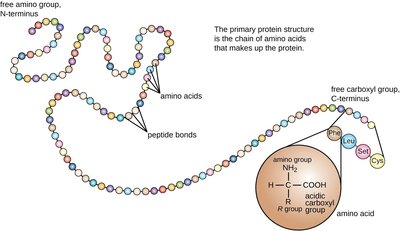
Proteins are hydrolyzed by extracellular proteases and peptidases into amino acids, which are transported into the cell and further metabolized.
Deamination: Removal of the amino group (-NH2) from amino acids, producing organic acids that enter the Krebs cycle.
Entry Points: Different amino acids enter central metabolism at various points.
Example: Microbes can use proteins as carbon and energy sources when sugars are unavailable.
Anabolic Pathways: Biosynthesis of Biomolecules
Polysaccharide Biosynthesis
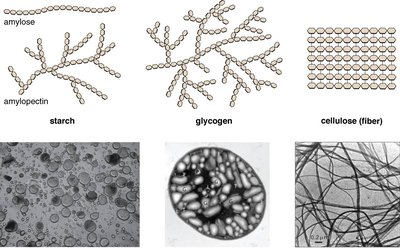
Microbes synthesize complex carbohydrates for energy storage and structural purposes.
Glycogen: A branched polysaccharide of glucose used for energy storage.
Peptidoglycan: A structural polysaccharide forming the bacterial cell wall.
Lipid Biosynthesis
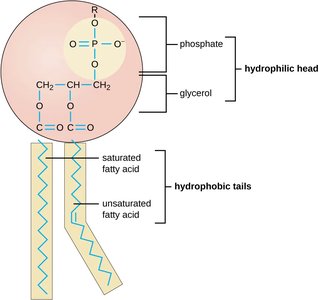
Lipids are synthesized from glycerol and fatty acids, forming cellular membranes and pigments.
Membranes: Phospholipids are key components of cell membranes.
Pigments: Chlorophyll and other pigments are synthesized for photosynthesis.
Amino Acid Biosynthesis
Amino acids are synthesized from organic acids and amino groups, with further modifications producing diverse R-groups.
Pathways: Central metabolic intermediates are used to build amino acids.
Example: Synthesis of serine, cysteine, and alanine from glycolytic intermediates.
Nucleotide Biosynthesis
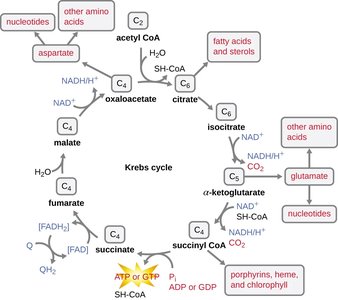
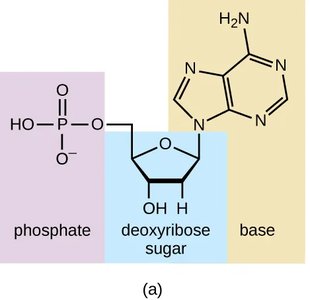
Nucleotides are synthesized from amino acids and pentose sugars, which are produced by the pentose phosphate pathway.
Pyrimidines and Purines: Built from amino acid precursors.
Pentose Sugars: Ribose and deoxyribose are synthesized for nucleotide assembly.
Integration of Metabolic Pathways
Amphibolic Pathways
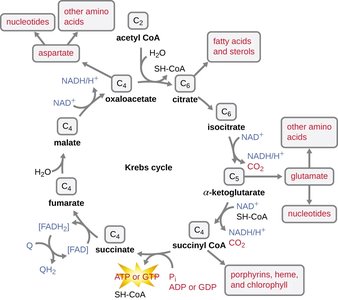
Amphibolic pathways serve dual purposes, functioning in both catabolism and anabolism. These pathways are highly regulated to balance energy production and biosynthesis.
Krebs Cycle: Central to both energy generation and precursor supply for biosynthesis.
Regulation: Enzyme activity is tightly controlled to meet cellular needs.
Photosynthesis in Microbes
Overview of Photosynthesis
Photosynthesis converts light energy into chemical energy, enabling the fixation of CO2 into organic molecules. It consists of light-dependent and light-independent reactions.
Light-dependent reactions: Generate ATP and NADPH.
Light-independent reactions: Use ATP and NADPH for carbon fixation (Calvin-Benson cycle).
Light-Dependent Reactions
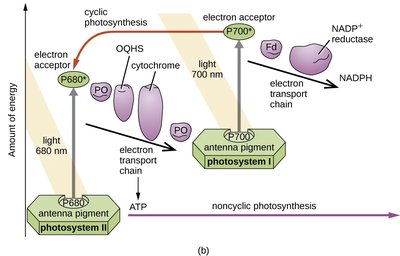
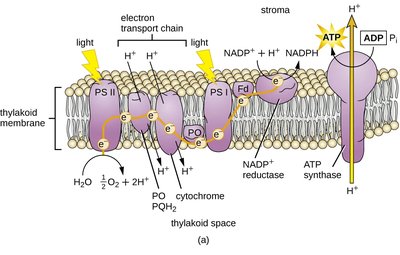
These reactions occur in the thylakoid membranes and involve the conversion of light energy to chemical energy.
Cyclic photophosphorylation: Electrons cycle within photosystem I, generating ATP.
Noncyclic photophosphorylation: Electrons flow from photosystem II to photosystem I, producing ATP, NADPH, and O2 by splitting water.
Light-Independent Reactions: Calvin-Benson Cycle
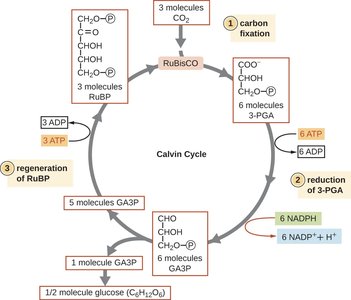
The Calvin-Benson cycle fixes carbon dioxide into organic molecules using ATP and NADPH. G3P is produced and can be used to synthesize other sugars.
Inputs: 3 CO2, 9 ATP, 6 NADPH
Outputs: 1 G3P (3C), 9 ADP, 6 NADP+
Carbon Counting: Essential for understanding the cycle's stoichiometry.
Metabolic Diversity in Microbes
Classification of Microbial Metabolism
Microbes exhibit diverse metabolic strategies based on their energy and carbon sources. These classifications help understand their ecological roles and physiological capabilities.
Phototrophs: Use light as an energy source.
Chemotrophs: Use organic or inorganic compounds for energy.
Autotrophs: Use CO2 as a carbon source.
Heterotrophs: Use organic molecules as a carbon source.
Chemoheterotrophs
Chemoheterotrophs use organic compounds for both energy and carbon. Most bacteria, fungi, animals, and protozoa fall into this category.
Energy and Carbon Source: Organic molecules
Examples: Escherichia coli, fungi, animals
Chemoautotrophs
Chemoautotrophs use inorganic compounds for energy and CO2 for carbon. They fix CO2 via the Calvin-Benson cycle and produce ATP by oxidative phosphorylation.
Energy Source: Inorganic compounds (e.g., H2S, NH3, Fe2+)
Carbon Source: CO2
Examples: Acidothiobacillus, Nitrosomonas, Nitrobacter
Photoautotrophs
Photoautotrophs use light for energy and CO2 for carbon, producing oxygen as a byproduct.
Energy Source: Light
Carbon Source: CO2
Examples: Cyanobacteria, green plants, algae
Photoheterotrophs
Photoheterotrophs use light for energy and organic molecules for carbon. They do not produce oxygen (anoxygenic).
Energy Source: Light
Carbon Source: Organic molecules
Examples: Chloroflexus, Rhodopseudomonas
Summary Table: Microbial Metabolic Types
Type | Energy Source | Carbon Source | Example Organisms |
|---|---|---|---|
Chemoheterotroph | Organic compounds | Organic molecules | Bacteria, fungi, animals, protozoa |
Chemoautotroph | Inorganic compounds | CO2 | Acidothiobacillus, Nitrosomonas, Nitrobacter |
Photoautotroph | Light | CO2 | Cyanobacteria, green plants, algae |
Photoheterotroph | Light | Organic molecules | Chloroflexus, Rhodopseudomonas |
Key Equations
Photosynthesis Equations
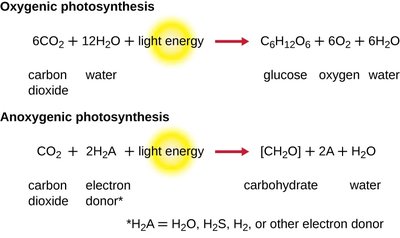
Oxygenic Photosynthesis:
Anoxygenic Photosynthesis:
where H2A can be H2O, H2S, H2, or other electron donors.
Study Questions
Describe how cells break down lipids and proteins to generate ATP.
Explain how catabolic and anabolic pathways are integrated in microbial metabolism.
Identify the products of the light reactions of photosynthesis.
Compare and contrast cyclic and noncyclic photophosphorylation.
Identify the inputs and outputs of the Calvin-Benson cycle.
Define photoautotroph, photoheterotroph, chemoautotroph, and chemoheterotroph.
