 Indietro
Microbial Metabolism: Thermodynamics, Bioenergetics, and Redox Reactions
Guida di studio - Note intelligenti
 Appunti personalizzati basati sui tuoi materiali, ampliati con definizioni chiave, esempi e contesto.
Microbial Metabolism and Energy Flow
Overview of Metabolism
Microbial metabolism encompasses all the chemical reactions that occur within microorganisms, enabling them to obtain energy, build cellular structures, and maintain life. Metabolism is divided into two main processes: anabolism (biosynthesis) and catabolism (breakdown of molecules).
Anabolism: The synthesis of macromolecules from precursor molecules, requiring energy and electrons.
Catabolism: The breakdown of energy-rich nutrients to release energy, electrons, and raw elements.
Key Point: Both processes are interconnected through the flow of energy and electrons, often mediated by molecules like ATP, NADH, and FADH2. 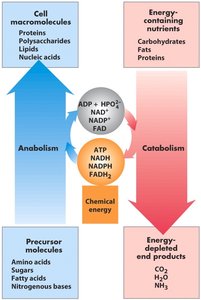
Microbial Diversity in Energy, Carbon, and Electron Acquisition
Microbes display remarkable diversity in how they acquire energy, carbon, and electrons. These sources define their ecological roles and metabolic strategies.
Energy Source:
Chemorganotrophs: Use organic molecules.
Chemolithotrophs: Use inorganic molecules.
Phototrophs: Use light.
Carbon Source:
Autotrophs: Use CO2.
Heterotrophs: Use organic molecules.
Electron Source:
Organotrophs: Use organic molecules.
Lithotrophs: Use inorganic molecules.
Example: A photolithoautotroph uses light for energy, inorganic molecules for electrons, and CO2 for carbon. 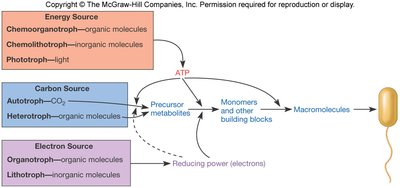
Chemical Principles of Microbial Metabolism
Organic Molecules: Glucose as a Central Metabolite
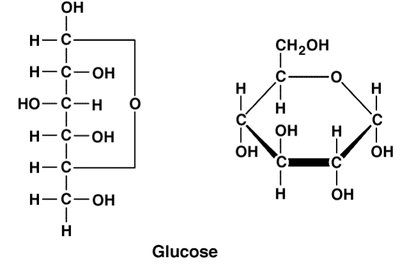
Glucose is a key organic molecule in microbial metabolism, serving as both an energy and carbon source. It exists in linear and cyclic forms.
Structure: Contains carbon-carbon bonds, making it an organic molecule.
Role: Central substrate in glycolysis and other metabolic pathways.
Thermodynamics and Bioenergetics
Basic Laws of Thermodynamics
Thermodynamics governs the direction and favorability of metabolic reactions.
First Law: Energy cannot be created or destroyed, only transformed.
Second Law: Entropy (disorder) of the universe increases in spontaneous reactions.
Key Terms:
Enthalpy (H): Total energy content.
Entropy (S): Degree of disorder.
Gibbs Free Energy (G): Usable energy for work.
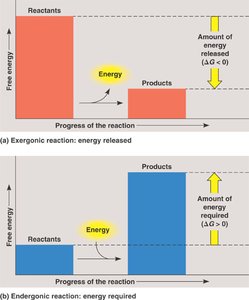
Equation: Interpretation: Negative indicates a favorable (exergonic) reaction; positive indicates an unfavorable (endergonic) reaction.
Exergonic vs. Endergonic Reactions
Exergonic: Energy-yielding, , spontaneous.
Endergonic: Energy-consuming, , non-spontaneous.
Example:
Aerobic breakdown of glucose: ( kJ/mol)
Photosynthesis: ( kJ/mol)
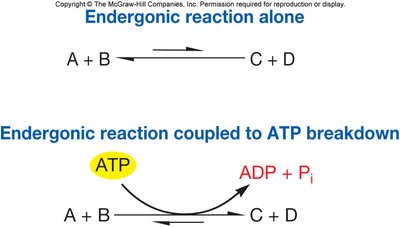
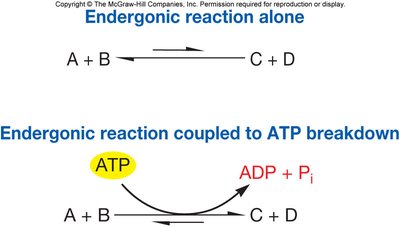
Coupling of Reactions via Enzymes
Endergonic reactions in cells are made possible by coupling them to exergonic reactions, often mediated by enzymes.
ATP hydrolysis: A highly exergonic reaction used to drive endergonic processes.
Enzymes: Lower activation energy and enable reaction coupling.
ATP: The Cellular Energy Currency
ATP Hydrolysis and Energy Release
Adenosine triphosphate (ATP) is the primary energy carrier in cells. Hydrolysis of ATP releases energy due to the instability of its phosphate bonds and increases entropy.
Reaction:
Why energy is released: Products are more stable; entropy increases.
Structure of ATP
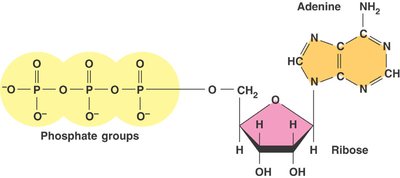
ATP consists of adenine, ribose, and three phosphate groups. The high-energy bonds between phosphates are the source of usable energy. 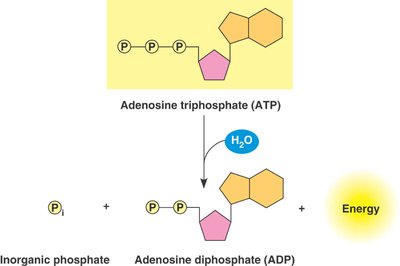
Enzymes and Reaction Rates
Role of Enzymes in Metabolism
Enzymes are biological catalysts that accelerate metabolic reactions by lowering the activation energy. They also enable the coupling of endergonic and exergonic reactions.
Activation energy (Ea): The energy barrier to reaction.
Transition-state complex: Intermediate formed during reaction.
Effect of enzyme: Reduces Ea, increases reaction rate.
Redox Reactions in Metabolism
Oxidation and Reduction
Redox reactions involve the transfer of electrons between molecules.
Oxidation: Loss of electrons.
Reduction: Gain of electrons.
Electron donor: Becomes oxidized.
Electron acceptor: Becomes reduced.
Example:
Glucose oxidation:
Photosynthesis (reduction):
Electron Flow and Energy Release
Electrons flow from molecules with lower reduction potential (E0') to those with higher E0', releasing energy. Oxygen is the ultimate electron acceptor in aerobic respiration due to its high affinity for electrons.
Electron carriers: NAD+, FAD
Electron transport chain (ETC): Series of redox reactions leading to ATP synthesis.
Metabolic Pathways and Catabolic Diversity
Metabolic Pathways
Metabolic pathways are series of linked chemical reactions, each catalyzed by a specific enzyme.
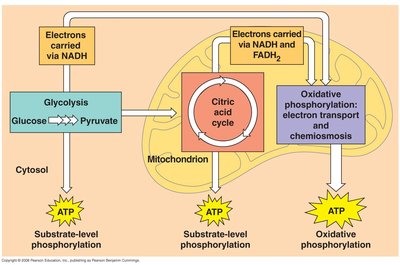
Pathways: Glycolysis, citric acid cycle, oxidative phosphorylation.
Electron carriers: NADH, FADH2 transport electrons to the ETC.
Catabolic Diversity of Microbes
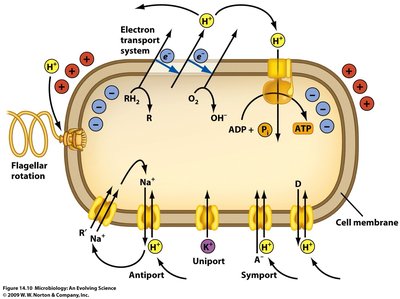
Microbes exhibit diverse catabolic strategies, allowing them to thrive in various environments and impact global biogeochemical cycles.
Substrate-level phosphorylation: Direct ATP synthesis during glycolysis and citric acid cycle.
Oxidative phosphorylation: ATP synthesis via ETC and chemiosmosis.
Summary Table: Microbial Metabolic Strategies
Source | Type | Example |
|---|---|---|
Energy | Chemorganotroph, Chemolithotroph, Phototroph | Glucose, H2, Light |
Carbon | Autotroph, Heterotroph | CO2, Organic molecules |
Electrons | Organotroph, Lithotroph | Organic, Inorganic molecules |
Additional info: The notes expand on the original content by providing definitions, examples, and context for key metabolic concepts, ensuring completeness and academic quality.
