 Indietro
Microbial Nutrition and Growth: Study Notes
Guida di studio - Note intelligenti
 Appunti personalizzati basati sui tuoi materiali, ampliati con definizioni chiave, esempi e contesto.
Microbial Nutrition and Growth
Introduction
This chapter explores the essential requirements for microbial growth, including chemical and physical factors, and the methods used to culture and study microorganisms. Understanding these requirements is fundamental for microbiology students, as it underpins laboratory techniques and the ecological roles of microbes.
Growth Requirements
Chemical and Energy Requirements
Nutrients are substances required for microbial metabolism and growth. They provide energy and building blocks for cellular structures.
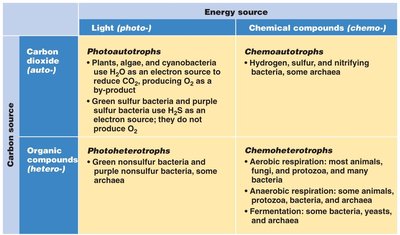
Microorganisms are classified based on their carbon and energy sources:
Carbon Source | Energy Source: Light (photo-) | Energy Source: Chemical Compounds (chemo-) |
|---|---|---|
Carbon dioxide (auto-) | Photoautotrophs: Plants, algae, cyanobacteria (use H2O as electron source, produce O2), green/purple sulfur bacteria (use H2S, do not produce O2). | Chemoautotrophs: Hydrogen, sulfur, nitrifying bacteria, some archaea. |
Organic compounds (hetero-) | Photoheterotrophs: Green/purple nonsulfur bacteria, some archaea. | Chemoheterotrophs: Aerobic/anaerobic respiration (animals, fungi, protozoa, many bacteria), fermentation (some bacteria, yeasts, archaea). |
Oxygen requirements vary among microbes:
Obligate aerobes require oxygen for growth.
Obligate anaerobes are harmed by oxygen.
Facultative anaerobes can grow with or without oxygen.
Aerotolerant anaerobes tolerate oxygen but do not use it.
Microaerophiles require reduced oxygen levels.
Toxic forms of oxygen include:
Singlet oxygen: Highly reactive, damages cells.
Superoxide radicals: Produced during incomplete reduction of O2 in the electron transport chain.
Enzymes such as superoxide dismutase and catalase detoxify these forms:
Superoxide dismutase:
Catalase:
Nitrogen, Phosphorus, Sulfur, and Other Chemical Requirements
Nitrogen is a limiting nutrient; essential for amino acids and nucleotides. Some bacteria fix atmospheric nitrogen, making it available to other organisms.
Phosphorus is needed for nucleic acids, ATP, and membranes.
Sulfur is required for some amino acids and vitamins.
Trace elements are required in small amounts (e.g., iron, copper, zinc).
Growth factors are organic compounds that some microbes cannot synthesize and must obtain from the environment (e.g., vitamins, amino acids).
Physical Requirements for Growth
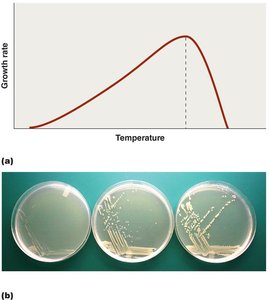
Temperature affects protein structure and membrane fluidity:
Low temperatures: Membranes become rigid and fragile.
High temperatures: Membranes become too fluid.
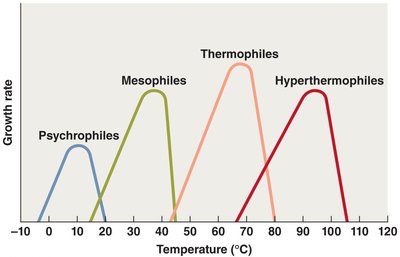
Microbes are classified by their temperature preferences:
Psychrophiles: Grow best at 0–20°C.
Mesophiles: Grow best at 20–40°C (includes most human pathogens).
Thermophiles: Grow best at 40–70°C.
Hyperthermophiles: Grow best above 70°C.
pH influences microbial growth:
Neutrophiles: Prefer neutral pH (6.5–7.5).
Acidophiles: Thrive in acidic environments.
Alkalinophiles: Live in alkaline conditions.
Microbes may alter their environment by producing acidic or basic waste products.
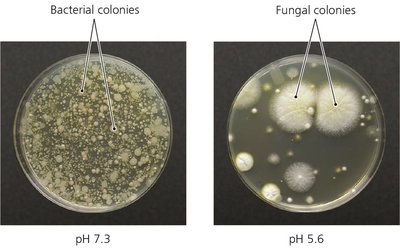
Water is essential for metabolism:
Most cells die without water, but endospores and cysts can survive desiccation.
Osmotic pressure affects cell survival:
Hypotonic solutions: Cells may swell and burst.
Hypertonic solutions: Cells shrink (plasmolysis).
Halophiles require or tolerate high salt concentrations.
Microbial Associations and Biofilms
Types of Microbial Relationships
Antagonistic: One microbe harms another.
Synergistic: Microbes cooperate for mutual benefit.
Symbiotic: Microbes are interdependent and rarely live apart.
Biofilms
Biofilms are complex communities of microorganisms attached to surfaces and embedded in a self-produced matrix.
Formed via quorum sensing, where microbes communicate and coordinate behavior.
Biofilms are common on medical devices, teeth (dental plaque), and mucous membranes.
Microbes in biofilms are often more resistant to antibiotics and immune responses.
Culturing Microorganisms
Culture Media
Most prokaryotes have not been cultured in the laboratory.
Nutrient broth and agar are common media; agar is a solidifying agent derived from red algae.
Six general types of culture media:
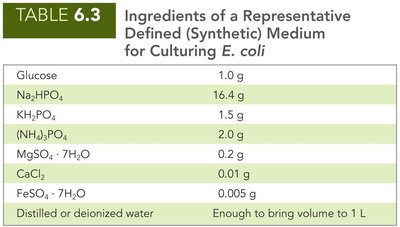
Defined (synthetic) media: Exact chemical composition is known. Used for fastidious organisms.
Ingredient | Amount (per 1 L) |
|---|---|
Glucose | 1.0 g |
Na2HPO4 | 16.4 g |
KH2PO4 | 1.5 g |
(NH4)3PO4 | 2.0 g |
MgSO4·7H2O | 0.2 g |
CaCl2 | 0.01 g |
FeSO4·7H2O | 0.005 g |
Distilled or deionized water | To 1 L |
Complex media: Exact composition is unknown; contains extracts from yeast, meat, or plants. Supports a wide variety of microbes.
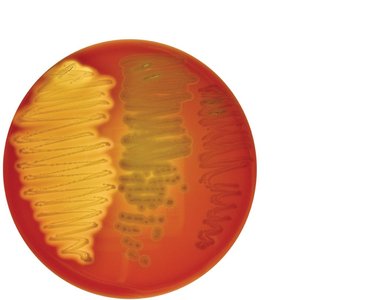
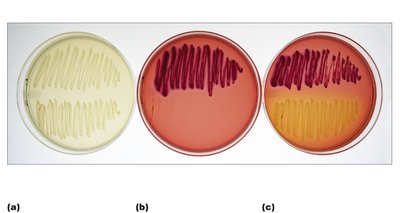
Selective media: Contains substances that favor the growth of particular microbes while inhibiting others (e.g., eosin, methylene blue, crystal violet).
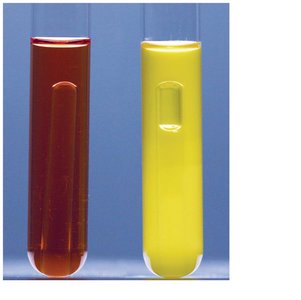
Differential media: Distinguishes between different microbes based on their biological characteristics (e.g., lactose fermentation).
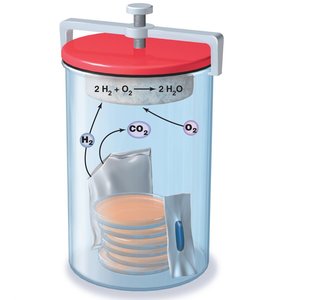
Anaerobic media: Used to culture obligate anaerobes; contains reducing agents to remove oxygen. Plates are incubated in anaerobic chambers.
Growth of Microbial Populations
Generation Time and Binary Fission
Generation time (doubling time): Time required for a cell to divide and its population to double.
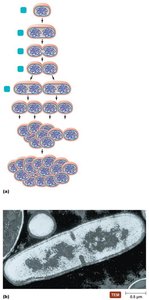
Most bacteria reproduce by binary fission:
Steps of binary fission:
Cell replicates its DNA.
Cell elongates, separating DNA molecules.
Cross wall forms; membrane invaginates.
Cross wall completes; cells separate.
Microbial Growth Curve
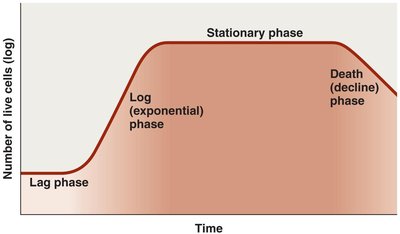
Microbial populations grow in a characteristic pattern when cultured in a closed system:
Lag phase: Cells adjust to environment; little or no division.
Log (exponential) phase: Rapid cell division; population doubles at a constant rate.
Stationary phase: Nutrient depletion and waste accumulation slow growth; cell division equals cell death.
Death (decline) phase: Cells die faster than they divide.
Additional info: Understanding microbial nutrition and growth is essential for controlling microbial populations in clinical, industrial, and environmental settings. The principles outlined here are foundational for advanced studies in microbial physiology, genetics, and biotechnology.
