 Indietro
Microbial Regulation of Gene Expression: Mechanisms and Examples Ch 7
Guida di studio - Note intelligenti
 Appunti personalizzati basati sui tuoi materiali, ampliati con definizioni chiave, esempi e contesto.
Microbial Regulation of Gene Expression
Overview of Gene Expression Regulation
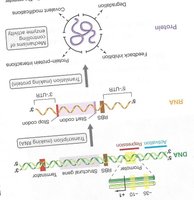
Microorganisms regulate gene expression at multiple levels to adapt to environmental changes and optimize resource use. Regulation can occur during transcription, translation, or post-translation, affecting the synthesis of proteins required for various cellular functions.
Transcriptional regulation: Control of mRNA synthesis from DNA.
Translational regulation: Control of protein synthesis from mRNA.
Post-translational regulation: Modification or degradation of proteins after synthesis.
Regulation of Biosynthetic and Catabolic Pathways
Feedback Inhibition in Biosynthetic Pathways
Biosynthetic pathways, such as those for arginine and tryptophan, are often regulated by feedback inhibition. The end product of the pathway inhibits transcription of genes encoding the enzymes involved in its synthesis, conserving resources when the product is abundant.
Induction in Catabolic Pathways
Catabolic pathways, such as lactose utilization, are typically induced by the presence of the substrate. The starting material (e.g., lactose) stimulates transcription of genes encoding enzymes required for its breakdown.
Regulation of Transcription in Bacteria
Tryptophan Biosynthesis and the trp Operon
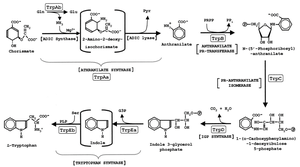
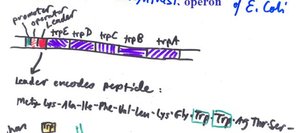
The trp operon in Escherichia coli is a classic example of transcriptional regulation in biosynthetic pathways. It encodes enzymes for tryptophan synthesis and is regulated by both repression and attenuation mechanisms.
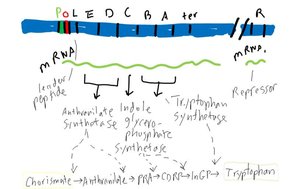
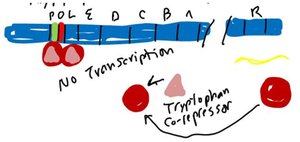
No tryptophan: The repressor is inactive, the promoter is accessible to RNA polymerase (RNAP), and transcription occurs, leading to tryptophan synthesis.
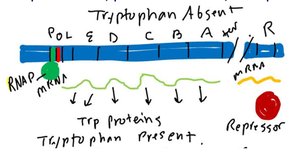
Tryptophan present: Tryptophan acts as a corepressor, activating the repressor protein, which binds the operator and blocks transcription.
Lactose Catabolism and the lac Operon
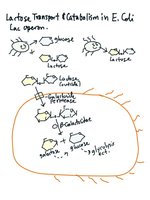
The lac operon in E. coli is a model for catabolic gene regulation. It enables the cell to metabolize lactose when glucose is absent and lactose is present.
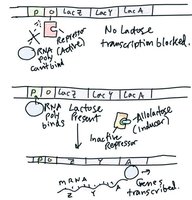
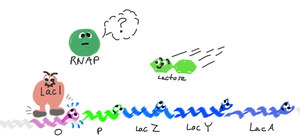
Lac operon structure: Includes a promoter, operator, and three structural genes: lacZ (β-galactosidase), lacY (permease), and lacA (acetylase). The LacI repressor is encoded separately.
No lactose: The LacI repressor binds the operator, blocking transcription.
Lactose present: Allolactose (an isomer of lactose) binds the repressor, inactivating it and allowing RNAP to transcribe the operon.
Catabolite Repression and the Role of Glucose
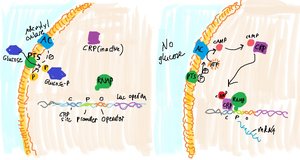
Glucose is the preferred carbon source for E. coli. When glucose is present, the lac operon is repressed even if lactose is available, a phenomenon known as catabolite repression. This is mediated by the cAMP receptor protein (CRP, also called CAP) and cyclic AMP (cAMP).
Glucose present: Low cAMP, inactive CRP, lac operon not transcribed.
Glucose absent: High cAMP, active CRP binds near the promoter, enhancing RNAP binding and transcription (if lactose is also present).
Two-Component Regulatory Systems
Mechanism and Examples
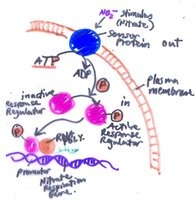
Two-component systems are widespread in Bacteria and Archaea, and involve a sensor kinase and a response regulator. Environmental signals (e.g., nitrate) activate the sensor kinase, which phosphorylates the response regulator, leading to changes in gene expression.
Example: NarXL system in E. coli regulates nitrate respiration genes.
Quorum Sensing
Cell Density-Dependent Gene Regulation
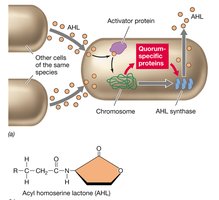
Quorum sensing allows bacteria to coordinate gene expression based on population density using signaling molecules such as acyl homoserine lactones (AHLs).
At high cell density, AHLs accumulate and activate transcription of specific genes, including those for virulence and biofilm formation.
Quorum Sensing in Staphylococcus aureus
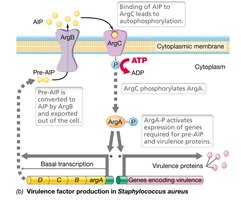
In Staphylococcus aureus, the AHL called AIP binds to the sensor kinase ArgC, which phosphorylates the response regulator ArgA. ArgA then increases transcription of AIP and virulence genes, enhancing pathogenicity.
Transcriptional Regulation in Archaea
Archaea use transcriptional repressors and activators similar to bacteria, but do not regulate transcription using alternative sigma factors. Some two-component systems are present.
The Stringent Response
Regulation of Cell Growth Under Nutrient Limitation
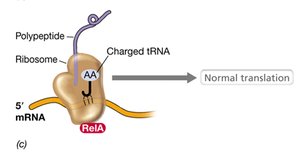
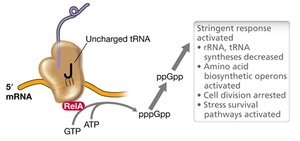
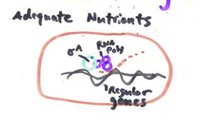
The stringent response is a global regulatory mechanism triggered by amino acid starvation or other stresses. It is mediated by the alarmone ppGpp, synthesized by RelA when uncharged tRNAs accumulate at the ribosome.
Abundant nutrients: Normal protein synthesis, rRNA/tRNA transcription, DNA replication, and cell division proceed.
Limited nutrients: ppGpp accumulates, reducing rRNA/tRNA synthesis, arresting DNA replication and cell division, and activating stress survival pathways.
Regulation by Sigma Factors
Sigma Subunit of RNA Polymerase
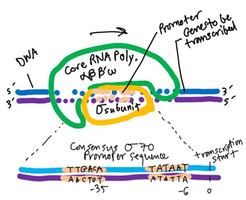
The sigma (σ) subunit of bacterial RNA polymerase recognizes specific promoter sequences, initiating transcription. The primary sigma factor in E. coli is σ70 for housekeeping genes. Alternative sigma factors direct RNAP to promoters for stress responses, such as heat shock, nitrogen starvation, or sporulation.
Alternate Sigma Factors
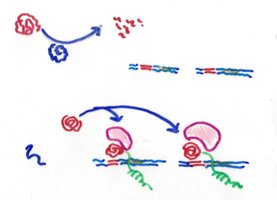
Alternative sigma factors allow bacteria to rapidly alter gene expression in response to environmental changes. For example, σ32 controls heat shock genes, while other sigma factors regulate responses to starvation, oxidative stress, or sporulation.
Endospore Formation in Bacillus subtilis
Starvation triggers a two-component system that activates transcription of the sporulation sigma factor SpoF, leading to endospore formation.
Riboswitches and Attenuation
Riboswitches
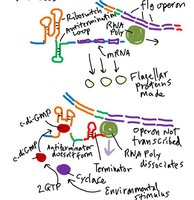
Riboswitches are regulatory segments of mRNA that bind small molecules, causing structural changes that affect transcription or translation. For example, cyclic di-GMP regulates flagellar biosynthesis in Clostridium difficile via a riboswitch.
Attenuation of the trp Operon
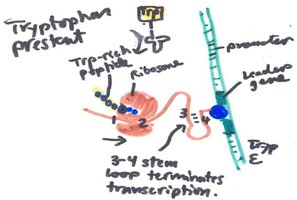
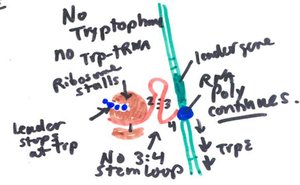
Attenuation is a mechanism where translation of a leader peptide affects transcription termination. In the trp operon, the presence or absence of tryptophan-tRNA determines whether transcription continues or terminates prematurely.
Tryptophan present: Ribosome quickly translates the leader peptide, forming a terminator stem-loop in mRNA, halting transcription.
No tryptophan: Ribosome stalls, allowing an anti-terminator structure to form, and transcription proceeds.
Post-Transcriptional Regulation
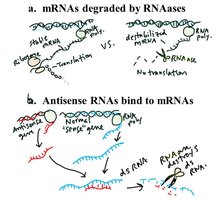
Gene expression can also be regulated after transcription by mechanisms such as mRNA degradation by RNases or binding of antisense RNAs, which can block translation or target mRNA for destruction.
Discussion Questions
Could transcriptional control by attenuation occur in (a) Archaea (b) Eukarya? Why?
Could the regulation of transcription of widely-separated genes via alternate sigma factors occur in (a) Archaea or (b) Eukarya? Why?
What phenotype would be observed with regard to tryptophan synthesis in E. coli (a) if trp promoter mutated so RNAP couldn't bind? (b) if the Repressor couldn't bind Tryptophan? (c) if the repressor couldn't bind the operator?
What phenotype would be observed with regard to tryptophan synthesis in E. coli if a TGG codon in the trp leader gene mutated to a TGC? Explain.
In what respect is the regulation of gene transcription via riboswitches very different than regulation of lactose, tryptophan, maltose, and nitrate metabolism in E. coli?
What would be the effect on β-galactosidase activity in E. coli (a) if the LacI repressor couldn't bind allolactose? (b) if the operator mutated so that LacI could not bind? (c) if adenylyl cyclase activity was constitutive?
Describe how Acyl-Homoserine Lactones (AHLs) regulate transcription through the Arg CAB system in Staphylococcus aureus. Why is this system medically important? How does this resemble systems for transcriptional regulation via hormones and protein tyrosine kinases in human cells?
What triggers the Stringent Response in bacterial cells? What modified nucleotide intracellular messenger is involved, and what are the end effects of the Stringent Response?
