 Indietro
Microbiology Study Guide: Viruses, Prions, and Diagnostic Immunoassays
Guida di studio - Note intelligenti
 Appunti personalizzati basati sui tuoi materiali, ampliati con definizioni chiave, esempi e contesto.
Q1. Define virus.
Background
Topic: General Virus Characteristics
This question tests your understanding of what a virus is and how it differs from living cells.
Key Terms:
Virus: Nonliving, noncellular entities that can infect animal, plant, or bacterial cells. They can have a DNA or RNA genome and are much smaller than cells.
Step-by-Step Guidance
Recall that viruses are not considered living organisms because they lack cellular structure and cannot carry out metabolism on their own.
Think about the main features that distinguish viruses from cells, such as their genetic material and their need for a host to replicate.
Consider why viruses were originally described as "filterable infectious agents."
Try solving on your own before revealing the answer!
Q2. Can viruses synthesize their own nucleic acids and proteins apart from a host?
Background
Topic: Viral Dependence on Host Cells
This question tests your understanding of viral replication and the limitations of viruses outside a host cell.
Key Terms:
Obligate Intracellular Pathogen: An organism that must invade a host cell to replicate.
Step-by-Step Guidance
Think about the cellular machinery required for nucleic acid and protein synthesis (e.g., ribosomes, polymerases).
Recall whether viruses possess these components or rely on the host cell for these functions.
Try solving on your own before revealing the answer!
Q3. What does it mean that viruses are obligate intracellular pathogens?
Background
Topic: Viral Replication Strategies
This question is about the relationship between viruses and their host cells.
Key Terms:
Obligate Intracellular Pathogen: A microbe that must enter a host cell to replicate and cause disease.
Step-by-Step Guidance
Consider what "obligate" means in a biological context (i.e., required or necessary).
Think about how viruses use host cell machinery for replication.
Try solving on your own before revealing the answer!
Q4. What is a virus that infects a bacterium called? What is a virion?
Background
Topic: Virus Types and Terminology
This question tests your knowledge of specific terms used in virology.
Key Terms:
Bacteriophage: A virus that infects bacteria.
Virion: A single, infectious virus particle.
Step-by-Step Guidance
Recall the term for viruses that specifically target bacteria.
Think about the structure and definition of a virion.
Try solving on your own before revealing the answer!
Q5. What is a capsid and what macromolecule makes up the capsid?
Background
Topic: Viral Structure
This question focuses on the protective protein shell of a virus and its composition.
Key Terms:
Capsid: The protein shell that encases the viral genome.
Macromolecule: Large molecules, such as proteins, nucleic acids, carbohydrates, and lipids.
Step-by-Step Guidance
Identify the main function of the capsid in a virus.
Recall which macromolecule forms the capsid structure.
Try solving on your own before revealing the answer!
Q6. What is a capsomere?
Background
Topic: Viral Structure
This question is about the subunits that make up the capsid.
Key Terms:
Capsomere: Protein subunits that assemble to form the capsid.
Step-by-Step Guidance
Think about how the capsid is constructed from smaller units.
Recall the role of capsomeres in determining the shape of the capsid.
Try solving on your own before revealing the answer!
Q7. List three general virus capsid shapes.
Background
Topic: Viral Morphology
This question tests your knowledge of the structural diversity of viruses.
Key Terms:
Helical, Icosahedral, Complex: The three main shapes of viral capsids.
Step-by-Step Guidance
Recall the basic geometric shapes that viral capsids can take.
Think about examples of viruses with each type of capsid shape.
Try solving on your own before revealing the answer!
Q8. What macromolecule comprises the viral envelope?
Background
Topic: Viral Structure
This question is about the composition of the viral envelope, which surrounds some viruses.
Key Terms:
Lipid: The main macromolecule in the viral envelope.
Step-by-Step Guidance
Recall what the viral envelope is derived from.
Think about the types of macromolecules found in cell membranes.
Try solving on your own before revealing the answer!
Q9. What is a naked virus?
Background
Topic: Viral Structure
This question tests your understanding of the difference between enveloped and non-enveloped viruses.
Key Terms:
Naked Virus: A virus without an envelope.
Step-by-Step Guidance
Consider what structural feature is missing in a naked virus compared to an enveloped virus.
Think about how this affects the virus's stability and transmission.
Try solving on your own before revealing the answer!
Q10. Where does an enveloped virus obtain its envelope?
Background
Topic: Viral Structure and Replication
This question is about how enveloped viruses acquire their outer layer.
Key Terms:
Budding: The process by which viruses acquire their envelope from the host cell membrane.
Step-by-Step Guidance
Recall the process of viral release from the host cell.
Think about what part of the host cell is used to form the viral envelope.
Try solving on your own before revealing the answer!
Q12. What is another term for viral spikes?
Background
Topic: Viral Structure
This question is about the terminology used for the protein structures on the surface of some viruses.
Key Terms:
Peplomers: Another term for viral spikes.
Step-by-Step Guidance
Recall the function of viral spikes in host cell recognition and attachment.
Think about alternative names used in virology for these structures.
Try solving on your own before revealing the answer!
Q13. What macromolecules make up viral spikes?
Background
Topic: Viral Structure
This question focuses on the composition of the spikes found on the surface of some viruses.
Key Terms:
Glycoprotein: A molecule made of protein and carbohydrate.
Step-by-Step Guidance
Recall the function of viral spikes in attachment to host cells.
Think about the types of macromolecules that can serve as recognition molecules on cell surfaces.
Try solving on your own before revealing the answer!
Q14. What part of the virus binds to specific factors on a host cell which determines the exact cell type a virus can infect?
Background
Topic: Viral Tropism and Host Specificity
This question is about how viruses recognize and attach to specific host cells.
Key Terms:
Viral Spikes: Surface proteins that interact with host cell receptors.
Step-by-Step Guidance
Recall the role of viral spikes in determining host range and tissue tropism.
Think about how these interactions influence which cells a virus can infect.
Try solving on your own before revealing the answer!
Q15. The influenza virus that causes swine flu is called H1N1. Name the glycoproteins that produce “HA” and “NA” spikes, which are represented by the letters H and N, respectively, in H1N1.
Background
Topic: Influenza Virus Structure
This question tests your knowledge of the specific glycoproteins found on the influenza virus surface.
Key Terms:
Hemagglutinin (HA): The "H" spike protein.
Neuraminidase (NA): The "N" spike protein.
Step-by-Step Guidance
Recall the function of hemagglutinin and neuraminidase in the influenza virus life cycle.
Think about how these proteins are used to classify influenza virus subtypes.
Try solving on your own before revealing the answer!
Q16. In general, can a single virus’s genome contain both DNA and RNA?
Background
Topic: Viral Genomes
This question is about the types of genetic material found in viruses.
Key Terms:
Genome: The complete set of genetic material in an organism or virus.
Step-by-Step Guidance
Recall the general rule about viral genomes (DNA or RNA, but not both in the same virion).
Consider if there are any exceptions to this rule.
Try solving on your own before revealing the answer!
Q17. Which type of single-stranded RNA virus genome functions directly as mRNA?
Background
Topic: Viral Replication Strategies
This question is about the classification of RNA viruses based on their genome polarity.
Key Terms:
ssRNA (+): Single-stranded RNA viruses with genomes that can serve directly as mRNA.
Step-by-Step Guidance
Recall the difference between positive-sense and negative-sense RNA viruses.
Think about which type can be immediately translated by host ribosomes.
Try solving on your own before revealing the answer!
Q18. What enzyme is used by single-stranded antisense RNA (ssRNA-) viruses to make mRNA from an RNA template?
Background
Topic: Viral Enzymes
This question is about the enzymes required for replication of negative-sense RNA viruses.
Key Terms:
RNA-dependent RNA polymerase (RdRP): The enzyme that synthesizes mRNA from an RNA template.
Step-by-Step Guidance
Recall why ssRNA- viruses cannot be directly translated by host ribosomes.
Think about the enzyme needed to convert the viral genome into a readable mRNA strand.
Try solving on your own before revealing the answer!
Q19. What is the function of the enzyme reverse transcriptase?
Background
Topic: Viral Enzymes and Replication
This question is about the enzyme used by retroviruses to replicate their genomes.
Key Terms:
Reverse Transcriptase: An enzyme that synthesizes DNA from an RNA template.
Step-by-Step Guidance
Recall which viruses use reverse transcriptase (e.g., retroviruses).
Think about the process of converting viral RNA into DNA for integration into the host genome.
Try solving on your own before revealing the answer!
Q20. Why do RNA viruses mutate more quickly than DNA viruses?
Background
Topic: Viral Mutation Rates
This question is about the fidelity of viral replication enzymes.
Key Terms:
Proofreading: The ability of some polymerases to correct errors during replication.
Step-by-Step Guidance
Recall the difference between RNA and DNA polymerases in terms of proofreading ability.
Think about how the lack of proofreading affects mutation rates in RNA viruses.
Try solving on your own before revealing the answer!
Q21. Do attenuated virus strains cause disease in healthy, non-immunocompromised hosts?
Background
Topic: Vaccine Development
This question is about the safety of live, weakened viruses used in vaccines.
Key Terms:
Attenuated Virus: A weakened form of a virus used in vaccines.
Step-by-Step Guidance
Recall the purpose of using attenuated viruses in vaccines.
Think about the risk of disease in healthy versus immunocompromised individuals.
Try solving on your own before revealing the answer!
Q22. Define tropism.
Background
Topic: Viral Host Range
This question is about the specificity of viruses for certain cell types or tissues.
Key Terms:
Tropism: The specificity of a virus for a particular host tissue or cell type.
Step-by-Step Guidance
Recall how viral spikes and host cell receptors determine which cells a virus can infect.
Think about examples of viruses with narrow versus broad tropism.
Try solving on your own before revealing the answer!
Q23. The influenza virus undergoes processes called antigenic drift and antigenic shift. Define these two processes and describe the outcome of each using the example of influenza.
Background
Topic: Viral Evolution and Immune Evasion
This question is about how influenza viruses change over time and the consequences for public health.
Key Terms:
Antigenic Drift: Minor genetic changes due to mutations.
Antigenic Shift: Major genetic changes, often due to reassortment between different viral strains.
Step-by-Step Guidance
Recall how antigenic drift leads to new strains that may escape immune detection.
Think about how antigenic shift can result in pandemics by creating novel viruses.
Try solving on your own before revealing the answer!
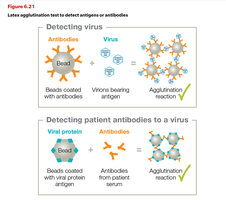
Q4 (Section 6.4): What type of immunoassay adheres viral antigen to latex beads to determine if a patient sample contains antibodies made to the virus?
Background
Topic: Immunoassays for Viral Detection
This question is about laboratory techniques used to detect viral infections by identifying antibodies or antigens in patient samples.
Key Terms and Concepts:
Immunoassay: A laboratory method that uses the binding between antigen and antibody to detect and quantify substances.
Latex Agglutination Test: A test where latex beads are coated with antigen or antibody to detect the presence of the corresponding antibody or antigen in a sample.
Step-by-Step Guidance
Recall that immunoassays can be designed to detect either antigens or antibodies in a patient sample.
Think about how latex beads can be coated with viral antigens to test for the presence of patient antibodies (indicating exposure or infection).
Consider the principle of agglutination: if the patient sample contains the target antibody, it will bind to the antigen-coated beads, causing visible clumping (agglutination).
Try solving on your own before revealing the answer!
