 Indietro
Practical Applications of Immunology: Vaccines and Diagnostic Immunology
Guida di studio - Note intelligenti
 Appunti personalizzati basati sui tuoi materiali, ampliati con definizioni chiave, esempi e contesto.
Vaccines and Immunization
Definition and Historical Context
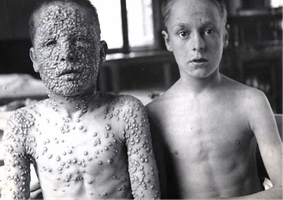
Vaccines are suspensions of organisms or their fractions that induce immunity against infectious diseases. The practice of variolation, inoculating smallpox virus into the skin, was an early form of immunization. Edward Jenner's use of cowpox to prevent smallpox marked the beginning of modern vaccination. Pasteur later expanded the term to include artificial induction of immunity against any infectious disease.
Principles and Effects of Vaccination
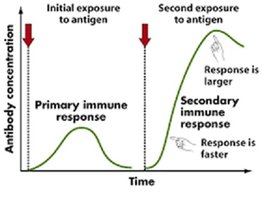
Vaccination provokes a primary immune response, leading to the formation of antibodies and memory cells. Upon subsequent exposure to the antigen, a rapid and intense secondary immune response occurs, providing effective protection.
Primary immune response: Initial antibody production upon first exposure.
Secondary immune response: Faster and stronger response upon re-exposure due to memory cells.
Herd immunity: Immunity in most of the population reduces outbreaks by limiting susceptible individuals.
Types of Vaccines
Vaccines are classified based on their composition and method of preparation. Each type has distinct advantages and limitations.
Live attenuated vaccines: Contain weakened pathogens; mimic natural infection and confer lifelong immunity with few doses. Not suitable for immunocompromised individuals.
Inactivated (killed) vaccines: Contain killed pathogens; safer but require repeated boosters and induce mainly humoral immunity.
Subunit vaccines: Use antigenic fragments to stimulate an immune response. Includes recombinant vaccines (produced by genetic modification) and virus-like particle (VLP) vaccines.
Conjugated vaccines: Combine antigens with proteins to enhance immune response, especially in children.
Nucleic acid (DNA) vaccines: Injected DNA produces protein antigens, stimulating both humoral and cellular immunity.
Toxoids: Inactivated toxins used to target harmful substances produced by bacteria.
Antitoxins: Serums containing antibodies against toxins.
Principal Vaccines Used in the United States
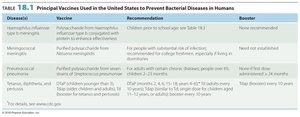
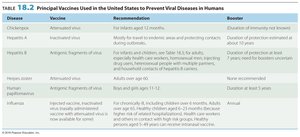
The following tables summarize the principal vaccines used to prevent bacterial and viral diseases in humans.
Disease | Vaccine | Recommendation | Booster |
|---|---|---|---|
Haemophilus influenzae type b meningitis | Polysaccharide from Haemophilus influenzae type b conjugated with protein | Children prior to school age | None recommended |
Pneumococcal pneumonia | Purified polysaccharide from Streptococcus pneumoniae | For people with substantial risk of infection | Need not established |
Tetanus, diphtheria, pertussis | DTaP (toxoid and subunit) | Children and adults | Booster every 10 years |
Disease | Vaccine | Recommendation | Booster |
|---|---|---|---|
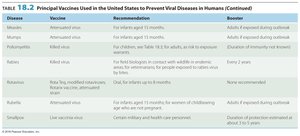
Chickenpox | Live attenuated virus | For infants aged 12 months | Duration of immunity not known |
Hepatitis A | Inactivated virus | For people at risk | Duration of protection not known |
Influenza | Antigenic fragments of virus | For chronically ill, elderly, and others | Annual |
Adjuvants
Adjuvants are chemical additives added to vaccines to improve their effectiveness. They enhance the innate immune response and are commonly used in commercial vaccines.
Alum: First aluminium salt used as an adjuvant, now replaced by aluminium hydroxide and aluminium phosphate.
Safety of Vaccines
Vaccines are the safest and most effective means of preventing infectious diseases in children. On rare occasions, vaccines can cause the disease, but there is no scientific proof linking MMR vaccines to autism.
Diagnostic Immunology
Sensitivity and Specificity
Diagnostic tests are evaluated based on sensitivity and specificity.
Sensitivity (true positive rate): Probability that a test is reactive if the specimen is a true positive.
Specificity (true negative rate): Probability that a test will not be reactive if the specimen is a true negative.
Monoclonal Antibodies
Monoclonal antibodies (Mabs) are uniform, highly specific antibodies produced in large quantities by hybridomas—fusion of myeloma cells and antibody-producing spleen cells. They are used in diagnostic tools and human therapy.
Murine monoclonal antibodies: Made from mouse proteins (-omab).
Chimeric monoclonal antibodies: Mouse variable region and human constant region (-ximab).
Humanized antibodies: Mostly human, except for mouse antigen-binding sites (-zumab).
Fully human antibodies: Produced from a human gene in a mouse (-umab).
Precipitation Reactions
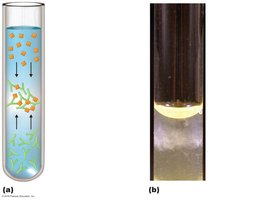
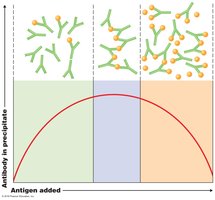
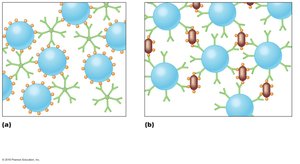
Precipitation reactions involve soluble antigens reacting with antibodies to form large, interlocking aggregates called lattices. The optimal ratio of antigen and antibody forms a visible precipitate.
Precipitin ring test: Cloudy line forms at the optimal ratio.
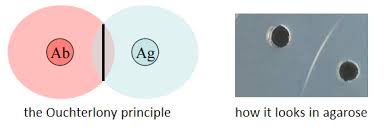
Immunodiffusion tests (Ouchterlony): Precipitation reactions in agar gel medium.
Immunoelectrophoresis: Combines electrophoresis with immunodiffusion to separate proteins in human serum.
Agglutination Reactions
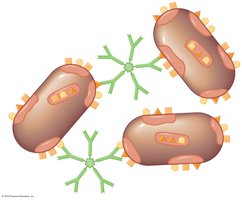
Agglutination reactions involve particulate antigens binding to antibodies to form visible aggregates. Direct agglutination tests detect antibodies against large cellular antigens and measure serum antibody concentration (titer).
Seroconversion: Significant change in titer as a disease progresses.
Indirect (passive) agglutination tests: Antibody reacts with soluble antigen adhering to particles or vice versa.
Hemagglutination
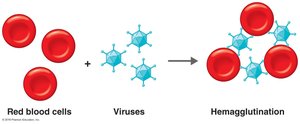
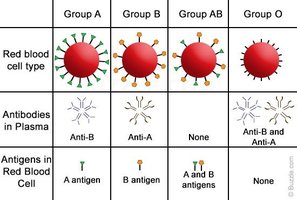
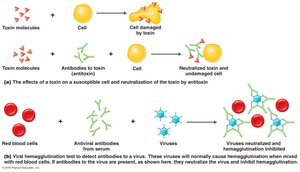
Hemagglutination is the agglutination of red blood cell surface antigens and complementary antibodies, used in blood typing. Viral hemagglutination occurs when viruses agglutinate RBCs without an antigen-antibody reaction.
Examples: Mumps, measles, influenza viruses.
Neutralization Reactions
Neutralization reactions involve antigen-antibody interactions that block the harmful effects of exotoxins or viruses. The viral hemagglutination inhibition test is used for subtyping viruses.
Antitoxins: Antibodies that neutralize toxins.
Viral hemagglutination inhibition: Antibodies in serum neutralize viruses and inhibit hemagglutination.
Fluorescent-Antibody Techniques
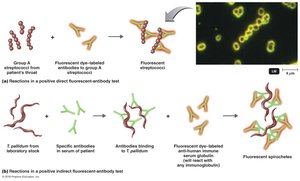
Fluorescent-antibody (FA) techniques combine fluorescent dyes with antibodies to identify microorganisms or detect specific antibodies in serum.
Direct FA tests: Identify microorganisms in clinical specimens.
Indirect FA tests: Detect specific antibodies in serum using anti-human immune serum globulin (anti-HISG).
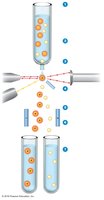
Fluorescence-activated cell sorter (FACS): Uses laser and detectors to sort cells labeled with fluorescent antibodies.
Enzyme-Linked Immunosorbent Assay (ELISA)
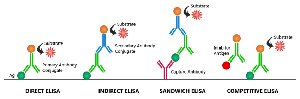
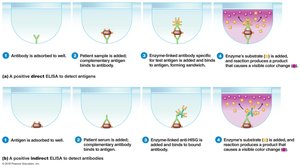
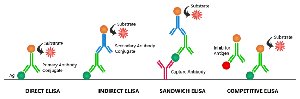
ELISA is a sensitive immunological assay used to detect antigens or antibodies. Direct ELISA uses one antibody to detect antigens, while indirect ELISA uses two antibodies to detect antibodies.
Direct ELISA: Sample containing antigens is mixed with antibody; enzyme-linked antibodies react with antigen and produce color upon substrate addition.
Indirect ELISA: Detects antibodies using a secondary enzyme-linked antibody.
Monoclonal Antibodies in Pregnancy Tests
Monoclonal antibodies are used in home pregnancy tests to detect human chorionic gonadotropin (hCG), a hormone produced during pregnancy. The test forms a sandwich of capture and free antibodies, resulting in a color change if hCG is present.
Western Blotting
Western blotting (protein immunoblotting) is an analytical technique used to identify and locate specific proteins via electrophoresis and blotting, based on their ability to bind to specific antibodies.
Key Steps: Protein separation by electrophoresis, transfer to a membrane, and detection using labeled antibodies.
Applications: Used in research and clinical diagnostics to confirm the presence of specific proteins, such as HIV antibodies.
