 Indietro
Regulation of Gene Expression and Molecular Information Flow in Microorganisms
Guida di studio - Note intelligenti
 Appunti personalizzati basati sui tuoi materiali, ampliati con definizioni chiave, esempi e contesto.
Regulation of Gene Expression in Microorganisms
Genetic Information Flow and Nucleic Acid Components
Genetic information in microorganisms is stored in nucleic acids, primarily DNA and RNA. The flow of genetic information follows the central dogma: DNA is transcribed into RNA, which is then translated into protein. Understanding the structure and function of these macromolecules is essential for studying microbial gene regulation.
DNA Structure: Double helix composed of nucleotides (adenine, thymine, cytosine, guanine).
Supercoiled DNA: DNA is often supercoiled to fit within the cell; DNA gyrase is an enzyme that introduces negative supercoils.
Types of Informational Macromolecules: DNA, RNA, and proteins are synthesized through tightly regulated processes.
DNA Replication in Prokaryotes
DNA replication is a fundamental process for cell division and genetic inheritance. In prokaryotes, replication occurs at the nucleoid and involves the formation of a theta structure in circular DNA.
Replication Fork: The site where DNA is unwound and new strands are synthesized.
Theta Structure: Characteristic of circular DNA replication in bacteria.
Transcription and Translation
Transcription is the process by which RNA polymerase synthesizes RNA from a DNA template. Translation is the subsequent process where ribosomes synthesize proteins from mRNA.
RNA Polymerase: Core enzyme and holoenzyme forms; sigma factors guide the enzyme to specific promoters.
Promoters: Specific DNA sequences recognized by sigma factors; include conserved regions such as the Pribnow box (TATAAT) and TTGACA.
Coupled Transcription and Translation: In prokaryotes, these processes occur simultaneously.
Polycistronic mRNA: Single mRNA molecule encoding multiple proteins, typical in operons.
Transcription Termination
Termination of transcription can occur via two mechanisms:
Rho-dependent termination: Rho protein recognizes specific DNA sequences and releases RNA polymerase.
Inverted repeats: Form hairpin structures in RNA, causing termination.
Transcription in Archaea
Archaea possess a single RNA polymerase similar to eukaryotic polymerase II. Their transcription regulation resembles that of bacteria, with both positive and negative controls.
Repressor Proteins: Block binding of TATA-binding protein (TBP) and transcription factor B (TFB).
Activator Proteins: Recruit TBP to the promoter, facilitating transcription.
Protein Synthesis and Ribosome Function
Ribosomes are the site of protein synthesis. rRNA plays critical roles in initiation, peptide bond formation, and translocation.
16S rRNA: Facilitates initiation and positions mRNA.
23S rRNA: Catalyzes peptide bond formation (peptidyl transferase activity).
Regulation of Gene Expression
Gene expression is regulated at multiple levels, including transcriptional and post-transcriptional mechanisms. DNA-binding proteins, transcription factors, and effectors play key roles.
Enzyme Repression: Prevents synthesis of enzymes when not needed (e.g., arginine operon).
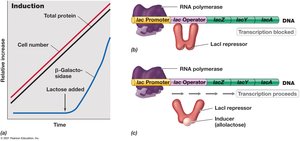
Enzyme Induction: Synthesis of enzymes in response to substrate presence (e.g., lac operon).
Example: The Lactose Operon
The lac operon is a classic example of enzyme induction. In the presence of lactose, the lac repressor is inactivated, allowing transcription of genes required for lactose metabolism.
LacI Repressor: Blocks transcription in absence of lactose.
Inducer (allolactose): Binds LacI, allowing RNA polymerase to transcribe the operon.
Positive and Negative Control of Transcription
Activator proteins enhance transcription by facilitating RNA polymerase binding, while repressor proteins inhibit transcription by blocking access to the promoter.
Transcription Controls in Archaea
Archaea use both positive and negative transcriptional controls, similar to bacteria. Repressor proteins block TBP and TFB binding, while activators recruit TBP.
Sensing and Signal Transduction: Two-Component Regulatory Systems
Two-component systems are common in bacteria and archaea for environmental sensing and gene regulation. They consist of a sensor kinase and a response regulator.
OmpR System: Regulates transcription in response to environmental signals.
Response Regulators: Can act as activators or repressors depending on the target genes.
Cell-to-Cell Signaling and Quorum Sensing
Quorum sensing is a mechanism by which bacteria and some archaea assess population density and regulate gene expression accordingly. Autoinducers are signaling molecules involved in this process.
Acyl Homoserine Lactone (AHL): Found in gram-negative bacteria.
Autoinducer 2 (AI-2): Allows interspecies communication.
Short Peptides: Used by gram-positive bacteria and archaea.
Global Control Systems
Global control systems regulate transcription of multiple genes across different regulons. Components include activators, repressors, signal molecules, two-component systems, regulatory RNA, and alternative sigma factors.
Stringent and General Stress Responses
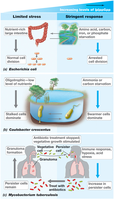
The stringent response is a regulatory mechanism that allows bacteria to survive nutrient deprivation and environmental stress by shutting down macromolecule synthesis and activating survival pathways.
Stringent Response: Shuts down rRNA and tRNA synthesis, activates stress survival genes.
Environmental Control: Different bacteria (e.g., Caulobacter crescentus, Mycobacterium tuberculosis) exhibit unique stringent responses.
Heat Shock Response
The heat shock response protects cells from protein denaturation due to heat, solvents, osmotic stress, or UV light. Heat shock proteins help refold or degrade damaged proteins.
Major Classes: Hsp100, Hsp90, Hsp70 (DnaK), Hsp60 (GroEL), Hsp10 (GroES).
Alternative Sigma Factor RpoH: Controls heat shock response in E. coli.
Attenuation and Leader Peptides
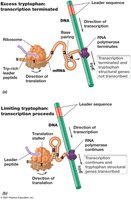
Attenuation is a regulatory mechanism seen in amino acid biosynthesis operons, such as the tryptophan operon in E. coli. Leader peptides and secondary structures in mRNA determine whether transcription proceeds or terminates.
Excess Tryptophan: Causes transcription termination.
Limiting Tryptophan: Allows transcription to proceed.
Inhibition of Enzyme Activity
Enzyme activity can be regulated post-translationally through feedback inhibition, allosteric inhibition, and isoenzyme inhibition.
Feedback Inhibition: End product inhibits the first enzyme in a pathway.
Allosteric Inhibition: Effector molecule binds to enzyme, changing its activity.
Isoenzyme Inhibition: Multiple enzymes catalyze the same reaction, regulated differently.
Summary Table: Key Regulatory Mechanisms in Microbial Gene Expression
Mechanism | Description | Example |
|---|---|---|
Enzyme Repression | Prevents synthesis of enzymes when not needed | Arginine operon |
Enzyme Induction | Induces enzyme synthesis in response to substrate | Lactose operon |
Attenuation | Transcription regulation via leader peptides | Tryptophan operon |
Quorum Sensing | Population density-dependent gene regulation | Lux operon in Aliivibrio fischeri |
Stringent Response | Stress survival pathway | E. coli, Caulobacter crescentus |
Heat Shock Response | Protection from protein denaturation | Hsp proteins in E. coli |
Additional info: These notes expand on brief points from the original material, providing academic context and examples for clarity. The included images directly illustrate key regulatory mechanisms discussed in the paragraphs.
