 Indietro
Selective and Differential Media in Microbiology: Principles and Applications
Guida di studio - Note intelligenti
 Appunti personalizzati basati sui tuoi materiali, ampliati con definizioni chiave, esempi e contesto.
Selective Media
Principles of Selective Media
Selective media are specialized growth media used in microbiology to favor the growth of certain microorganisms while inhibiting others. These media are essential for isolating specific pathogens from mixed samples and for environmental detection of indicator organisms such as coliforms.
Definition: Selective media contain agents that suppress unwanted microbes and encourage desired ones.
Clinical Use: Used to isolate suspected pathogens from normal flora.
Environmental Use: Used to detect coliforms indicating fecal contamination.
Differential Media: Some selective media also include indicators to differentiate among selected microbes based on biochemical reactions.
Components of Selective Media
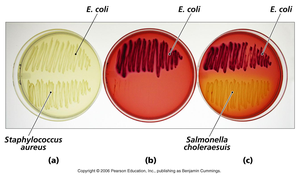
Selective media are formulated with specific nutritional and chemical components to achieve selectivity and differentiation.
Nutritional Components: Provide basic requirements for microbial growth (carbon, phosphorus, nitrogen, etc.), often as digests or extracts (e.g., yeast extract, casein digest).
Inhibitors: Chemicals such as antibiotics, NaCl, or bile salts that prevent growth of certain microbes.
Substrates: Compounds (e.g., lactose, mannitol) utilized by microbes for differentiation.
Indicators: Chemicals (e.g., pH indicators, ferric ammonium citrate) that make biochemical reactions visible.
Gram Positive Selective Media
Columbia CNA Agar
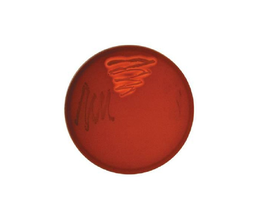
Columbia CNA agar is a selective medium designed to isolate Gram-positive organisms by inhibiting Gram-negative bacteria.
Selective Agents: Colistin and nalidixic acid target Gram-negative bacteria.
Differentiation: Hemolytic reactions (lysis of red blood cells) allow differentiation among Gram-positive species.
Application: Useful for clinical isolation of Gram-positive pathogens.
Mannitol Salt Agar (MSA)
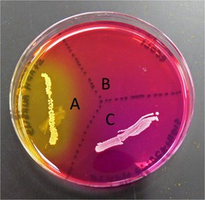
Mannitol Salt Agar is a selective and differential medium primarily used for the isolation of Staphylococcus species, especially S. aureus.
Selective Agent: 7.5% NaCl inhibits non-halophiles and Gram-negative bacteria.
Differentiation: Mannitol fermentation is detected by a pH indicator (phenol red), which turns yellow if acid is produced.
Interpretation: Only halophilic staphylococci grow; S. aureus ferments mannitol, turning the medium yellow.
Gram Negative Selective Media
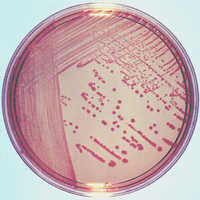
MacConkey Agar
MacConkey Agar is a selective and differential medium used to isolate and differentiate Gram-negative enteric bacteria based on lactose fermentation.
Selective Agents: Bile salts and crystal violet inhibit Gram-positive bacteria.
Differentiation: Lactose fermenters produce acid, turning the pH indicator (neutral red) pink/red.
Interpretation: Non-lactose fermenters remain colorless or pale.
Application: Used for isolation of Enterobacteriaceae and detection of coliforms.
Hektoen Enteric Agar
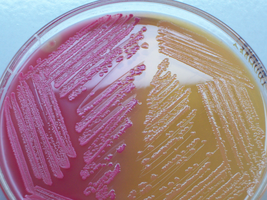
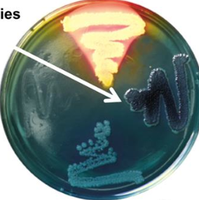
Hektoen Enteric Agar is a selective and differential medium used for the isolation and differentiation of Salmonella and Shigella from other Gram-negative enterics.
Selective Agent: Bile salts inhibit Gram-positive bacteria.
Differentiation: Fermentation of lactose, sucrose, or salicin produces yellow-pink colonies; reduction of sulfur to hydrogen sulfide (H2S) results in black precipitate (FeS).
Indicators: Bromothymol blue and acid fuchsin for pH changes; ferric ammonium citrate for H2S detection.
Application: Used to distinguish Salmonella (black colonies) and Shigella (green colonies) from other enterics.
Laboratory Application
Spot Inoculation and Plate Interpretation
In laboratory practice, selective and differential media are used to spot inoculate multiple organisms on a single plate, allowing for comparative analysis of growth and biochemical reactions.
Procedure: Divide plate into sectors, label, and inoculate with different organisms.
Incubation: Plates are incubated at 37℃ for 48 hours.
Analysis: Results are interpreted based on growth, color changes, and colony morphology.
Summary Table: Selective and Differential Media
Medium | Selective For | Inhibitors | Differentiation | Indicator |
|---|---|---|---|---|
Columbia CNA | Gram-positive bacteria | Colistin, Nalidixic acid | Hemolysis | Blood (RBC lysis) |
Mannitol Salt Agar | Staphylococci (halophiles) | NaCl (7.5%) | Mannitol fermentation | Phenol red (pH) |
MacConkey Agar | Gram-negative enterics | Bile salts, Crystal violet | Lactose fermentation | Neutral red (pH) |
Hektoen Enteric Agar | Gram-negative enterics | Bile salts | Lactose/sucrose/salicin fermentation, H2S production | Bromothymol blue, Acid fuchsin, Ferric ammonium citrate |
Key Equations and Biochemical Reactions
Lactose Fermentation:
Mannitol Fermentation:
Hydrogen Sulfide Production:
FeS Precipitation:
Additional info: Academic context was added to clarify the principles, applications, and interpretation of selective and differential media, as well as to provide a summary table and relevant biochemical equations.
