 Indietro
Standard Plate Count and Serial Dilution in Microbiology
Guida di studio - Note intelligenti
 Appunti personalizzati basati sui tuoi materiali, ampliati con definizioni chiave, esempi e contesto.
Standard Plate Count and Serial Dilution
Introduction to Standard Plate Count
The Standard Plate Count (SPC) is a fundamental microbiological technique used to estimate the number of viable microorganisms in a liquid sample. This method is widely applied in clinical diagnostics and food safety testing to determine microbial load.
Purpose: To estimate the concentration of live bacteria in a sample.
Applications:
Diagnosis of urinary tract infections (UTIs): Significant infection is indicated by >100,000 CFU/mL.
Testing safety of pasteurized milk: Acceptable levels are <20,000 CFU/mL.
Colony-Forming Units (CFU): Only plates with 30–300 CFUs are counted for accuracy.
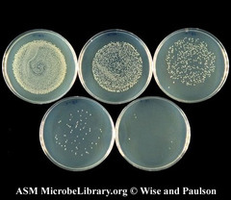
Principle of Serial Dilution
Serial dilution is a stepwise dilution of a substance in solution. In microbiology, it is used to reduce the concentration of cells to a countable number, allowing for accurate enumeration of colonies after plating.
Each dilution step reduces the concentration by a known factor (e.g., 1:10, 1:100, 1:1000).
Aliquots from each dilution are plated onto agar to grow isolated colonies.
Plates with 30–300 colonies are considered statistically reliable for counting.
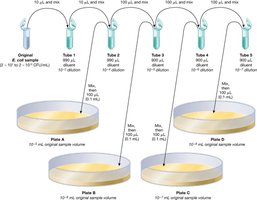
Calculating Original Cell Density (OCD)
The Original Cell Density (OCD) is calculated to determine the concentration of viable cells in the original sample. The formula used is:
CFU: Average number of colonies counted on a plate (between 30–300).
D: Dilution factor of the plate counted.
V: Volume of inoculum plated (in mL).
Example Calculation:
If 100 μL (0.1 mL) of a 10-2 dilution is plated and 76 colonies are counted:
Key Terms and Definitions
Colony-Forming Unit (CFU): A unit used to estimate the number of viable bacteria or fungal cells in a sample.
Dilution Factor (D): The ratio by which the original sample is diluted.
Inoculum Volume (V): The volume of diluted sample plated onto the agar.
Original Cell Density (OCD): The calculated concentration of viable cells in the original sample.
Summary Table: Standard Plate Count Parameters
Parameter | Definition | Typical Value/Range |
|---|---|---|
CFU (Colony-Forming Units) | Number of colonies counted on a plate | 30–300 |
D (Dilution Factor) | Proportion by which the sample is diluted | e.g., 0.01 for 10-2 |
V (Volume Plated) | Amount of diluted sample plated | 0.1 mL (100 μL) |
OCD (Original Cell Density) | Calculated viable cell concentration in original sample | Varies (e.g., 7.6 × 10⁴ CFU/mL) |
Additional info: The standard plate count is a critical method in both clinical and industrial microbiology for ensuring safety and quality control. Accurate dilution and plating techniques are essential for reliable results.
