 Indietro
Study Guide: Viruses, Viroids, and Prions (Microbiology - Chapter 13)
Guida di studio - Note intelligenti
 Appunti personalizzati basati sui tuoi materiali, ampliati con definizioni chiave, esempi e contesto.
Viruses, Viroids, and Prions
General Characteristics of Viruses
Viruses are unique infectious agents that differ fundamentally from cellular organisms. They are obligatory intracellular parasites, meaning they require living host cells to multiply. Viruses contain either DNA or RNA as their genetic material, but never both. They lack ribosomes and an ATP-generating mechanism, making them dependent on host cells for replication and metabolism.
Obligatory intracellular parasites: Must invade host cells to reproduce.
Genetic material: DNA or RNA, single- or double-stranded, linear or circular.
Protein coat: Called a capsid, surrounds the nucleic acid.
No ribosomes or ATP generation: Cannot synthesize proteins or generate energy independently.
Comparison of Viruses and Bacteria
Viruses and bacteria differ in several key aspects, as shown in the table below:
Feature | Bacteria | Viruses |
|---|---|---|
Intracellular Parasite | No | Yes |
Plasma Membrane | Yes | No |
Binary Fission | Yes | No |
Pass through Filters | No | Yes |
DNA and RNA | Yes | No (only one) |
ATP Generation | Yes | No |
Ribosomes | Yes | No |
Sensitivity to Antibiotics | Yes | No |
Host Range
The host range of a virus refers to the spectrum of host cells it can infect. Most viruses are highly specific, infecting only certain cell types within a host, determined by specific attachment sites and cellular receptors. Bacteriophages are viruses that infect bacteria.
Virus Sizes
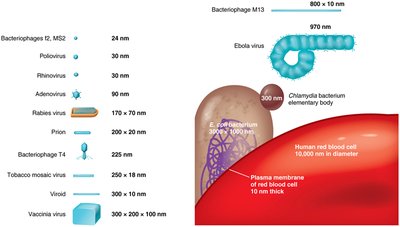
Viruses vary greatly in size, from about 24 nm (bacteriophage f2, MS2) to nearly 1000 nm (Ebola virus). Their size is much smaller than most bacteria and human cells.
Viral Structure
The complete, fully developed viral particle is called a virion. Virions consist of:
Nucleic acid: DNA or RNA, single- or double-stranded.
Capsid: Protein coat made of subunits called capsomeres.
Envelope: Lipid, protein, and carbohydrate coating present in some viruses.
Spikes: Projections from the envelope or capsid, important for attachment.
General Morphology of Viruses
Viruses are classified by their shape and structure:
Helical viruses: Hollow, cylindrical capsid.
Polyhedral viruses: Many-sided, often icosahedral.
Enveloped viruses: Surrounded by an envelope.
Complex viruses: Complicated structures, such as bacteriophages.


Taxonomy of Viruses
Viruses are classified based on their genetic material, structure, and host range. The taxonomy includes:
Genus: Ends in -virus
Family: Ends in -viridae
Order: Ends in -ales
Viral species: Group sharing genetic information and ecological niche
Subspecies: Designated by numbers
Isolation, Cultivation, and Identification of Viruses
Growing Bacteriophages
Bacteriophages are grown in bacteria, forming plaques (clearings) on a lawn of bacteria. Each plaque corresponds to a single virus and can be quantified as plaque-forming units (PFU).

Growing Animal Viruses
Animal viruses are grown in cell cultures. Tissues are treated with enzymes to separate cells, and virally infected cells are detected by their cytopathic effect (CPE). Continuous cell lines are often used.

Viral Identification
Cytopathic effects: Observable changes in host cells.
Serological tests: Detect viral antigens or antibodies (e.g., Western blotting).
Nucleic acid tests: PCR and other molecular methods.
Viral Multiplication
Viruses must invade a host cell and take over its metabolic machinery to multiply. The process can be visualized as a one-step growth curve:
Eclipse period: No detectable virions.
Virion release: Rapid increase in virion numbers.
Acute infection: Peak in virion numbers, followed by decline.

Multiplication of Bacteriophages
Lytic Cycle
The lytic cycle results in the destruction of the host cell:
Attachment: Phage attaches to host cell.
Penetration: Phage injects DNA into host.
Biosynthesis: Production of phage DNA and proteins.
Maturation: Assembly of phage particles.
Release: Host cell lyses, releasing new virions.

Lysogenic Cycle
In the lysogenic cycle, phage DNA is incorporated into the host genome as a prophage. The host cell replicates the prophage DNA, which may later excise and enter the lytic cycle. Phage conversion and specialized transduction can occur, transferring specific bacterial genes.


Multiplication of Animal Viruses
Animal viruses multiply through several steps:
Attachment: Virus attaches to cell membrane.
Entry: By receptor-mediated endocytosis or fusion.
Uncoating: Viral or host enzymes remove capsid.
Biosynthesis: Production of nucleic acid and proteins.
Maturation: Assembly of viral components.
Release: By budding (enveloped viruses) or rupture.


Biosynthesis of DNA Viruses
DNA viruses replicate their DNA in the nucleus using viral enzymes and synthesize capsid proteins in the cytoplasm using host enzymes.

Examples of DNA Virus Families
Adenoviridae: Double-stranded DNA, nonenveloped; causes respiratory infections.
Poxviridae: Double-stranded DNA, enveloped; causes skin lesions (e.g., smallpox).
Herpesviridae: Double-stranded DNA, enveloped; includes viruses causing cold sores, chickenpox, mononucleosis, and Kaposi’s sarcoma.
Papovaviridae: Double-stranded DNA, nonenveloped; causes warts and can lead to cancer.
Biosynthesis of RNA Viruses
RNA viruses multiply in the host cell’s cytoplasm using RNA-dependent RNA polymerase. The replication strategy depends on the type of RNA:
ssRNA (+) strand: Serves directly as mRNA for protein synthesis.
ssRNA (−) strand: Must be transcribed to a + strand to serve as mRNA.
dsRNA: Both strands are used in replication.
Examples of RNA Virus Families
Picornaviridae: Single-stranded RNA, + strand, nonenveloped; includes rhinovirus (common cold).
Rhabdoviridae: Single-stranded RNA, − strand, enveloped; includes rabies virus.
Retroviridae: Single-stranded RNA, produces DNA via reverse transcriptase; includes HIV.
Viruses and Cancer
Some viruses can cause cancer by transforming normal cells into tumor cells. Oncogenic viruses integrate into the host DNA and induce tumors. Examples include:
DNA oncogenic viruses: Herpesviridae (Epstein-Barr virus), Papovaviridae (human papillomavirus), Hepadnaviridae (hepatitis B virus).
RNA oncogenic viruses: Retroviridae (HIV).
Latent and Persistent Viral Infections
Latent viral infections remain in host cells without symptoms and may reactivate. Persistent viral infections progress slowly and are often fatal.
Disease | Primary Effect | Causative Virus |
|---|---|---|
Cold sores | Skin/mucous membrane lesions | HHV-1, HHV-2 |
Leukemia | Increased WBC growth | HTLV-1, HTLV-2 |
Shingles | Skin lesions | Varicellovirus |
Cervical cancer | Increased cell growth | Human papillomavirus |
HIV/AIDS | Decreased CD4+ T cells | HIV-1, HIV-2 |
Liver cancer | Increased cell growth | Hepatitis B virus |
Plant Viruses and Viroids
Plant viruses enter through wounds or via insects. Plant cells are protected by an impermeable cell wall. Viroids are short pieces of naked RNA that cause plant diseases.
Prions
Prions are proteinaceous infectious particles, inherited and transmissible by ingestion, transplant, or surgical instruments. They cause spongiform encephalopathies such as mad cow disease and Creutzfeldt-Jakob disease (CJD).
Summary Table: Families of Viruses That Affect Humans
Class | Viral Family | Important Genera | Clinical Features |
|---|---|---|---|
Double-stranded DNA | Adenoviridae | Mastadenovirus | Respiratory infections, tumors |
Double-stranded DNA | Papovaviridae | Papillomavirus | Warts, cervical/anal cancer |
Double-stranded DNA | Poxviridae | Orthopoxvirus | Smallpox, skin lesions |
Double-stranded DNA | Herpesviridae | Simplexvirus, Varicellovirus | Cold sores, chickenpox, mononucleosis |
Single-stranded DNA | Parvoviridae | Human parvovirus B19 | Fifth disease, anemia |
Double-stranded RNA | Reoviridae | Reovirus, Rotavirus | Mild respiratory infections |
Single-stranded RNA (+) | Picornaviridae | Rhinovirus | Common cold |
Single-stranded RNA (−) | Rhabdoviridae | Lyssavirus | Rabies |
Single-stranded RNA, produces DNA | Retroviridae | Lentivirus (HIV) | AIDS |
Double-stranded DNA, uses reverse transcriptase | Hepadnaviridae | Hepadnavirus | Hepatitis B, liver tumors |
