 Indietro
Chapter 2:The Chemistry of Biology: -Book Notes
Guida di studio - Note intelligenti
 Appunti personalizzati basati sui tuoi materiali, ampliati con definizioni chiave, esempi e contesto.
Atoms, Bonds, and Molecules: Fundamental Building Blocks
Atoms and Elements
Atoms are the smallest units of matter that retain the properties of an element. Elements are pure substances consisting of only one type of atom, each with a characteristic atomic structure and predictable chemical behavior.
Protons: Positively charged particles found in the nucleus.
Neutrons: Neutral particles also located in the nucleus.
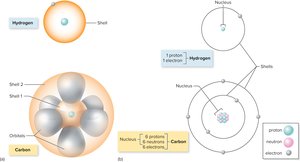
Electrons: Negatively charged particles that orbit the nucleus in electron shells.
Isotopes: Variant forms of elements differing in neutron number; some are radioactive and useful in research and medicine.
Electron Orbitals and Shells
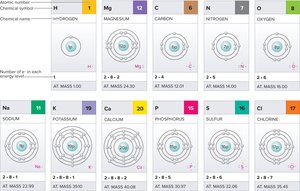
Electrons occupy specific regions called orbitals, which are grouped into shells around the nucleus. The arrangement of electrons in these shells determines the chemical properties and reactivity of an atom.
Valence electrons: Electrons in the outermost shell, crucial for bond formation.
The Periodic Table
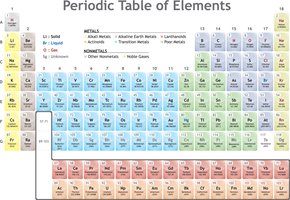
The periodic table organizes elements by increasing atomic number and groups them based on similar chemical properties. It is a fundamental tool for understanding element classification and predicting chemical behavior.
Groups: Columns with elements sharing similar properties.
Periods: Rows indicating increasing atomic number.
Chemical Bonds and Molecules
Covalent Bonds and Polarity
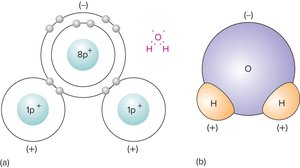
Covalent bonds form when atoms share electrons. The nature of the sharing determines whether the molecule is polar or nonpolar.
Single covalent bond: Shares one pair of electrons (e.g., H2).
Double covalent bond: Shares two pairs of electrons (e.g., O2).
Polar molecule: Unequal sharing leads to partial charges (e.g., H2O).
Nonpolar molecule: Equal sharing, no charge separation.
Ionic Bonds and Ionization
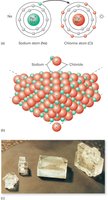
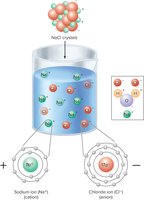
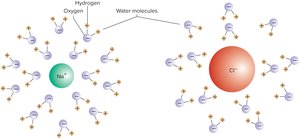
Ionic bonds are formed when electrons are transferred from one atom to another, resulting in charged ions. Ionization occurs when ionic compounds dissolve in water, producing cations and anions.
Cation: Positively charged ion.
Anion: Negatively charged ion.
Electrolytes: Substances that release ions in water.
Hydrogen Bonding
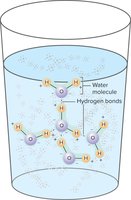
Hydrogen bonds are weak attractions between a hydrogen atom covalently bonded to one molecule and an electronegative atom (oxygen or nitrogen) on another molecule. These bonds are crucial for the structure of water and biological macromolecules.
Temporary and easily disrupted.
Van der Waals forces: Weak attractions between polar molecules.
Molecular and Structural Formulas
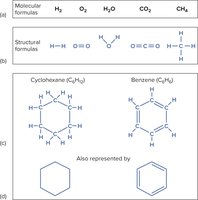
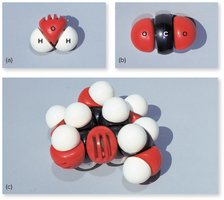
Molecular formulas indicate the types and numbers of atoms in a molecule, while structural formulas show the arrangement of atoms and bonds.
Examples: H2, O2, H2O, CO2, CH4
Structural formulas: Reveal bond positions and molecular geometry.
Solutions and pH
Solutions and Solubility
A solution is a homogeneous mixture of solute(s) dissolved in a solvent. Water is the most common biological solvent due to its polarity.
Hydrophilic: Attracts water (e.g., salt, sugar).
Hydrophobic: Repels water (e.g., benzene).
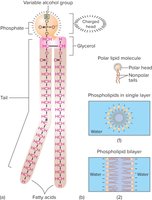
Amphipathic: Contains both hydrophilic and hydrophobic regions (e.g., phospholipids).
Acidity, Alkalinity, and the pH Scale
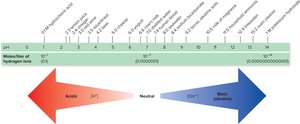
The pH scale measures the concentration of hydrogen ions in a solution, ranging from 0 (acidic) to 14 (basic). It is logarithmic, with each unit representing a tenfold change in ion concentration.
Acidic: pH < 7, excess hydrogen ions.
Basic: pH > 7, excess hydroxyl ions.
Neutralization: Reaction between acids and bases producing water and salts.
The Chemistry of Carbon and Functional Groups
Organic and Inorganic Molecules
Organic molecules contain both carbon and hydrogen, forming the basis of life. Inorganic molecules lack this combination.
Carbon: Can form four bonds, allowing for diverse structures (chains, rings, branches).
Functional Groups
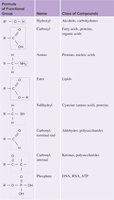
Functional groups are specific molecular groups attached to organic compounds, conferring unique chemical properties and reactivity.
Formula | Name | Class of Compounds |
|---|---|---|
R-OH | Hydroxyl | Alcohols, carbohydrates |
R-COOH | Carboxyl | Fatty acids, proteins, organic acids |
R-NH2 | Amino | Proteins, nucleic acids |
R-COOR | Ester | Lipids |
R-SH | Sulfhydryl | Cysteine, proteins |
R-CHO | Carbonyl (terminal) | Aldehydes, polysaccharides |
R-CO-R | Carbonyl (internal) | Ketones, polysaccharides |
R-PO4 | Phosphate | DNA, RNA, ATP |
Macromolecules: Superstructures of Life
Carbohydrates: Sugars and Polysaccharides
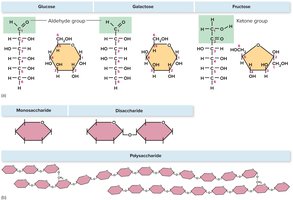
Carbohydrates are organic molecules composed of carbon, hydrogen, and oxygen. They serve as energy sources and structural components.
Monosaccharides: Simple sugars (e.g., glucose, galactose, fructose).
Disaccharides: Two monosaccharides joined (e.g., lactose).
Polysaccharides: Long chains of monosaccharides (e.g., cellulose, starch).
Carbohydrate Bonds
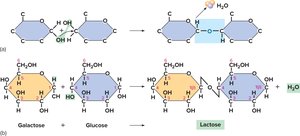
Glycosidic bonds link monosaccharides, formed by dehydration synthesis (removal of water).
Hydrolysis: Addition of water breaks polysaccharides into simpler sugars.
Polysaccharides: Structure and Function
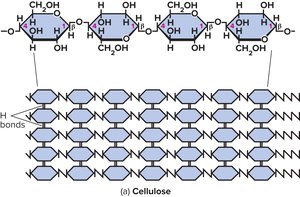
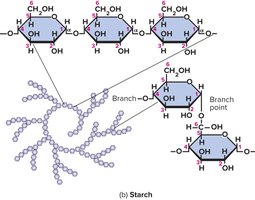
Polysaccharides have diverse roles, including structural support and energy storage. Cellulose and starch are key examples.
Cellulose: Provides rigidity to plant cell walls.
Starch: Energy storage in plants.
Lipids: Fats, Phospholipids, and Waxes
Triglycerides
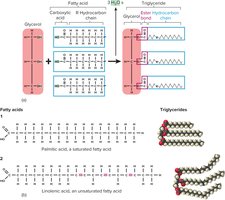
Triglycerides are storage lipids composed of glycerol and three fatty acids. They are important energy reserves.
Saturated fatty acids: No double bonds, solid at room temperature.
Unsaturated fatty acids: One or more double bonds, liquid at room temperature.
Phospholipids and Membrane Structure
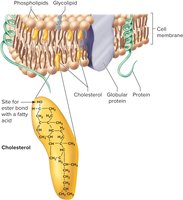
Phospholipids are essential for cell membrane structure, featuring hydrophilic heads and hydrophobic tails. They form bilayers that provide selective permeability.
Phospholipid bilayer: Basis of biological membranes.
Proteins: Shapers of Life
Amino Acids and Protein Structure
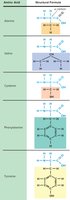
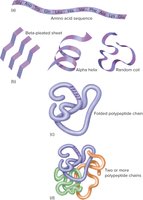
Proteins are polymers of amino acids, which have a central alpha carbon, an amino group, a carboxyl group, a hydrogen atom, and an R group. The sequence and structure of amino acids determine protein function.
Primary structure: Sequence of amino acids.
Secondary structure: Alpha helix or beta-pleated sheet.
Tertiary structure: Three-dimensional folding.
Quaternary structure: Multiple polypeptide chains.
Nucleic Acids and ATP
Nucleic Acid Structure
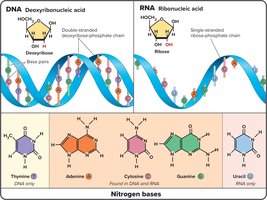
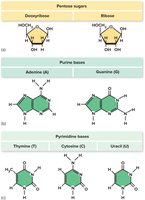
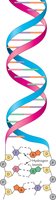
Nucleic acids (DNA and RNA) are polymers of nucleotides, each consisting of a nitrogen base, a pentose sugar, and a phosphate group. DNA encodes genetic information, while RNA translates and expresses it.
Pyrimidines: Thymine, cytosine, uracil (single ring).
Purines: Adenine, guanine (double ring).
ATP: The Energy Molecule
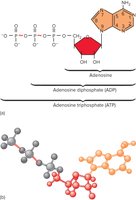
Adenosine triphosphate (ATP) is the primary energy carrier in cells. It consists of adenine, ribose, and three phosphate groups. Energy is released when the bond between the second and third phosphate is broken.
ATP hydrolysis:
Cells: Where Chemicals Come to Life
Fundamental Characteristics of Cells
Cells are the basic units of life, composed of aggregates of atoms and molecules. All cells share certain features, including a cell membrane, DNA-containing chromosomes, and ribosomes for protein synthesis.
Eukaryotic cells: Have a nucleus and organelles; found in animals, plants, fungi, and protozoa.
Bacteria and Archaea: Lack a nucleus and organelles; structurally complex and capable of diverse activities.
