 Indietro
Viral Replication, Effects on Host Cells, and Oncogenesis: Study Notes for Microbiology
Guida di studio - Note intelligenti
 Appunti personalizzati basati sui tuoi materiali, ampliati con definizioni chiave, esempi e contesto.
Viral Replication Mechanisms
Herpesvirus and Adenovirus Replication
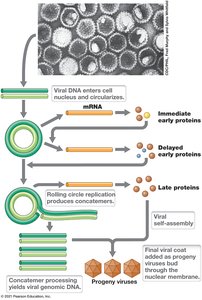
Herpesviruses and adenoviruses are DNA viruses that replicate within the host cell nucleus. Their replication involves the synthesis of early and late proteins, rolling circle replication, and the assembly of progeny virions.
Immediate Early Proteins: These are produced soon after viral DNA enters the nucleus and are essential for initiating viral replication.
Delayed Early Proteins: Synthesized after immediate early proteins, they facilitate DNA replication.
Rolling Circle Replication: Produces concatemers—long DNA molecules containing multiple genome copies.
Late Proteins: Involved in viral assembly and packaging.
Viral Assembly: Final viral coat is added as progeny virions bud through the nuclear membrane.
Poliovirus Replication
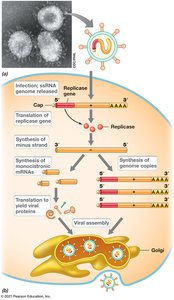
Poliovirus is a positive-sense single-stranded RNA virus. Its replication occurs in the cytoplasm and involves the synthesis of a minus strand, followed by the production of new plus strands for viral assembly.
Genome Release: Infectious ssRNA genome is released into the cytoplasm.
Translation: Replicase gene is translated to produce replicase enzyme.
Minus Strand Synthesis: Replicase synthesizes a complementary minus strand.
Viral Assembly: New viral proteins and genomes are assembled in the cytoplasm.
Coronaviruses
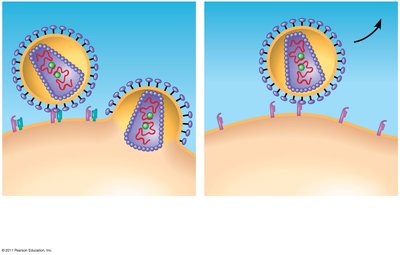
Coronaviruses are enveloped, positive-sense RNA viruses. They enter host cells via membrane fusion and replicate in the cytoplasm, producing new virions that bud from intracellular membranes.
Entry: Virus binds to host cell receptors and fuses with the plasma membrane.
Replication: Viral RNA is translated and replicated, leading to the production of new viral proteins and genomes.
Assembly: Virions are assembled and released from the cell.
Retrovirus Structure and Replication
Retrovirus Genome and Proteins
Retroviruses possess a single-stranded RNA genome and encode three main gene regions: gag, pol, and env.
Gag: Encodes structural proteins and protease.
Pol: Encodes reverse transcriptase and integrase.
Env: Encodes envelope glycoproteins.
Recognition of Host Cell by HIV
HIV infects cells expressing the CD4 receptor and the CCR5 co-receptor. Cells lacking CCR5 are resistant to HIV infection.
CD4 Receptor: Primary receptor for HIV attachment.
CCR5 Co-receptor: Required for viral entry; absence confers resistance.
Retrovirus Replication: Entry, Uncoating, and Reverse Transcription
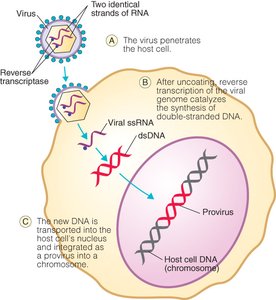
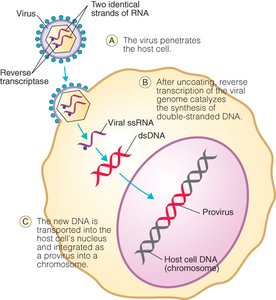
Retroviruses enter host cells, uncoat, and use reverse transcriptase to synthesize DNA from their RNA genome. The resulting DNA is integrated into the host genome as a provirus.
Entry: Virus penetrates the host cell.
Reverse Transcription: Viral ssRNA is converted to dsDNA.
Integration: Viral DNA is integrated into host cell DNA.
Retrovirus Replication: Integration, mRNA Production, and Budding
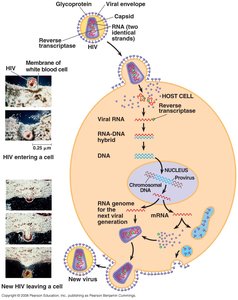
After integration, viral mRNA and genomes are produced, translated, and processed. New virions bud from the host cell membrane.
mRNA Production: Host machinery transcribes viral genes.
Protein Translation: Viral proteins are synthesized and processed.
Budding: New virions are released from the cell.
Effects of Animal Viruses on Host Cells
Lytic Infection
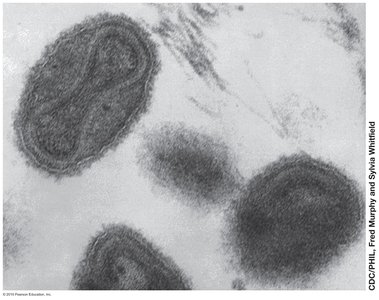
Lytic viruses destroy host cells during replication, resulting in cell death and release of progeny virions.
Destruction of Host Cells: Cell lysis releases new virions.
Examples: Pox viruses, poliovirus.
Persistent Infection
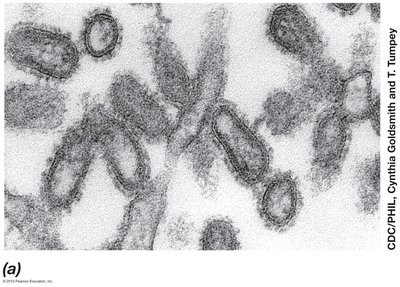
Persistent infections are caused by enveloped viruses that release new virions without lysing the host cell. The cell remains infected and continues to produce virions.
Non-lytic Release: Virions exit without killing the cell.
Examples: Influenza virus.
Latent Infection
Latent viruses remain dormant within host cells, sometimes integrating into the genome. Symptoms appear only when the virus reactivates.
Dormancy: Virus is not actively replicating.
Examples: Herpes simplex virus, Varicella-Zoster herpesvirus, HIV.
Oncogenic Infection
Oncogenic viruses cause transformation of normal cells into cancer cells by altering genes that regulate cell growth.
Transformation: Genetic changes lead to uncontrolled cell proliferation.
Examples: Human Papillomavirus, Epstein-Barr Virus, Cytomegalovirus.
Human Oncogenic Viruses and Cell Growth
Oncogenes and Viral Oncogenesis
Oncogenes are genes that can cause cancer when mutated or misexpressed. Proto-oncogenes are normal genes that can become oncogenes. Viral oncogenes (v-onc) are present in some viruses and can drive cell proliferation.
Proto-oncogene: Normal gene regulating cell growth.
Oncogene: Mutated or misexpressed gene causing uncontrolled proliferation.
Viral Oncogene: Genes in viral genomes that promote cell division (e.g., E6 and E7 of HPV).
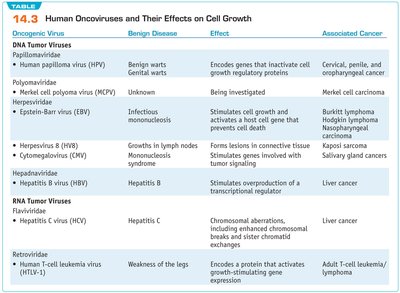
Oncogenic Virus | Benign Disease | Effect | Associated Cancer |
|---|---|---|---|
Papillomaviridae (HPV) | Benign warts, genital warts | Encodes genes that inactivate cell growth regulatory proteins | Cervical, penile, oropharyngeal cancer |
Polyomaviridae (MCPyV) | Unknown | Being investigated | Merkel cell carcinoma |
Herpesviridae (EBV) | Infectious mononucleosis | Stimulates cell growth and inhibits apoptosis | Burkitt lymphoma, Hodgkin lymphoma, nasopharyngeal carcinoma |
Herpesviridae (HHV-8) | Growths in lymph nodes | Forms lesions in connective tissue | Kaposi's sarcoma |
Hepadnaviridae (HBV) | Hepatitis B | Stimulates overproduction of a transcriptional regulator | Liver cancer |
Flaviviridae (HCV) | Hepatitis C | Chromosomal aberrations, integration into host chromosome | Liver cancer |
Retroviridae (HTLV-1) | Weakness of the legs | Encodes a protein that activates transcription of viral genes | Adult T-cell leukemia/lymphoma |
Retrovirus Integration and Oncogene Activation
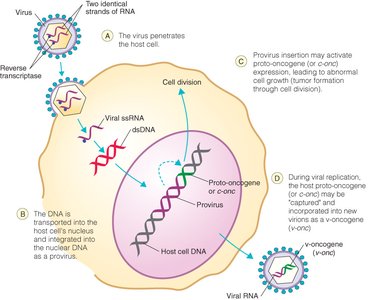
Retrovirus integration can convert proto-oncogenes into oncogenes, leading to abnormal cell growth and tumor formation.
Provirus Insertion: May activate proto-oncogene expression.
Viral Replication: Proto-oncogene may be incorporated into new viral genomes as v-onc.
Polyomaviruses and Tumor Induction
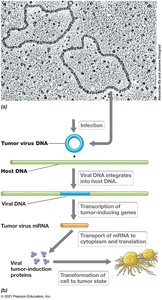
Polyomaviruses can integrate their DNA into host genomes, leading to the expression of tumor-inducing genes and transformation of cells into a tumor state.
Integration: Viral DNA integrates into host DNA.
Tumor Induction: Expression of viral genes transforms cells.
Possible Effects of Animal Virus Infection
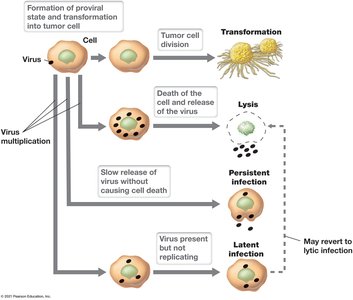
Animal virus infection can result in transformation, lysis, persistent infection, or latent infection, depending on the virus and host cell type.
Transformation: Cell becomes cancerous.
Lysis: Cell death and virus release.
Persistent Infection: Slow release of virus without cell death.
Latent Infection: Virus present but not replicating.
Viral Infection of Plant Cells
Characteristics of Plant Viruses
Plant viruses share many traits with animal viruses but differ in host range, envelope status, and transmission mechanisms.
Wide Host Range: Infect many plant species.
Mostly Not Enveloped: Lack lipid envelopes.
Transmission: Occurs via wounds or vectors (insects, nematodes, fungi).
Process of Viral Infection in Plants
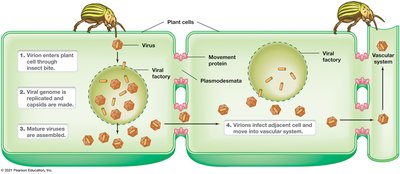
Plant cell walls prevent entry by endocytosis. Viruses enter through wounds or are transmitted by vectors. Once inside, they replicate and move to adjacent cells.
Entry: Through wounds or vector-mediated penetration.
Replication: Viral genome is replicated and capsids are assembled.
Movement: Virions move to adjacent cells via plasmodesmata.
Fungal Oomycetes and Plant Virus Transmission
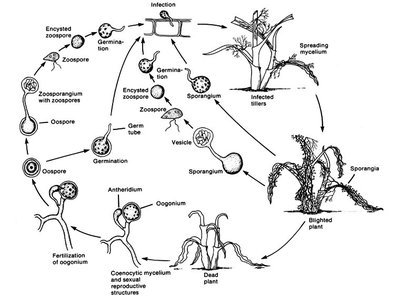
Fungal oomycetes can facilitate plant virus transmission by creating wounds or acting as vectors. Their life cycle involves infection, spore production, and plant colonization.
Oomycetes: Fungal-like organisms that infect plants.
Transmission: Help viruses enter plant cells.
Additional info:
Retrovirus replication involves reverse transcription, integration, and budding, which are key steps in the HIV life cycle.
Oncogenic viruses can disrupt normal cell cycle regulation, leading to cancer.
Plant viruses often rely on insect vectors for transmission due to the immobility and rigid cell walls of plants.
