 Indietro
Viruses and Prions: Structure, Replication, and Pathogenesis
Guida di studio - Note intelligenti
 Appunti personalizzati basati sui tuoi materiali, ampliati con definizioni chiave, esempi e contesto.
Viruses and Prions
Introduction to Viruses and Prions
Viruses and prions are unique infectious agents that differ fundamentally from cellular life forms. This chapter explores their classification, structure, replication mechanisms, and their roles in disease, including oncogenesis.
Viruses are considered nonliving because they lack cellular structure and metabolic processes.
Prions are infectious proteins that cause neurodegenerative diseases.
Comparison of Viruses, Prokaryotic, and Eukaryotic Cells
Viruses are distinct from prokaryotic and eukaryotic cells in several ways:
Viruses lack organelles, cytoplasm, and a cell membrane.
They require a host cell for replication, unlike prokaryotes and eukaryotes, which reproduce independently.
Viruses possess either DNA or RNA genomes, not both.
Viral Structure: Capsids, Envelopes, and Spikes
Viruses are composed of several structural components:
Capsid: Protein shell that encases the viral genome.
Envelope: Lipid membrane derived from the host cell, present in some viruses.
Spikes: Glycoproteins protruding from the capsid or envelope, facilitating host cell attachment.
Genomic Variations Among Viruses
Viral genomes vary in type and structure:
Can be DNA or RNA, single- or double-stranded.
Genomes may be linear or circular.
These variations influence replication strategies and host interactions.
Host Range and Tropism
Host range and tropism define viral specificity:
Host Range: The collection of species a virus can infect.
Tropism: The specific tissues or cells within a host that a virus targets.
Example: Influenza virus infects respiratory tract cells in humans.
Bacteriophage Replication: Lytic and Lysogenic Cycles
Bacteriophages (viruses that infect bacteria) replicate via two main pathways:
Lytic Cycle: Virus destroys the host cell after replication.
Lysogenic Cycle: Viral genome integrates into the host genome, replicating passively until triggered to enter the lytic cycle.
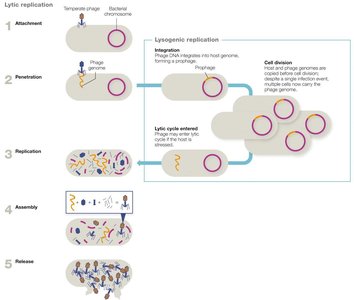
Phage Conversion: Lysogenic phages can alter host cell properties, sometimes increasing pathogenicity.
Animal Virus Replication Pathways
Animal viruses follow a series of steps for replication:
Attachment: Virus binds to host cell surface proteins.
Penetration: Entry via fusion (enveloped viruses) or endocytosis (naked viruses).
Uncoating: Viral capsid is removed, exposing the genome.
Replication: Viral genome is copied and proteins are synthesized.
Assembly: New virions are assembled.
Release: Enveloped viruses exit by budding; naked viruses cause cell lysis.
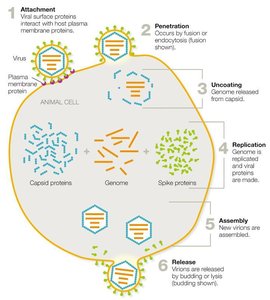
Enveloped viruses acquire their envelope from the host cell membrane during budding.
Naked viruses lack an envelope and are released by rupturing the host cell.
Persistent Infections: Chronic and Latent Mechanisms
Persistent infections occur when viruses remain in the host for extended periods:
Chronic infection: Virus continuously replicates at low levels.
Latent infection: Virus remains dormant, reactivating periodically.
Oncogenic Viruses and Cancer
Some viruses are oncogenic, meaning they can cause cancer:
They stimulate uncontrolled cell division by inactivating tumor suppressor proteins.
They decrease host cell responsiveness to apoptosis, "immortalizing" cells.
Examples include Human papillomavirus (HPV) and Epstein-Barr virus (EBV).
Summary Table: Lytic vs. Lysogenic Replication
Feature | Lytic Cycle | Lysogenic Cycle |
|---|---|---|
Host Cell Fate | Destroyed | Survives, viral genome integrated |
Viral Genome | Replicates independently | Integrated as prophage |
Release | Cell lysis | Triggered by environmental factors |
Medical Importance | Acute infections | Phage conversion, persistent infections |
Key Terms and Definitions
Capsid: Protein shell of a virus.
Envelope: Lipid membrane surrounding some viruses.
Prophage: Integrated viral genome in a bacterial host.
Oncogenic virus: Virus capable of causing cancer.
Persistent infection: Long-term viral presence in host.
Relevant Equations
Viral replication rate (generalized):
