 Indietro
Viruses of Plants and Animals: Structure, Genomics, and Life Cycles ch 11 part 2
Guida di studio - Note intelligenti
 Appunti personalizzati basati sui tuoi materiali, ampliati con definizioni chiave, esempi e contesto.
Viruses of Plants and Animals
Classification of Viruses: Genomic Material and Life Cycle
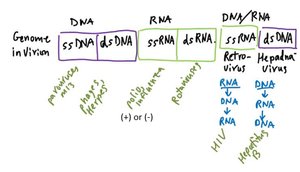
Viruses are classified based on the type of nucleic acid in their genome (DNA or RNA), strandedness (single or double), and their replication strategies. This classification is fundamental for understanding viral diversity, evolution, and mechanisms of infection.
DNA Viruses: Can have single-stranded (ssDNA) or double-stranded (dsDNA) genomes.
RNA Viruses: Can have single-stranded (ssRNA) or double-stranded (dsRNA) genomes. ssRNA viruses are further divided into (+) sense (directly translated) and (–) sense (require transcription to (+) sense).
Reverse-Transcribing Viruses: Retroviruses (ssRNA-RT) and Hepadnaviruses (dsDNA-RT) use reverse transcriptase to convert RNA to DNA or vice versa during their life cycle.
RNA Genome Viruses
General Features and Replication
RNA viruses encode a viral replicase enzyme for genome replication. This enzyme lacks proofreading ability, resulting in high mutation rates. During replication, a double-stranded RNA intermediate (replicative form) is often present.
(+) Strand RNA Viruses: Their genomes can be directly translated by host ribosomes to produce viral proteins.
(–) Strand RNA Viruses: Require a viral transcriptase to synthesize a complementary (+) strand before translation can occur.
Tobacco Mosaic Virus (TMV)
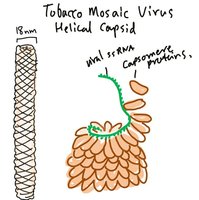
The Tobacco Mosaic Virus is a classic example of a (+) strand RNA virus infecting plants. Its structure and genome organization have been pivotal in virology research.
Genome: Linear, single-stranded (+) RNA, approximately 6,400 nucleotides.
Capsid: Helical structure composed of capsomere proteins surrounding the RNA.
Historical Note: Rosalind Franklin contributed to elucidating the structure of TMV.
TMV Genome Organization and Life Cycle
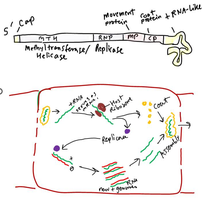
The genome encodes replication proteins, movement proteins, and capsid proteins.
Replication occurs in the host cytoplasm, with the viral RNA serving as both genome and mRNA.
Poliovirus
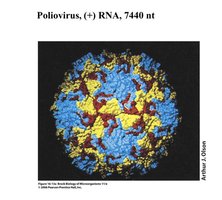
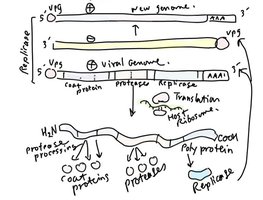
Poliovirus is a (+) strand RNA virus that causes poliomyelitis in humans. Its entire genome functions as mRNA, and it is translated into a single polyprotein, which is then cleaved into functional proteins by viral proteases.
Genome: 7,440 nucleotides, single-stranded (+) RNA.
Virion: Icosahedral capsid.
Life Cycle: The genome is translated into a polyprotein, which is processed into replicase and structural proteins.
Coronaviruses
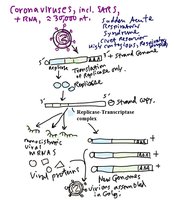
Coronaviruses are enveloped (+) strand RNA viruses with large genomes (~30,000 nt). They cause respiratory diseases in humans and animals, including SARS, MERS, and COVID-19.
Genome: Single-stranded (+) RNA, capped and polyadenylated.
Life Cycle: The genome is directly translated to produce replicase proteins. Subgenomic RNAs are synthesized for structural and accessory proteins.
Notable Diseases: SARS (2003), MERS (2012-2014), COVID-19 (2019-present).
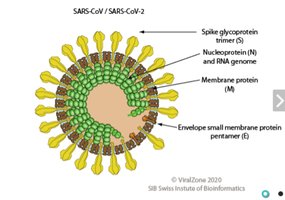
Structure of SARS-CoV and SARS-CoV-2 Virion
Spike (S) Protein: Mediates attachment and entry via ACE2 receptor.
Membrane (M) Protein: Shapes the viral envelope.
Envelope (E) Protein: Functions as an ion channel.
Nucleocapsid (N) Protein: Binds viral RNA.
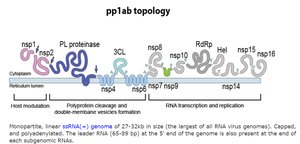
SARS-CoV-2 Genome and Protein Processing
The first two open reading frames (ORF1a and ORF1b) are translated into a large polyprotein (pp1ab), which is cleaved by viral proteases (PL and 3CL) into functional proteins, including replicase and transcriptase components.
Structural proteins (S, M, N, E) are translated from subgenomic RNAs.

(–) Strand RNA Genome Viruses
General Features
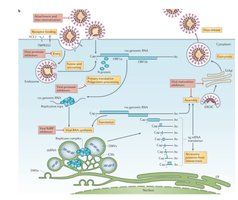
(–) strand RNA viruses cannot be directly translated. They carry a viral transcriptase to synthesize (+) strand mRNAs for translation and replication.
Influenza Virus
Influenza viruses are enveloped (–) strand RNA viruses with segmented genomes. They are responsible for seasonal flu epidemics and pandemics.
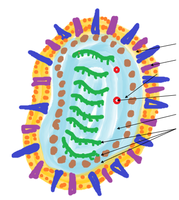
Key Proteins: Hemagglutinin (HA) for binding, neuraminidase (NA) for release, replicase, and transcriptase.
Genome: Segmented (–) RNA, each segment encodes different proteins.
Influenza Virus Life Cycle
Attachment via hemagglutinin to sialic acid receptors, endocytosis, replication in the nucleus, assembly, and budding from the host cell membrane.
Antigenic Drift and Shift
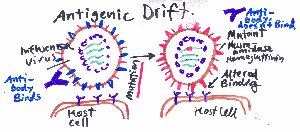
Antigenic Drift: Gradual accumulation of mutations in HA or NA, leading to new strains that escape host immunity.
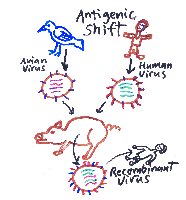
Antigenic Shift: Reassortment of genome segments between different strains (e.g., human and avian), often in pigs, resulting in novel viruses with pandemic potential.
RNA to DNA Genome Viruses (Reverse-Transcribing Viruses)
Retroviruses (e.g., HIV)
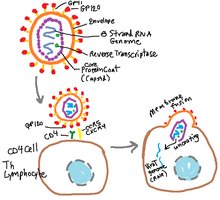
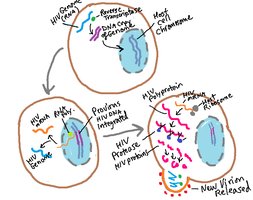
Retroviruses have an RNA genome but replicate through a DNA intermediate using reverse transcriptase. HIV is the most notable example, causing AIDS by infecting CD4+ T cells.
Virion Structure: Contains envelope, core capsid, reverse transcriptase, and spike proteins (GP120, GP41).
Life Cycle: Entry, reverse transcription of RNA to cDNA, integration into host genome, transcription, translation, assembly, and budding.
Drug Targets: Reverse transcriptase, integrase, and protease.
Hepadnaviruses (e.g., Hepatitis B Virus)
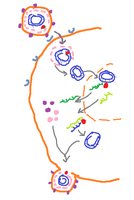
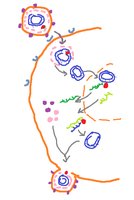
Hepadnaviruses have a partially double-stranded DNA genome and replicate via an RNA intermediate. The viral polymerase has both DNA polymerase and reverse transcriptase activities.
Virion Structure: Enveloped, contains DNA polymerase, core, and surface antigens.
Life Cycle: DNA genome is converted to RNA, then reverse transcribed back to DNA for packaging into new virions.
Pathogenesis: Infects liver cells, can cause jaundice and chronic liver disease.


Other DNA Genome Viruses
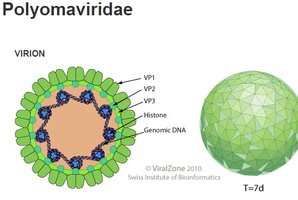
Polyomaviruses (e.g., SV40)
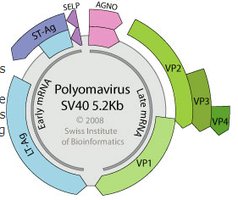
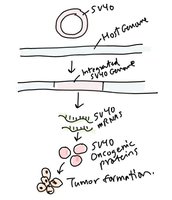
Polyomaviruses are small, circular dsDNA viruses. SV40 can integrate into the host genome and transform cells, potentially leading to cancer by inhibiting tumor suppressor proteins like p53.
Genome: Circular dsDNA, encodes early and late proteins.
Oncogenesis: Large T-antigen disrupts cell cycle regulation.
Adenoviruses
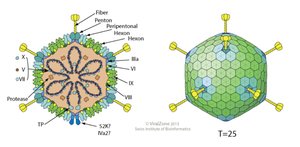
Adenoviruses are unenveloped, icosahedral dsDNA viruses that cause mild respiratory infections and are used as vectors in gene therapy.
Genome: Linear dsDNA, ~36 kbp.
Applications: Gene delivery in biotechnology.
Papovaviridae (Human Papilloma Virus, HPV)
HPV is a small dsDNA virus that can integrate into host chromosomes. Certain types are associated with cervical cancer due to the action of viral oncogenes.
Genome: Circular dsDNA, ~8 kbp.
Oncogenesis: Viral proteins disrupt cell cycle control.
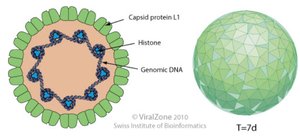
Herpesviridae
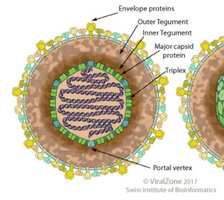
Herpesviruses are large, enveloped dsDNA viruses that can establish latent infections. Examples include Herpes Simplex Virus, Varicella-Zoster Virus (chickenpox, shingles), and Epstein-Barr Virus (mononucleosis). Rely on host RNA polymerase to transcribe. Chickenpox has dormancy period for years and herpes are in that group.
Genome: Linear dsDNA, ~150 kbp.
Latency: Ability to remain dormant in host cells and reactivate later.
Mimivirus
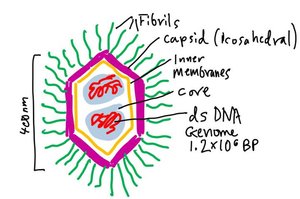
Mimivirus is a giant virus visible under a light microscope, infecting amoebas. It has a large dsDNA genome encoding hundreds of proteins, including some involved in translation, but lacks ribosomes and metabolism outside the host. Half a micrometer across in diameter, seen by a light microscope, they infect amoebas, around 900 protien genes,(very genomic complexity), do make their own Trna so that don't have any ribosomes
Genome: dsDNA, 1.2 million base pairs.
Significance: Challenges the traditional definition of viruses due to its size and gene content.
Key Concepts and Discussion Questions
Compare genome organization between MS2 phage and TMV.
Describe modifications at the 5' and 3' ends of the poliovirus genome and how a single ORF produces multiple proteins.
Explain how SV40 fits three coat protein ORFs into a small genome region and its effects on the host.
Outline the HIV life cycle and identify unique steps targeted by antiretroviral drugs.
Discuss the unusual features of the Hepatitis B virus genome and life cycle, and the functions of its polymerase.
Define antigenic drift and shift in influenza viruses and relate them to host range and genome structure.
